
Server data from the Official MCP Registry
Cross-platform shared memory and ticket coordination for AI agents across MCP clients.
About
Cross-platform shared memory and ticket coordination for AI agents across MCP clients.
Security Report
Valid MCP server (1 strong, 2 medium validity signals). No known CVEs in dependencies. Imported from the Official MCP Registry. 1 finding(s) downgraded by scanner intelligence.
3 files analyzed · 1 issue found
Security scores are indicators to help you make informed decisions, not guarantees. Always review permissions before connecting any MCP server.
Permissions Required
This plugin requests these system permissions. Most are normal for its category.
What You'll Need
Set these up before or after installing:
Environment variable: AGENT_PROJECT_DIR
How to Install
Add this to your MCP configuration file:
{
  "mcpServers": {
    "io-github-swisspra-on-board": {
      "env": {
        "AGENT_PROJECT_DIR": "your-agent-project-dir-here"
      },
      "args": [
        "onboard-memory-mcp"
      ],
      "command": "uvx"
    }
  }
}Documentation
View on GitHubFrom the project's GitHub README.
On Board
Shared project memory for agents. One MCP server, one project memory folder, many IDEs and agent clients. New in v4.0.0: agents wake each other. The human stops being the message pump.




What this is
On Board is a local MCP server for coordinating AI agents across a project. It gives Claude Desktop, Claude Code, Codex, Cursor, Antigravity, and other MCP clients the same project memory, ticket queue, and handoff history.
The goal is simple: when one agent stops and another agent continues, the next agent should not need the human to explain the project again.
onboard → read memory → claim work → write progress → hand off
Everything stays local to the project unless you choose to connect other tools.
🚀 v4.0.0 — agents now wake each other
Until v4 this board was pull-only: an agent found out about new work when a
human told it to look. v4 ships memory_wait_for_event — an agent parks
inside one tool call and wakes the moment a peer creates a ticket, submits
work, or delivers a verdict.
This is not a demo claim. In the launch trial, a GPT agent (Codex) and a Claude agent closed a full reject → fix → resubmit cycle on this board with zero human relay — the reviewer's fix instructions travelled inside the wake payload, the worker re-read the file, attached a sha256, and resubmitted; the reviewer reproduced the hash byte-for-byte before approving:
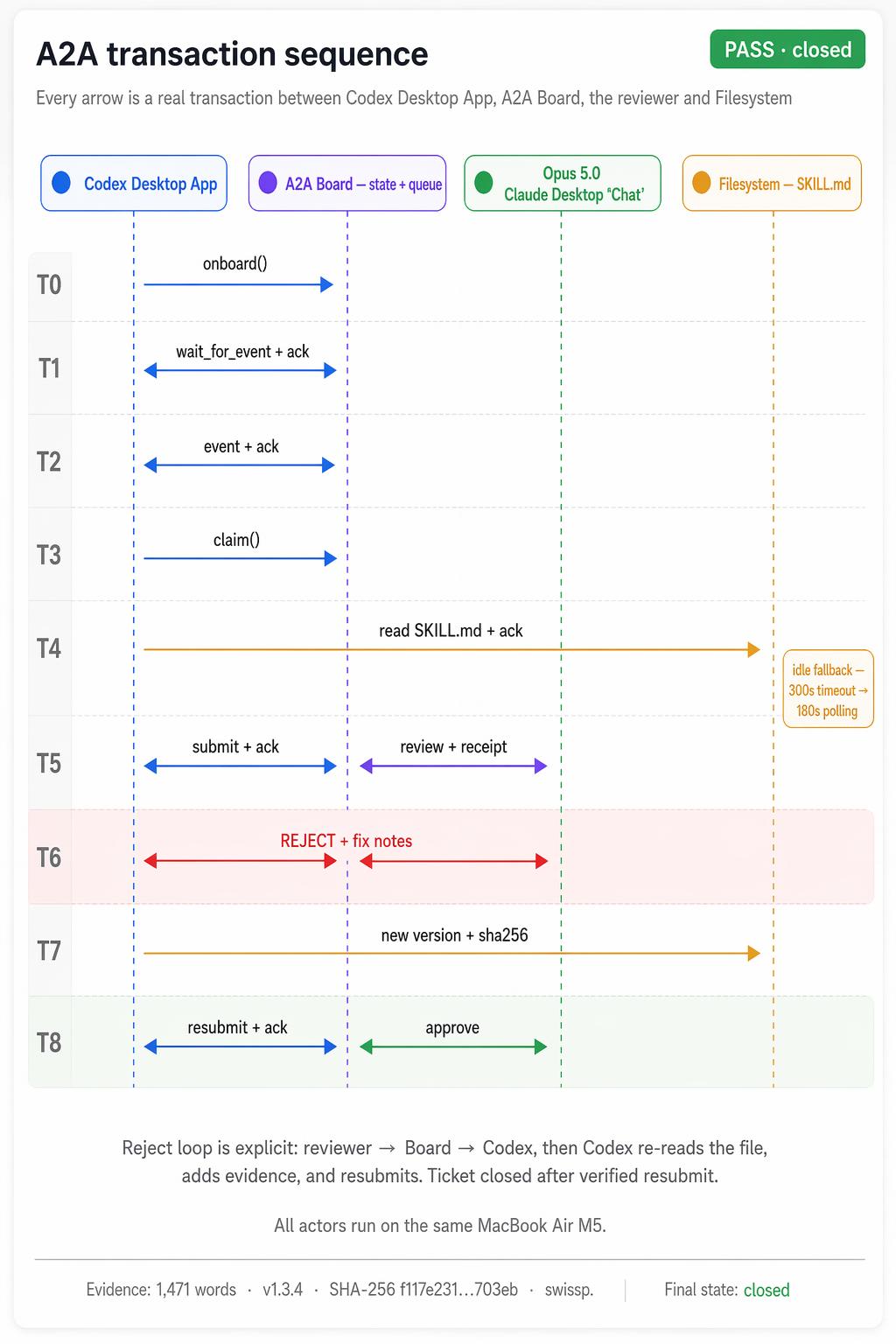
Full mechanics in Agent-to-agent: the listening half · breaking changes in CHANGELOG.md · release notes.
Why this exists
Most agent workflows break for boring reasons:
- The next chat does not know what the last chat did.
- Parallel agents overwrite or redo each other's work.
- Important decisions live only in conversation history.
- Handoffs are informal, so review and follow-up work drift.
On Board keeps those facts in project-local files under .agent-mem/.
The MCP tools expose that memory to any supported client.
Who this is for
- Solo developers using more than one agent or IDE
- Teams experimenting with multi-agent coding workflows
- Projects where handoffs, tickets, and review notes matter
- Local-first MCP users who want shared context without a hosted service
It is not an autonomous project manager. Humans still decide what matters, review important changes, and accept the final result.
Quick start
Install the server
The server is published as onboard-memory-mcp.
Install it with whichever tool you prefer:
# Homebrew (tap once, then the short name works: brew install onboard-memory)
brew install swisspra/tap/onboard-memory

# pipx
pipx install onboard-memory-mcp

# uv
uv tool install onboard-memory-mcp
All three provide the onboard-memory-mcp command (Homebrew also adds a short
onboard-memory alias). Homebrew covers macOS and Linux; on Windows use
pipx or uv (the command is onboard-memory-mcp.exe). Point your MCP client's
command at it instead of python3 onboard_server.py. You can also skip this
and run from a clone using the setup paths below. (On Homebrew 6+, approve the
one-time tap-trust prompt, or run brew trust swisspra/tap.)
Headless config (no clone)
With the server installed, wire your MCP client to it directly — no repo
checkout, no setup-project.sh:
{
  "mcpServers": {
    "agent-memory": {
      "command": "onboard-memory-mcp",
      "env": { "AGENT_PROJECT_DIR": "/full/path/to/your/project" }
    }
  }
}
- CLI clients (Claude Code, Codex) inherit your shell
PATH, so the bareonboard-memory-mcpworks. - GUI clients (Claude Desktop, Cursor) launch with a minimal
PATH. Use the absolute path fromwhich onboard-memory-mcp(whereon Windows) ascommand— typically/opt/homebrew/bin/onboard-memory-mcp(Homebrew, Apple Silicon),/usr/local/bin/onboard-memory-mcp(Homebrew, Intel),/home/linuxbrew/.linuxbrew/bin/onboard-memory-mcp(Homebrew, Linux),~/.local/bin/onboard-memory-mcp(pipx / uv on macOS/Linux), or%USERPROFILE%\.local\bin\onboard-memory-mcp.exe(pipx / uv on Windows).
AGENT_PROJECT_DIR is required — it decides which project owns .agent-mem/.
In your first chat, call memory_init once (creates .agent-mem/), then
memory_onboard each session. Nothing to create by hand.
The pipx/uv path installs from prebuilt wheels (no compiler) on Python 3.11+
for Linux, Windows, and Apple-Silicon macOS; on Python 3.10 or Intel macOS a
couple of Rust/C dependencies may build from source, so prefer brew there.
Template: configs/binary-mcp.json; full detail and
platform notes in docs/SETUP.md.
Set up a project
Choose one setup path:
Option 1: Agent setup
Ask an agent to read AGENT_SETUP.md and help you set up the project. This is the easiest path if you already have an agent available.
Option 2: Script setup
git clone https://github.com/swisspra/On_Board.git
cd On_Board
bash setup-project.sh /full/path/to/your/project
bash doctor.sh /full/path/to/your/project
Add the generated MCP config to your client:
/full/path/to/your/project/.onboard/mcp.generated.json
Some clients accept this JSON directly. Others require you to merge it into their own MCP settings file.
After memory is initialized, open the dashboard with:
bash /full/path/to/your/project/.onboard/run-dashboard.sh
On Board is installed once. Each project points to the same On Board folder,
but gets separate memory through AGENT_PROJECT_DIR.
Each setup-project.sh run also registers the project locally in
.onboard/linked-projects.json inside the On Board checkout. This file is
gitignored and only helps updates remember which projects point here.
The setup script uses uv sync --inexact to install/update dependencies without
pruning local test/dev extras. MCP clients run python3 onboard_server.py; the
launcher uses the local .venv directly and rebuilds it only if the venv is
missing. This keeps normal startup fast, avoids uv run startup timeouts, and
makes a shared central checkout more durable.
On Board does not write memory from end-turn hooks. Current Stop hooks in
several agent clients run every turn, which creates noisy memory and can force
agents to re-onboard too often.
Optional: add AGENT_MEM_CONTEXT_DIRS to the generated MCP config when agents
should read shared docs/specs outside the project folder.
Option 3: Advanced manual setup
If you do not want to run the setup script, install with uv sync, write the
MCP config yourself, and add project rules/hooks manually. See
docs/SETUP.md.
In your first chat with any MCP-aware agent (Claude Desktop, Claude Code, Cursor, Codex, Antigravity):
memory_bootstrap(
  agent_name="dev-main",
  description="Existing project using On Board",
  current_task="Set up shared project memory"
)

memory_onboard(
  agent_name="dev-main",
  agent_platform="claude-code",
  agent_role="main"
)
That's it. The agent now sees the project briefing, the open tickets, the recent memory, and the protocol it should follow. Every subsequent action is stamped with its identity.
Full setup details and manual setup: see docs/SETUP.md.
To update an existing install, run bash update.sh in the central On Board
checkout. It will show known linked projects. Refresh all of them with
bash update.sh --refresh-linked, or inspect them with
bash setup-project.sh --list-linked.
The loop in one example
1. SPEC
   opus-testcase reads requirement → writes 5–20 acceptance tickets
   with explicit pre/post conditions.

2. BUILD
   dev-track-2 claims a ticket → implements in src/ → submits with
   file diff + test plan.

3. TEST
   Jonhny-tester picks up submission → runs UI in Chromium → captures
   screenshots → submits PASS or FAIL with evidence.

4. REVIEW
   desktop-opus4.7 (or the human) checks evidence → approves OR rejects
   with concrete fix instructions.

   If rejected → ticket reopens → dev-track-2 patches → Jonhny retests
   → loop closes.
When this loop runs cleanly, a single ticket goes from open to "shipped
to production" in 4–15 minutes of agent time. The human checks in at the
end, not in the middle.
Agent-to-agent: the listening half (v4)
Everything above still works pull-style. v4 adds the missing edge: agents can now wake each other instead of waiting for a human to relay messages.
worker:  memory_wait_for_event(agent_name="dev-track-2", timeout_s=180)
         → parks inside one tool call until the board changes
lead:    memory_create_ticket(..., assigned_to="dev-track-2")
worker:  wakes in seconds, claims, works,
         memory_submit_ticket(..., stay_active=True)
lead:    wakes on the submission, reviews
worker:  wakes on the verdict — approve closes the loop;
         a rejection arrives WITH the review notes and fix
         instructions in the wake payload, so it re-claims,
         fixes, and resubmits without asking anyone
Design points, all field-verified across Claude Desktop × Claude Desktop and Claude × Codex (GPT):
- Check before blocking — a re-arm after a gap returns its backlog in 0 s instead of waking empty. One wake drains the whole queue.
- Loop guard — an agent never wakes on its own actions, so two listeners cannot ping-pong each other.
- Role gate — completed ≠ success: whoever executed a ticket may reach
submittedbut may never close it; only the owner or a main/lead/reviewer adjudicates. Solo use is still possible via explicitallow_self_review=True, permanently stamped in the audit. - Client limits respected — Claude Desktop cancels tool calls at ~240 s
per call (measured), so timeouts clamp to 200 s there; stdio clients
(Claude Code, Codex) may pass
long_waitand park much longer. - Idle budget, in minutes — the server counts consecutive empty parks and
answers
STAND-DOWNonceidle_budget_min(default 15) is spent, so an unattended listener stops on its own instead of looking wedged. Budgets are stated in minutes because a human watching a silent loop counts wall clock, not iterations — a compliant agent looping for 20 minutes looks stuck even when it is exactly on budget. Every idle reply printsidle 3/5 — ~6 min to stand-down. The counter resets on a real event and never on re-arming, andSTAND-DOWNis a distinct status so a loop matching onidlecannot read it as permission to continue.idle_budget_min=0listens indefinitely. - Use the
listenMCP prompt for the standard re-arm loop.
v4 also hardens the board for simultaneous writers (advisory lock on ticket mutations, per-process tmp files), because with A2A two agents acting in the same instant is the normal case, not the rare one. Breaking changes and the migration guide live in CHANGELOG.md.
Tools (29 MCP tools, 5 buckets)
| Bucket | Tools |
|---|---|
| Agent lifecycle | memory_onboard, memory_agent_join, memory_handoff, memory_checkpoint, memory_get_briefing, memory_wait_for_event |
| Ticket queue | memory_create_ticket, memory_claim_ticket, memory_submit_ticket, memory_review_ticket, memory_cancel_ticket, memory_terminate_ticket, memory_list_tickets |
| Persistent memory | memory_write, memory_read, memory_search, memory_search_vector, memory_links |
| Project context | memory_init, memory_bootstrap, memory_status, memory_doctor, memory_update_state, memory_context_dirs, memory_context_read |
| Compaction | memory_prepare_compaction, memory_compact, memory_token_usage, memory_search_archive |
Full reference: docs/TOOLS.md.
What makes this different
On Board is not only a place to store memories. It keeps the work loop visible:
onboard -> claim ticket -> submit evidence -> review -> approve or reopen
That gives agents a shared queue, stable identities, recent handoffs, and a review gate. Rejected work reopens with fix instructions instead of becoming a dead terminal state.
Project structure (runtime data)
your-project/
├── .agent-mem/                runtime memory, gitignored
│   ├── project.json
│   ├── agents.json            agent registry (identity, status, KIA)
│   ├── memories.json
│   ├── state.json             project phase, owner, design defaults
│   ├── archive.json
│   ├── digests.json
│   ├── checkpoints/
│   └── tickets/
│       ├── _index.json
│       ├── TK-<id>.md         the spec
│       ├── TK-<id>-submit.md  dev submission
│       ├── TK-<id>-review.md  QA / reviewer verdict
│       └── closed/
Everything is plain text or JSON. You can cat your way through the
project's full history. No vector DB lock-in, no opaque embeddings — just
files an audit can read.
Current status (v4.0.4, August 2026)
The current local setup is built around one central On Board checkout and one project-selected memory folder:
memory_onboardis the primary start call for agents and returns compact current context.memory_wait_for_eventturns the board push-capable: agents park, wake on peer actions, and close reject/retry loops with zero human relay (see the A2A section).memory_doctorchecks setup and data integrity.setup-project.shgenerates project MCP config, rules, startup hooks, and a dashboard launcher.- Linked-project registry tracks which projects point at the central checkout, so updates can refresh known projects without scanning the machine.
- Runtime startup uses
python3 onboard_server.py; the launcher normally execs.venv/bin/python server.pyand only falls back touv sync --inexactif.venvis missing. - Startup hooks return a small read-only briefing. End-turn/Stop hooks are not installed by default because current clients can run them too often.
- The dashboard is local and read-only.
Full CHANGELOG: CHANGELOG.md.
License
Apache-2.0. Free to use, fork, modify, redistribute, build commercial products on. No restrictions on use.
Reviews
No reviews yet
Be the first to review this server!
More Developer Tools MCP Servers
Fetch
Freeby Modelcontextprotocol · Developer Tools
Web content fetching and conversion for efficient LLM usage
Paperclip
Freeby Paperclipai · Developer Tools
Trending hip-hop artist momentum scores across four cultural dimensions.
Netdata
Freeby Netdata · Developer Tools
Real-time infrastructure monitoring with metrics, logs, alerts, and ML-based anomaly detection.
Toleno
Freeby Toleno · Developer Tools
Toleno Network MCP Server — Manage your Toleno mining account with Claude AI using natural language.
mcp-creator-python
Freeby mcp-marketplace · Developer Tools
Create, build, and publish Python MCP servers to PyPI — conversationally.
MCP Marketplace
Freeby mcp-marketplace · Developer Tools
Search and install MCP servers from inside your AI client.