
Server data from the Official MCP Registry
Finds what will hurt in a Django project: cascades, N+1, unsafe migrations, tenant leaks.
About
Finds what will hurt in a Django project: cascades, N+1, unsafe migrations, tenant leaks.
Security Report
Valid MCP server (1 strong, 1 medium validity signals). No known CVEs in dependencies. Package registry verified. Imported from the Official MCP Registry.
4 files analyzed · 1 issue found
Security scores are indicators to help you make informed decisions, not guarantees. Always review permissions before connecting any MCP server.
Permissions Required
This plugin requests these system permissions. Most are normal for its category.
What You'll Need
Set these up before or after installing:
Environment variable: DJANGO_CHAINSAW_PROJECT_PATH
Environment variable: DJANGO_CHAINSAW_SETTINGS_MODULE
How to Install
Add this to your MCP configuration file:
{
  "mcpServers": {
    "io-github-syrian963-django-chainsaw-mcp": {
      "env": {
        "DJANGO_CHAINSAW_PROJECT_PATH": "your-django-chainsaw-project-path-here",
        "DJANGO_CHAINSAW_SETTINGS_MODULE": "your-django-chainsaw-settings-module-here"
      },
      "args": [
        "django-chainsaw-mcp"
      ],
      "command": "uvx"
    }
  }
}Documentation
View on GitHubFrom the project's GitHub README.
django-chainsaw-mcp










An MCP server and CLI that analyses a Django project rather than describing
it. Not what is in here — what will hurt: what a delete takes with it,
which migration breaks the pods still running, which query returns another
tenant's row, what a save() sets off three hops away.
There is no model in the loop. Every answer comes from the AST and Django's own app registry, so the same input gives the same output, and nothing leaves the machine. It is an MCP server so an assistant can ask it questions, and a CLI so CI can gate on the answers.
22 checks: 19 need the app registry (16 Django, three of those DRF as well), one needs only Python, one reads FastAPI, one reads SQLAlchemy. Why this exists →
Install
It has to run in an interpreter that can import your project. Everything
here reads the app registry, which means django.setup(), your settings and
your apps:
/path/to/project/.venv/bin/python -m pip install django-chainsaw-mcp
A plain uvx django-chainsaw-mcp starts and then fails every check, because
uvx gives it an isolated environment with no trace of your project. To avoid
installing, hand uv the dependencies instead:
uvx --with-requirements requirements.txt --from django-chainsaw-mcp django-chainsaw check
Two environment variables point it at the project:
| Variable | Example |
|---|---|
DJANGO_CHAINSAW_PROJECT_PATH | /srv/app — the directory settings are importable from |
DJANGO_CHAINSAW_SETTINGS_MODULE | myproject.settings |
django-chainsaw project-info proves the setup before anything else, and says
which half is missing. Five minutes end to end →
mcp-name: io.github.syrian963/django-chainsaw-mcp
One command
django-chainsaw check --tenant-root myapp.Organisation
44 finding(s): 1 critical, 14 high, 29 medium

CRITICAL
--------
  [deploy-safety] RemoveField drops 'legacy_code' while code still uses it
      shop/0002_remove_product_legacy_code
      During a rolling deploy the old pods keep running against the new
      schema and will fail.
      fix: Ship a release that stops using it, deploy that everywhere,
           then ship this migration.
Every analysis, merged, worst first, one exit code.
On a pull request
This is the part that decides whether a tool like this survives. Point tenancy
at a five year old project and it returns two hundred candidates; nobody reads
two hundred candidates, somebody adds continue-on-error, and it runs forever
with nobody looking.
django-chainsaw tenancy --since main     # only what this branch changed
django-chainsaw tenancy --baseline       # everything old, ratcheted
django-chainsaw check --sarif out.json   # annotate the diff, on the line
--since compares at the merge base, so a branch that is behind main is not
blamed for other people's work. --baseline keeps existing findings in the
report and stops them blocking; anything new fails the build, and fixing an old
one is reported so the number only ever goes down. Findings are fingerprinted on
file plus identity, never the line, so adding an import does not resurrect
twenty findings nobody touched.
--sarif writes the format GitHub and GitLab annotate a pull request with, so
findings land on the line instead of in a log nobody opens.
As an MCP server
claude mcp add django-chainsaw --scope local \
  --env DJANGO_CHAINSAW_PROJECT_PATH=/srv/app \
  --env DJANGO_CHAINSAW_SETTINGS_MODULE=myproject.settings \
  -- /srv/app/.venv/bin/python -m django_chainsaw_mcp.server
Ask it project_info first: the smallest call that proves both the transport
and the Django boot. Five prompts carry the ordering the tools do not —
before_deploy, why_is_this_slow, what_breaks_if_i_delete, triage,
review_this_branch.
Claude Desktop, Cursor, VS Code, Windsurf, Zed, Docker →
Or as one HTML file
django-chainsaw report --out findings.html --title myproject
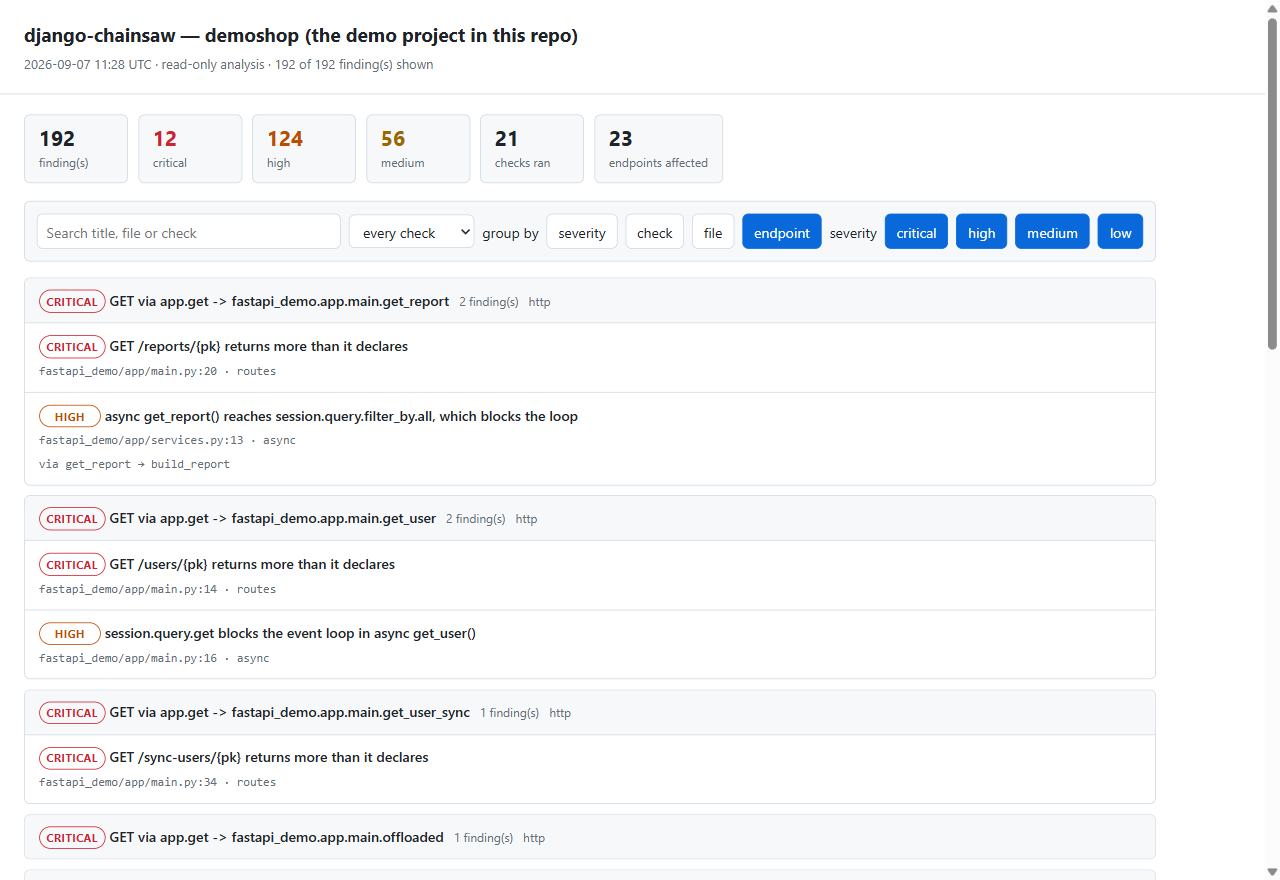
Grouped by endpoint is the view that matters: which pages carry this, and through what call path. No server, no network, no build step — the CSS, the script and the data are all in the file, so it works from a CI artifact or an email attachment. report.md
The checks
| Tool | Answers |
|---|---|
project_info | Does the target project load at all? Run this first when something is broken. |
list_models | Every model with fields, relation kind, direction and on_delete. |
delete_impact | Delete one row: what cascades, what blocks, what gets nulled. Transitive. |
find_n_plus_one | Relation traversals in a template that each cost a query, and the fix. |
scan_templates | The same across a directory, resolving context from views. |
migration_risk | Migrations rated: blocks writes, rewrites the table, breaks running code. |
deploy_safety | Is this destructive migration safe to ship yet? |
find_unscoped_queries | Which queries read data the caller may not own? The IDOR shape. |
what_happens_on | What does this save actually trigger? Follows the signal chain. |
missing_indexes | Fields the code filters or sorts on that carry no index. |
datetime_audit | Naive datetimes and field defaults that break when the clock moves. |
serializer_exposure | What DRF serializers expose, including what the next migration will add. |
serializer_nplusone | N+1 in DRF serializers, which is where it lives in an API project. |
explain_model | Everything about one model, plus the risks only visible combined. |
endpoint_cost | How many queries one request costs, before anybody sends one. |
api_contract / api_contract_check | What this branch changes about the API, and who it breaks. |
escaping_side_effects | Mail and tasks fired inside a transaction that can still roll back. |
bypassed_effects | Bulk writes that skip everything the save() chain promised. |
race_conditions | Counters read into Python, changed, and saved. Also unsafe upserts. |
money_precision | Where a decimal amount stops being exact. |
celery_arguments | What the worker actually receives, and whether it can even be called. |
queries_in_loops | Queries written inside a loop, split by which of three fixes applies. |
defeated_prefetches | Prefetches paid for and then re-queried by the accessor that reads them. |
request_impact | Every finding grouped by the entry points that reach it, so the question becomes which endpoint to fix. |
choice_typos | Literals a field's choices will never match: valid SQL, zero rows, no exception. |
multiplied_aggregates | Counts and sums multiplied by a join across two multi-valued relations. |
dangling_references | URL names, templates, signal senders and Celery tasks nothing will resolve. |
open_endpoints | Sensitive fields on endpoints anybody can call. |
unused_eager_loading | Joins and prefetches nothing in the response reads. |
check | Run everything that applies, one severity-sorted list, one exit code. |
suggest_fixes | Findings turned into code, grouped by how safe each one is to apply. |
| Tool | Answers |
|---|---|
project_profile | What is this built on? Counted from the project's own imports. |
blocking_in_async | Which synchronous call stops the event loop for every request? |
fastapi_exposure | Endpoints that serialise more than they declare. |
sqlalchemy_nplusone | Relationships loaded one row at a time, including during serialisation. |
amplification | Which endpoint can a stranger use to exhaust the database? |
Plus the resource django://models. check profiles the project first and runs
what applies, and says "does not apply, and here is why" for the rest —
silence would read exactly like a clean result. Nothing about the FastAPI
support imports the project, so those checks run on a checkout with no
dependencies installed at all.
36 of the 37 tools declare readOnlyHint, so a client can stop asking
permission for each call; the exception is api_contract_check with
update=True, which writes the snapshot and says so.
Every tool, argument and output shape →
What it will not tell you
Nothing here executes the target project or reads its data, which buys safety and speed and costs certainty. Every tool states its own blind spots in its own output:
delete_impactdoes not run signals or customdelete()overrides.find_n_plus_onereports candidates; it reads the template and the model graph, not the queryset in the view.migration_riskdoes not know row counts, PostgreSQL version, or deploy strategy.deploy_safetycannot seegetattr(obj, name), runtime SQL, or another repository.CLEARmeans nothing was found here.
A confident wrong answer is worse than an incomplete one. In this kind of tooling the failure mode is not a crash, it is a plausible sentence that sends someone in the wrong direction. limitations.md
What it does to your code
It imports the target project. django.setup() imports your settings and
every app in INSTALLED_APPS, and the checks additionally import the modules
that declare serializers, views and URLs — so anything those do at import time
happens. Do not point this at code you would not run.
It does not run your application: no view, no task, no management command.
One check reads the database, read-only — MigrationLoader reads
django_migrations, and nothing is written.
It writes files only when you ask: fix --write applies the mechanical
class of fix only, and a baseline, a contract snapshot or --sarif write where
you tell them to. Nothing leaves the machine — no network calls, no
telemetry, no uploads.
Documentation
docs/ is the index.
why.md | why this exists, three checks worth reading about, and the bar a new one clears |
quickstart.md | five minutes from clone to first finding |
usage.md | installing against a real project, Docker, troubleshooting |
clients.md | Claude Code, Cursor, VS Code, Windsurf, Zed |
cli.md | commands, exit codes, CI |
tools.md | every tool, argument and output shape |
tested-against.md | eighteen public projects, what they found in this tool, and the checks that never fired |
limitations.md | what the analysis cannot see |
baseline.md | ratcheting, so this survives a legacy codebase |
fixes.md | suggestions as real code, and which can be applied |
architecture.md | how it is put together, and why the bootstrap drives the design |
performance.md | where the time goes on a large project |
Contributing
CONTRIBUTING.md | workflow, house style, how to run the suites |
CHANGELOG.md | every release, and the reasoning behind the changes |
SECURITY.md | what this does to the code you point it at |
CODE_OF_CONDUCT.md | be straight with people and be kind about it |
A proposal for a new check answers four questions, which the issue template asks directly: what the defect looks like as code, how it fails in production, what already finds it, and what it must stay silent on. Two finished features were deleted from this repository after measurement showed they could not tell a real finding from a correct one.
MIT. One process stays bound to the first project it loads, because
django.setup() cannot be undone — run a second instance for a second project.
Reviews
No reviews yet
Be the first to review this server!
More Developer Tools MCP Servers
Paperclip
Freeby Paperclipai · Developer Tools
Trending hip-hop artist momentum scores across four cultural dimensions.
Git
Freeby Modelcontextprotocol · Developer Tools
Read, search, and manipulate Git repositories programmatically
Toleno
Freeby Toleno · Developer Tools
Toleno Network MCP Server — Manage your Toleno mining account with Claude AI using natural language.
mcp-creator-python
Freeby mcp-marketplace · Developer Tools
Create, build, and publish Python MCP servers to PyPI — conversationally.
MCP Marketplace
Freeby mcp-marketplace · Developer Tools
Search and install MCP servers from inside your AI client.
MarkItDown
Freeby Microsoft · Content & Media
Convert files (PDF, Word, Excel, images, audio) to Markdown for LLM consumption