
Server data from the Official MCP Registry
Turn a screen recording into agent-readable annotated keyframes. MCP server + CLI on ffmpeg.
About
Turn a screen recording into agent-readable annotated keyframes. MCP server + CLI on ffmpeg.
Security Report
Valid MCP server (3 strong, 2 medium validity signals). No known CVEs in dependencies. Package registry verified. Imported from the Official MCP Registry.
7 files analyzed · 1 issue found
Security scores are indicators to help you make informed decisions, not guarantees. Always review permissions before connecting any MCP server.
Permissions Required
This plugin requests these system permissions. Most are normal for its category.
How to Install
Add this to your MCP configuration file:
{
  "mcpServers": {
    "io-github-teunlao-vidin": {
      "args": [
        "-y",
        "@teunlao/vidin"
      ],
      "command": "npx"
    }
  }
}Documentation
View on GitHubFrom the project's GitHub README.
vidin
Turn a video into something a coding agent can actually read.
Claude Code, Codex and friends accept images, not video. So when a bug report arrives as a screen recording, the video is dead weight — someone has to watch it and retype what happened. vidin watches it instead: it converts the recording into a small set of annotated keyframes plus a written timeline, and serves them to agents over MCP.
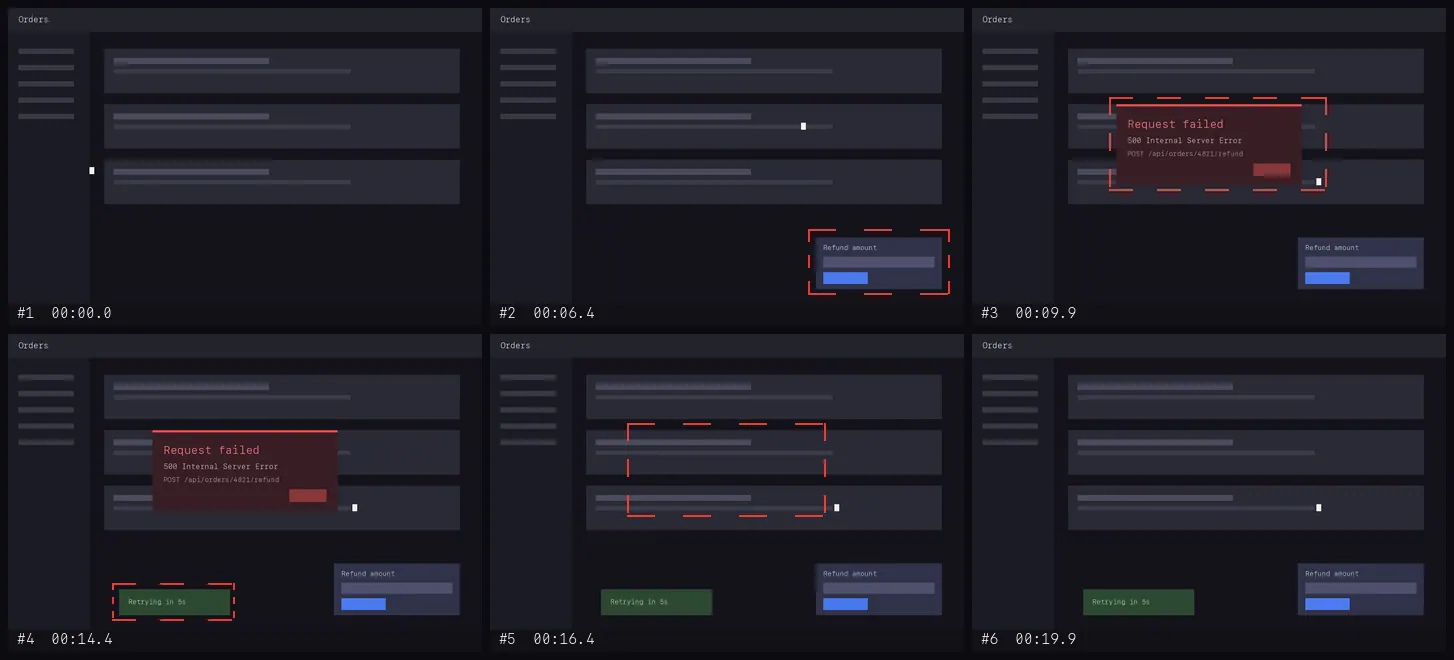
A 20-second recording in, six frames out: the refund panel, the 500 dialog, the retry toast, the recovery — each boxed and timestamped. (The clip is vidin's synthetic test fixture.)
- Event-driven, not one-frame-per-second. A frame is kept when the screen changes and then comes to rest. Three minutes of someone reading costs almost nothing; every real UI event is captured.
- Fast. A 3-minute 1080p recording takes ~4 seconds on an M-series Mac. An hour-long one costs time, not RAM.
- One command to run.
npx @teunlao/vidin— all it asks of the machine isffmpeg; no sharp, no headless browser, no native image library. - Shaped for agent context. The MCP tools return a written report and one contact sheet first; full-detail frames only for the moments that turn out to matter.
- Timestamps you can scrub to. An agent can say "the error appears at 00:41.2" and you jump straight there in the original file.
Quickstart
brew install ffmpeg # + yt-dlp, only if you'll pass URLs
Hook it into Claude Code:
claude mcp add vidin -- npx -y @teunlao/vidin mcp
Or in .mcp.json / ~/.codex/config.toml equivalents:
{
  "mcpServers": {
    "vidin": { "command": "npx", "args": ["-y", "@teunlao/vidin", "mcp"] }
  }
}
Or straight from the shell:
npx @teunlao/vidin ~/Desktop/bug.mov       # → ./.vidin/bug/
npm i -g @teunlao/vidin                    # or put `vidin` on PATH for good
vidin https://example.com/screencast.mp4   # downloaded with yt-dlp
vidin zoom bug.mov --from 00:41 --to 00:45 --fps 6
vidin probe bug.mov
What comes out
out/
  REPORT.md        the entry point: timeline table, what changed where, what to open
  manifest.json    the same, machine readable
  sheets/          the whole video as labelled 3x3 grids (~1.3k tokens each)
  frames/          full-detail annotated frames
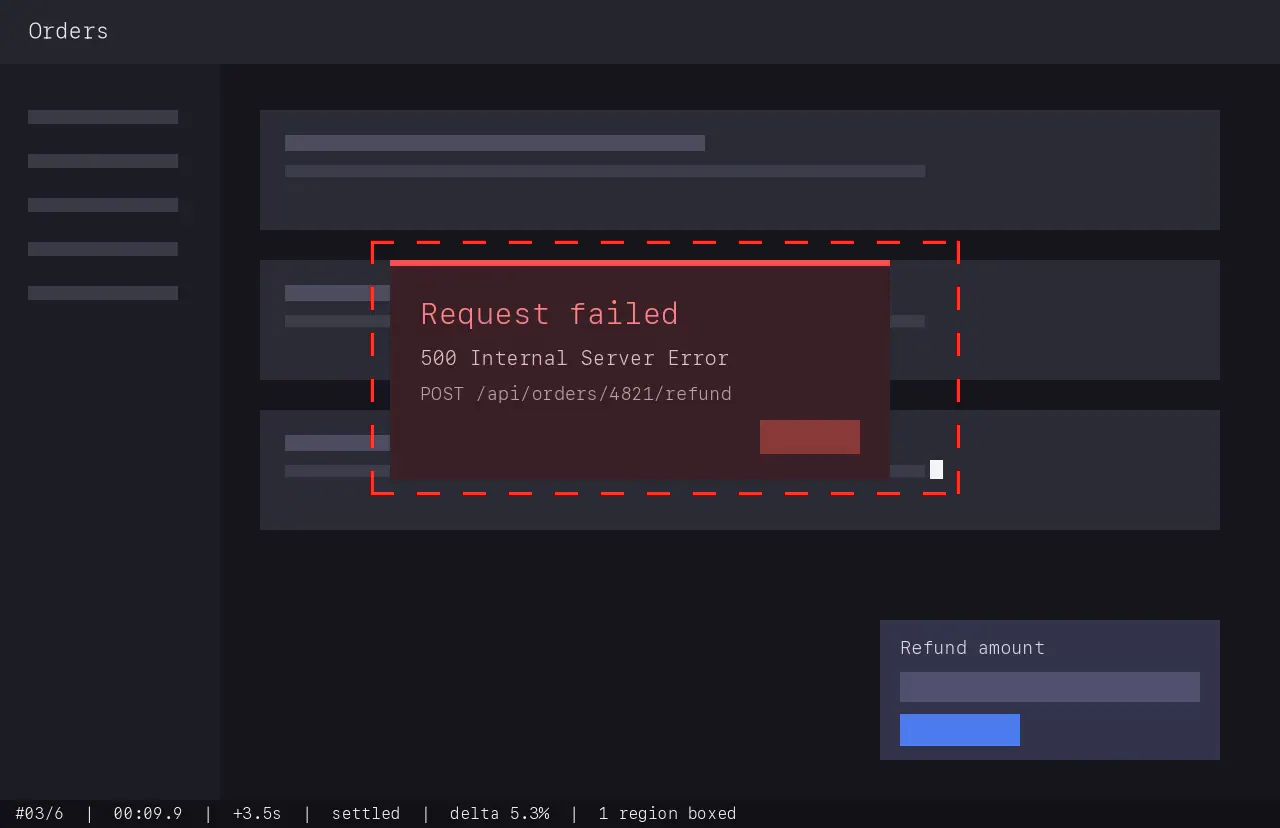
Each frame carries a red dashed box around the regions that changed since the previous kept frame, and a bottom bar with the frame number, the timestamp in the original video, the gap since the previous frame, why the frame was kept, and how much of the screen changed.
The MCP tools
Four tools, shaped so an agent spends context in the right order:
| tool | what it does |
|---|---|
analyze_video | video → frames on disk; returns the report text and one contact sheet image |
get_frames | full-detail frames by number or time range, capped so a call can't flood the context |
zoom_clip | re-extract a narrow window at a higher frame rate — for the moment two frames don't explain |
probe_video | duration / resolution / fps / audio, cheap |
The intended loop: analyse → look at the sheet → read the timeline → open two or three frames → zoom in if the moment between them is still unclear. Opening everything up front would burn the context before knowing which second matters.
Profiles and tuning
| profile | for |
|---|---|
bug-report | default — someone recorded a screen, narrated a bug, stopped |
dense | short clips where every twitch matters (24 fps analysis, up to 80 frames) |
walkthrough | long recordings; fewer frames, wider anchors |
cheap | smallest footprint, for when the context really is tight (12 frames at 1092px) |
Tuning without leaving the profile: --max-frames, --sensitivity (percent of
the screen that counts as an event, lower = more frames), --fps, --width,
--quality, --no-annotate, --no-sheets.
Why pick frames instead of slicing them
One screenshot per second turns three minutes into 180 frames of which ~90% are identical, because the person was reading, thinking or moving the mouse. Those duplicates don't cost much — they bury the handful of frames where something actually happened, and an agent has to look at all of them to find out which. Frame selection is a signal-to-noise problem wearing a cost problem's clothes.
vidin is event driven instead. It walks the video at 12 fps in downscaled RGB and keeps a frame only when something actually happened:
- Change is measured against the last kept frame, not the previous sample, so slow drift accumulates instead of hiding under the threshold.
- Frames land after the change, not inside it. When motion starts, nothing is emitted yet — the selector waits for the screen to come to rest and keeps the settled frame. You get the state after the click, not the animation blur.
- Colour counts as change. Comparison is per channel, not on brightness. A field turning red or a green toast over a grey panel barely moves the luma and is exactly what a bug report is about.
- A moving mouse costs nothing, by arithmetic rather than special-casing: at analysis resolution a pointer is an order of magnitude below the event threshold. There was once a subsystem for recognising it; measured on real recordings it changed no decision anywhere, so it is gone.
- Guard rails. A minimum gap, anchor frames across long still stretches, periodic samples while a long animation runs, and a hard budget (40 frames by default) that drops the least informative frames first while keeping the ends of the timeline.
Two invariants hold whatever path a frame took:
- Nothing is dropped silently. The comparison baseline only ever advances by keeping a frame. There is no path that folds a changed screen into the baseline without emitting it — that would make the change unrecoverable, since every later comparison would measure zero against a state you never see.
- Annotations describe the neighbour you can actually see. After the frame budget prunes the middle of the timeline, every survivor's change percentage and boxes are recomputed against the frame that now precedes it.
How it works
ffmpeg ─raw RGB @12fps, 400px─ selector ──timestamps+regions── ffmpeg ──annotated WebP
         one decode pass,         event state machine            drawbox/drawtext
         streamed                 in plain TypeScript            per frame
Decoding streams two frames at a time; the selector additionally keeps the
downscaled buffers of the frames it has kept so it can recompute their deltas
after pruning. That is bounded by the frame budget, not by video length: ~32 MB
at the defaults. All drawing is done by ffmpeg filters, which is why there is
no image library in package.json.
Development
Development runs on Bun; the runtime code itself sticks to
node: APIs, which is what lets the published package run anywhere npx does.
git clone https://github.com/teunlao/vidin && cd vidin && bun install
bun test
The fixture is a synthetic screen recording with a scripted timeline — a panel,
an error dialog, a toast, a recovery, and two stretches of pointer-only motion.
The suite asserts that each staged event yields exactly one settled frame and
that pointer motion alone yields none. test/regressions.test.ts builds its
own clips and pins every failure a review has found, so a fixed bug stays
fixed.
Not there yet
- Audio transcript. Narration is the highest-signal part of a bug report.
Planned: local Whisper (
whisper.cppormlx-whisper) → atranscript.mdaligned to the frame timeline. - OCR over kept frames, so an agent can grep an error message without spending vision tokens at all.
- Pointer position and clicks are not reported — deliberately. A drawn crosshair was checked against a real recording and was right about half the time: a growing DevTools request list moves down the screen exactly like a pointer does. A wrong marker asserts "the user was pointing here" on a coin flip, and the pointer is plainly visible in the frame anyway.
- Horizontal scroll is not detected; vertical is.
- Small elements need a nudge. The default event threshold is 0.4% of the
screen, so a progress bar or a badge below that is not an event on its own.
--sensitivity 0.2or--profile densecatches them, at the cost of more frames.
Reviews
No reviews yet
Be the first to review this server!
More Developer Tools MCP Servers
Paperclip
Freeby Paperclipai · Developer Tools
Trending hip-hop artist momentum scores across four cultural dimensions.
Netdata
Freeby Netdata · Developer Tools
Real-time infrastructure monitoring with metrics, logs, alerts, and ML-based anomaly detection.
Toleno
Freeby Toleno · Developer Tools
Toleno Network MCP Server — Manage your Toleno mining account with Claude AI using natural language.
mcp-creator-python
Freeby mcp-marketplace · Developer Tools
Create, build, and publish Python MCP servers to PyPI — conversationally.
MCP Marketplace
Freeby mcp-marketplace · Developer Tools
Search and install MCP servers from inside your AI client.
MarkItDown
Freeby Microsoft · Content & Media
Convert files (PDF, Word, Excel, images, audio) to Markdown for LLM consumption