
Server data from the Official MCP Registry
Deterministic Artifact Evaluation preflight and run-path grader for research repositories.
About
Deterministic Artifact Evaluation preflight and run-path grader for research repositories.
Security Report
Valid MCP server (2 strong, 3 medium validity signals). No known CVEs in dependencies. Package registry verified. Imported from the Official MCP Registry.
12 files analyzed · 1 issue found
Security scores are indicators to help you make informed decisions, not guarantees. Always review permissions before connecting any MCP server.
Permissions Required
This plugin requests these system permissions. Most are normal for its category.
How to Install
Add this to your MCP configuration file:
{
  "mcpServers": {
    "io-github-tom409114-rrdoctor": {
      "args": [
        "--from",
        "rrdoctor",
        "rrdoctor"
      ],
      "command": "uvx"
    }
  }
}Documentation
View on GitHubFrom the project's GitHub README.
Research Repo Doctor
Get your research artifact ready for Artifact Evaluation before the deadline: scan the repo, scaffold the easy fixes, verify the run path, and generate the appendix.
Web demo for public repos: https://research-repo-doctor-bckncrcwwmg6jrbsrd6btj.streamlit.app/ If the hosted demo is waking up or reinstalling dependencies, the local zero-install command below is the reliable fallback:
uvx rrdoctor scan .
Maintainers can check anonymous demo access with
python scripts/check_live_demo.py https://research-repo-doctor-bckncrcwwmg6jrbsrd6btj.streamlit.app/.
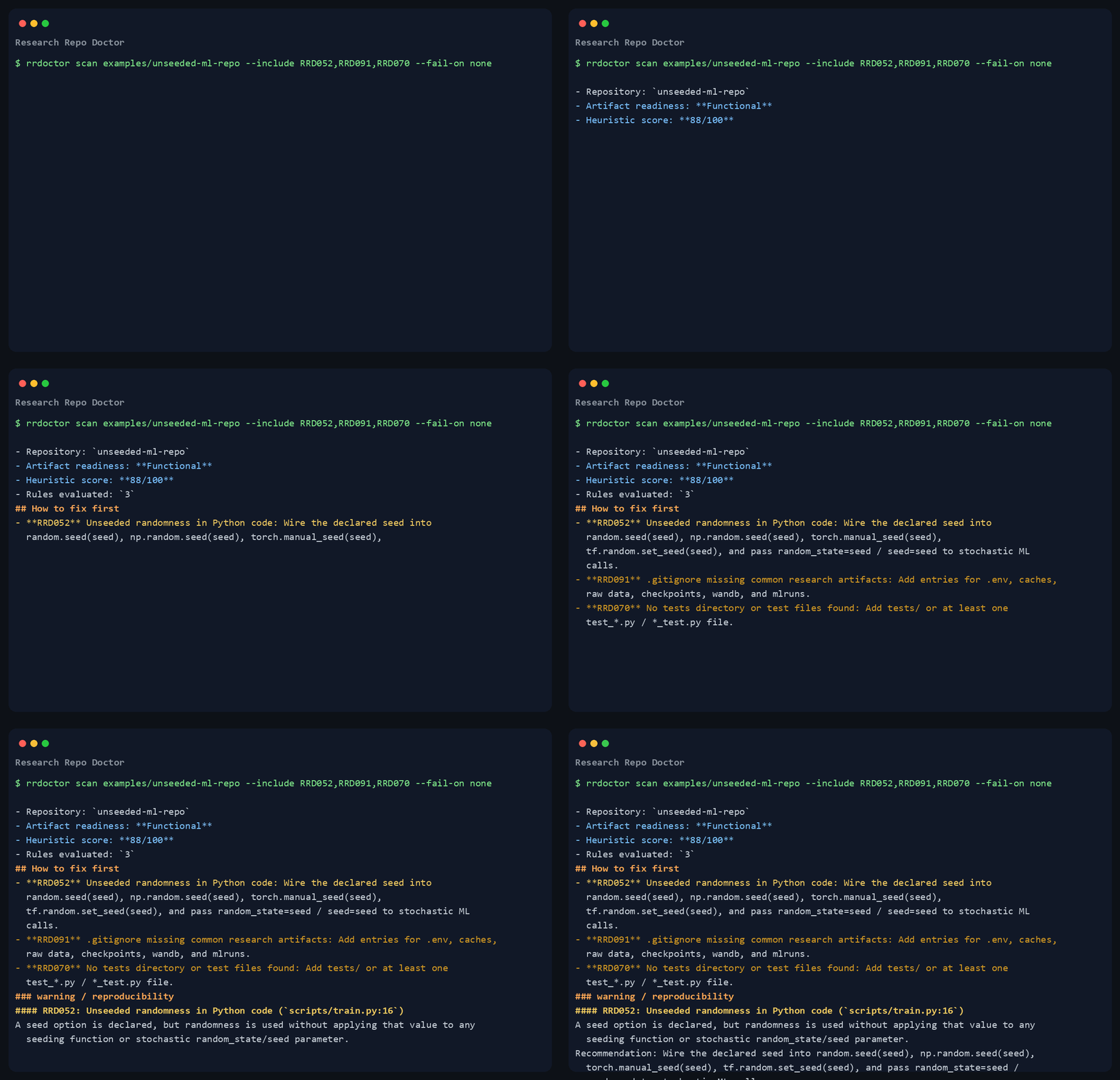




rrdoctor is a local CLI and GitHub Action for research artifact preparation. It audits
whether a repo is reviewable, citable, and close to runnable; scaffolds safe mechanical
fixes; maps findings to an AE-style readiness level; and turns the rest into a checklist
any coding agent or human can finish.
Make it a pull-request gate
The GitHub Action is the main adoption path: run the CLI while preparing the artifact, then keep the same deterministic preflight on every pull request.
name: Reproducibility preflight

on:
  pull_request:
  push:
    branches: [main]

permissions:
  contents: read

jobs:
  rrdoctor:
    runs-on: ubuntu-latest
    steps:
      - uses: actions/checkout@v7
      - uses: Tom409114/research-repo-doctor@v0.2.24
        with:
          profile: standard
          fail-on: error
The full GitHub Action guide covers sticky PR comments, new-finding baselines, agent plans, appendices, and complete AE prep packets.
AE deadline loop
uvx rrdoctor prepare . --profile acm --out-dir rrdoctor-prep

# Or run the pieces explicitly:
uvx rrdoctor scan . --profile acm
uvx rrdoctor fix . --write
uvx rrdoctor appendix . --profile acm --output ARTIFACT_APPENDIX.md
uvx rrdoctor verify . --profile acm
uvx rrdoctor verify . --profile acm --run --timeout 600 --fail-on error  # trusted repos only
# Or pin the official quickstart command as the dynamic gate:
uvx rrdoctor verify . --profile acm --command "python train.py config/default.py" --run --timeout 600 --fail-on error
For trusted repositories, rrdoctor verify --run can go beyond static checks. For supported
Python repositories it creates a temporary isolated environment, installs declared
dependencies, and executes the declared entrypoint there under a timeout. Other ecosystems
retain an explicit resolver preflight. With the default gate (--fail-on error), failed or
blocked dynamic L2/L3 steps return a nonzero exit code. Use --command when the artifact has
a specific smoke-test or quickstart command that reviewers should run. Dynamic mode may run
dependency build/install hooks as well as the entrypoint, so never use it on untrusted code.
rrdoctor prepare writes the report, agent plan, artifact appendix, and verification ladder
into one local evidence directory.
Artifact Evaluation chairs and lab maintainers can use the AE chair guide for optional pre-submission wording and CI examples.
For public calibration evidence, see the 80-repository data brief and the nanoGPT first-run regression case study.
What it catches
- "Your
--seedflag does nothing."RRD052spots code that declares a seed option but never callsrandom.seed,np.random.seed,torch.manual_seed,tf.random.set_seed, orrandom_state=seed. - "This worked on my laptop." Local-only data paths, missing data provenance, and undocumented retrieval steps.
- "The environment silently changed." Unpinned dependencies, missing runtime versions, undeclared imports, and absent dependency manifests.
- "The notebook lies." Stale outputs, out-of-order execution, checkpoint artifacts, and secret-like notebook output.
- "Reviewers cannot tell how to cite or rerun this." Missing license, citation, CI, tests, changelog, results provenance, or experiment entrypoint.
Install
Run once, without installing:
uvx rrdoctor scan .
Alternatives:
pipx run rrdoctor scan .
pip install rrdoctor
rrdoctor scan .
Developer install from source:
git clone https://github.com/Tom409114/research-repo-doctor.git
cd research-repo-doctor
python -m pip install -e ".[dev]"
rrdoctor scan .
Fix the easy gaps
Let rrdoctor create the safe scaffolding for you. It is deterministic, idempotent, and
never overwrites existing files.
rrdoctor fix . --write
It can scaffold missing governance docs, citation metadata, data/results provenance notes,
a reproducible-seed helper, changelog entries, and common research .gitignore entries.
The hard parts become a reviewable plan:
rrdoctor plan . --output plan.md
Use with your coding agent
Paste this into Claude Code, Cursor, GitHub Copilot, or any other coding agent:
Use rrdoctor as the deterministic, offline, no-API-key grader for this research repo.

Run:
rrdoctor scan . --format json --output baseline.json
rrdoctor plan . --output plan.md

Work through plan.md without weakening rrdoctor checks.

Definition of done:
rrdoctor scan . --baseline baseline.json --fail-on-new error
The final command is the objective gate: it verifies the agent's work against the starting baseline and fails only on newly introduced errors.
Copyable agent templates are available for Agent Skills / Claude Code-style workflows and Cursor project rules under integrations/.
Keywords: research software, reproducibility, artifact evaluation, repository audit, auto-fix, coding agents, AGENTS.md, GitHub Action, notebooks, data availability, citation metadata.
Help calibrate the rules
The fastest way to improve rrdoctor is real scan feedback from real research repositories. After one scan, the low-friction 10-minute trial report asks only what was useful, wrong or missing, and whether the tool fits a real deadline. For a focused rule report, please open a false-positive, false-negative, scan-case, or new-rule issue. Include the rule ID, command, rrdoctor version, and a sanitized minimal repo shape. See feedback and calibration for the short checklist.
Why this matters
Research code often lands on GitHub under deadline pressure. A reviewer or future lab member finds a promising repository and then loses hours because the environment is underspecified, data paths are local, notebooks contain stale outputs, dependencies are unpinned, or the citation is unclear.
Research Repo Doctor turns those recurring release blockers into deterministic checks with concrete remediation - and, where it is safe to do so, scaffolds the mechanical starting points. It is built to sit in the ordinary maintenance path: run locally while preparing a release, then run automatically on pull requests through GitHub Actions.
The audit runs without an AI API key, network access, or hosted service. That same determinism makes it an honest grader: it can verify fixes made by a person or a coding agent.
audit -> fix -> plan -> (your coding agent / you) -> verify -> PR
  |       |       |                                  |
  |       |       rrdoctor plan                      rrdoctor scan --baseline
  |       rrdoctor fix --write                       --fail-on-new error
  rrdoctor scan
What's new in 0.2.24
- Better systems-artifact coverage: existing checks now recognize Cargo, CMake, Meson, container, and Nix evidence plus documented artifact scripts and Cargo commands across entrypoint, test, CI, and release workflows.
- Quieter static scans: target-source
SyntaxWarningnoise is suppressed, and escaped Python exception text no longer looks like a local Windows path. - A rechecked first-run trust case: public PyPI
rrdoctor==0.2.23still scores nanoGPT asFunctionalat 76/100 with 0 errors, while the original noisyRRD050andRRD063findings remain absent. - An explicit JOSS boundary: the draft-paper notes now separate the more-than-six-month public-history gate from research-use, authorship, conflict-of-interest, and AI-disclosure evidence that maintainers must supply.
- A configuration file that actually governs the scan: CLI and MCP calls
load the target repository's
.rrdoctor.ymlfrom any working directory; profile, report, threshold, failure, include/exclude, and rule settings now work beneath explicit CLI overrides.
What's new in 0.2.23
- A safer release path: the hosted demo can stay pinned to the latest published PyPI package while a new release propagates, avoiding broken Streamlit deployments during Trusted Publishing.
- A first-class GitHub Action path: a compact pull-request workflow now appears near the top of the README and is guarded by public-readiness tests.
- A shorter feedback loop: completed web-demo scans link to a structured 10-minute trial report for useful findings, false positives, false negatives, and real deadline fit.
- Official MCP Registry distribution:
v0.2.24is published asio.github.Tom409114/rrdoctor, with MCP support remaining an optional extra rather than a core scanner dependency. Registry inclusion is distribution metadata, not endorsement or evidence of adoption. - Stronger dynamic verification coverage: an offline integration test proves L3 can install and import a declared local wheel inside its temporary Python environment.
What's new in 0.2.22
- Real Python environment verification:
rrdoctor verify --runnow creates a temporary isolated venv, installs the repository's declared dependencies, and runs L3 with that interpreter and PATH instead of stopping at a resolver dry run. - Honest execution boundaries: verification reports disclose dependency build-hook risk, redact machine-specific temporary paths, and remove the temporary environment after the run. Other ecosystems retain an explicit resolver preflight.
- Stronger isolation checks: inherited
PYTHONHOMEandPYTHONPATHvalues are removed, and versioned launchers such aspython3.10are redirected to the temporary environment.
What's new in 0.2.21
- More honest corpus evidence: the public 80-repository calibration corpus now has 80 focused review notes, 0 repositories awaiting focused review, and a concise data brief that explains what the corpus does and does not prove.
- Lower-noise model-release scans:
RRD050andverifynow recognize common model-release entrypoints such asdemo.py,inference.py,predict.py,sample.py, andgenerate.pyin root,scripts/, andtools/layouts. - Less noisy secret checks:
RRD063andRRD090now require stronger entropy evidence for genericapi_key/token/secret/passwordassignments while still flagging provider-shaped keys. - More agent integrations: the repository includes copyable GitHub Copilot instructions alongside the existing Agent Skill and Cursor templates for the baseline -> plan -> verify loop.
- Clearer launch artifacts: the JOSS draft now states the evaluation evidence and limitations more explicitly, and the live-demo check now follows Streamlit's anonymous redirect handshake before deciding whether the app is reachable.
What's new in 0.2.20
- Lower-noise mature scientific package scans:
RRD010now recognizes common license filenames such asLICENSE.txt, andRRD043ignores CI/devcontainer paths, tests/fixtures, URL path segments, and documented placeholder/example absolute paths. - Lower-noise library and secret heuristics:
RRD050no longer treats mature package/library projects, including common nestedpackage/layouts, as missing paper experiment entrypoints, andRRD090ignores URL query tokens, local function-call or method-call token variables, generic fake tokens in test helpers, and provider-looking substrings embedded inside longer biological/test sequences. - More reviewed corpus evidence: SciPy is a focused review case and an
expected-absent regression gate for
RRD010andRRD043; scikit-image, JAX, NetworkX, Keras, Transformers, PyTorch Lightning, Biopython, torchvision, MDAnalysis, QuTiP, ESM, stable-diffusion, detectron2, DINO, StyleGAN2-ADA PyTorch, instant-ngp, Big Vision, latent-diffusion, taming-transformers, generative-models, pytorch-image-models, Brax, ArviZ, PyMC, Pyro, TensorFlow Probability, statsmodels, Optax, and the remaining corpus entries now add first-run trust gates or focused review evidence. The latest 80-repository corpus gate has 0 expected-absent regressions, 80 reviewed notes, and 0 repositories still awaiting focused review. - Less template-like auto-fix output:
rrdoctor fix --writecan now read simple literalsetup.pymetadata statically, without executing repository code, when generating citation and provenance scaffolds. - More filled Artifact Appendix access notes:
rrdoctor appendixreuses the same local metadata inference to pre-fill repository URLs and versions for legacysetup.py/setup.cfgprojects. - More realistic L2 environment checks:
rrdoctor verify --runnow resolves common nested Python requirement files such asrequirements/base.txtandrequirements/main.txt, plus.yamlConda environment files, instead of skipping those repository layouts. - Lower-noise notebook secret checks:
RRD063now shares the test/fixture generic fake-token suppression used byRRD090, while still flagging standalone provider-style keys.
What's new in 0.2.19
- Lower-noise experiment entrypoint detection:
RRD050now recognizes package-level research binaries such ast5x/train.py, documentedpython3 ${T5X_DIR}/t5x/train.pycommands, and notebook-first artifacts with clearly named demo/example/reproduce notebooks such asgraphcast_demo.ipynb. - More first-run corpus evidence: focused review notes now cover 32/60 seed corpus repositories. The latest 60-repository static corpus scan has 0 expected-absent regressions and keeps t5x and GraphCast as entrypoint regression gates.
What's new in 0.2.18
- Lower-noise dependency checks:
RRD034now parses Python AST imports instead of regex-matching source text, so comments, docstrings, and prose examples do not look like missing packages. - Runtime-focused dependency signal: docs, tests, benchmarks, vendored code,
maintainer tooling,
conftest.py, build-system requirements, and local sibling modules are filtered out before dependency-gap reporting. - More corpus review evidence: focused review notes now cover 30/60 seed corpus repositories, including scikit-learn, Astropy, scvi-tools, and DINOv2 checks for dependency-signal noise.
- Current install path: PyPI, GitHub Action examples, demo requirements, citation metadata, and the self-scan report are aligned to this release.
What's new in 0.2.15
- Clearer verification evidence:
rrdoctor verifyreports now lead with the gate outcome, failure threshold, timeout, trust boundary, rerun command, and the source of any L3 dynamic command. - Stronger Artifact Appendix scaffolding:
rrdoctor appendixnow pre-fills local README/project metadata, dependency manifests, data/results docs, config files, and detected entrypoint commands where available. - More useful generated data notes:
rrdoctor fix --writecarries over candidate dataset URLs, DOIs, README data commands, and local data scripts when scaffoldingDATA.md. - Maintainer launch gates:
python scripts/check.pyandpython scripts/check_public_readiness.pyprovide cross-platform local checks for release, JOSS, Artifact Evaluation, and public outreach readiness.
What's new in 0.2.14
- One-command AE evidence packet:
rrdoctor preparewrites the static report, agent fix plan, Artifact Appendix, and verification ladder into one local directory for deadline handoff. - CI-uploaded AE packet: the GitHub Action now supports
prepare: "true"andprepare-output, so pull requests and release gates can upload the same reviewer-ready packet. - Pinned run-path verification:
verify --command "...", the Actionverify-commandinput, and the MCPverifytool let maintainers pin the official quickstart command and timeout as the L3 gate. - Lower first-run noise: MAE-style root
main_*.pyscripts, AlphaFold-stylerandom_seed=plumbing, test-file randomness, and placeholder absolute paths are handled more conservatively.
What's new in 0.2.13
- Scan reports now lead to the AE workflow: Markdown reports and agent fix
plans now include next-step commands for
rrdoctor plan,rrdoctor appendix, staticrrdoctor verify, and trusted-only dynamicverify --run. - Stronger auto-fix scaffolds: generated
AGENTS.mdfiles now include the scan -> plan -> baseline verification loop, and generated results-provenance notes include local repository context, current result files, and a structured result inventory table. - Better adoption materials: public docs now include a feedback/calibration path and an Artifact Evaluation chair guide with optional pre-submission wording and CI examples.
What's new in 0.2.12
- Trusted dynamic Action gate: GitHub Action users can now set
verify-run: "true"plusverify-fail-on: errorso trusted dynamic verification blocks CI while still uploading the verification report. - Agent distribution templates: repository Copilot instructions, an Agent Skill template, and a Cursor project rule make the deterministic scan -> plan -> verify loop copyable across coding-agent workflows.
- Tighter evidence wording: corpus and JOSS draft wording now distinguishes focused review notes from full manual repository audits.
What's new in 0.2.11
- First-run trust tuning: README install/run commands, seeded local RNGs, PyTorch parameter initialization, UUID-like identifiers, and classic ML repos now produce fewer false positives.
- Real dynamic gate:
rrdoctor verify --run --fail-on errornow exits nonzero when dependency resolution or the detected run path fails or is blocked. - More calibration evidence: 22 focused review notes are now committed, including BERT, CLIP, improved-diffusion, MAE, and AlphaFold follow-ups with expected-absent checks for fixed noisy findings.
What's new in 0.2.10
- More reliable corpus calibration: the public evaluation-corpus runner now
falls back to GitHub archives when
git clonetimes out, keeping first-run trust checks less dependent on flaky transport. - Cleaner maintainer automation: first-party workflows and documentation examples now use current Node 24-compatible GitHub Actions releases.
- Sharper diagnostics:
rrdoctor doctornow reports optional MCP integration availability only when the package and import-time dependencies actually load.
What's new in 0.2.9
- Clearer first-run CLI behavior:
rrdoctor --versionnow reports the installed package version, and running barerrdoctorprints the root help page successfully.
What's new in 0.2.8
- Better README run-path recognition: README-documented
python -m package.train ...commands now count as experiment entrypoints when they map to local repository modules. - Stronger dynamic verification for ML launchers:
rrdoctor verifynow recognizes module-runner commands such aspython -m torch.distributed.run train.py ...when they include a local Python entrypoint.
What's new in 0.2.7
- Better citation scaffolds:
rrdoctor fix --writenow reads structured PEP 621 and Poetry metadata, preserves multiple authors, normalizes SSH git remotes, and handles git worktree origin URLs when generatingCITATION.cff. - Lower-noise dependency checks:
RRD034now understands PEP 621 environment markers and Poetry dependency groups, reducing undeclared-import false positives.
What's new in 0.2.6
- Lower-noise secret checks: Rcpp
Generator tokenmarkers and public pkgdowndocsearch.api_keysearch configuration no longer triggerRRD090, while generic credential-like API keys still do. - More reliable corpus scans: the evaluation runner now falls back to
GitHub archive downloads when
git clonetransport is flaky, without installing or executing target repositories. - More manual calibration evidence: the current public corpus snapshot covers 60/60 successful static scans, 22 focused review notes loaded in that snapshot, and 0 expected-absent regressions.
What's new in 0.2.5
- Model-release entrypoints: README-documented
python scripts/*.py/python tools/*.pycommands and pyproject-declared CLI commands now count as experiment entrypoints, reducing first-run false positives on repositories such as Segment Anything and Whisper. - ML tools entrypoints: common
tools/train.py,tools/test.py, and related ML framework commands now count forRRD050. - Seed helper scaffolding:
rrdoctor fix --writecan scaffold a reproducibleset_global_seed(seed)helper forRRD052without overwriting project code. - Corpus regression gates: entrypoint fixes are backed by focused review
notes and
expected_absentchecks in the public evaluation corpus.
What's new in 0.2.4
- First-run trust improvements: root-level
train.py/main.py/run.py, Snakemake/Nextflow workflows, and README run commands count as experiment entrypoints. - Lower-noise security checks: notebook and repository secret detection now requires high-confidence credential-like values before raising blocking errors.
- More realistic README checks: concrete training, evaluation, benchmark, workflow, or reproduction commands count as evidence for reproducing results.
- Corpus-backed rule calibration: the public evaluation corpus tracks false-positive and false-negative review notes, expected-absent regression gates, and aggregate rule frequencies.
- Release hygiene: citation guidance detection recognizes README Citing sections, BibTeX, DOI links, and "please cite" text; local git tags count as deterministic version evidence.
- Release polish: the demo GIF is generated, issue access is open, and the committed self-scan report is 100/100.
What's new in 0.2.0
rrdoctor fixprovides deterministic, idempotent auto-fix for common gaps (governance docs, citation metadata, data/results provenance, seed helper scaffolding, changelog, ignore entries). Never overwrites.rrdoctor planemits a tool-agnostic fix plan you can hand to any coding agent; every task names the deterministic check that verifies it.- Baseline gating:
rrdoctor scan --baseline report.json --fail-on-new errorfails only on newly introduced findings, so large repos can adopt the audit incrementally. rrdoctor badgeemits a Shields.io endpoint or SVG artifact-readiness badge.- Artifact readiness labels map findings to an AE-style level:
Available,Functional, orReproduced-ready. The numeric score remains as a secondary triage signal. - First-class PR automation: the Action posts a sticky PR comment, writes a job summary,
and can attach the fix plan, using only the built-in
GITHUB_TOKEN. - New rules include unpinned dependencies, committed notebook checkpoints, pre-commit config, and an AGENTS.md task guide for agent and human contributors.
Quickstart
rrdoctor scan .                   # deterministic audit (Markdown report)
rrdoctor fix . --write            # apply safe scaffolding for easy gaps
rrdoctor plan . --output plan.md  # tool-agnostic work order for the rest
rrdoctor scan . --format json --output baseline.json --fail-on none
rrdoctor scan . --baseline baseline.json --fail-on-new error  # gate regressions
Stricter gate and report file:
rrdoctor scan . --profile strict --fail-on warning --output rrdoctor-report.md
Machine-readable and agent output:
rrdoctor scan . --format sarif --output rrdoctor.sarif --fail-on none
rrdoctor scan . --format agent --output fix-plan.md
Before a submission deadline:
rrdoctor prepare . --profile acm --out-dir rrdoctor-prep          # one local AE packet
rrdoctor appendix . --profile acm --output ARTIFACT_APPENDIX.md   # appendix + checklist mapping
rrdoctor verify . --profile neurips                               # L1/L2/L3 ladder (static)
rrdoctor verify . --run --timeout 600 --fail-on error              # build + run gate (trusted repos)
rrdoctor verify . --command "python train.py config/default.py" --run --timeout 600
Submission profiles: acm, neurips, icml, ml-paper, fair4rs, joss (alongside the
general minimal/standard/strict/ml tiers). Static dependency and runtime checks also
understand R, Julia, Rust/Cargo, CMake-based builds, containers, and Nix environments, not just
Python and JavaScript.
The audit -> fix -> verify loop
A deterministic checker is reproducible and trustworthy but cannot write prose or judge intent. A coding agent edits well but needs a precise specification and an objective definition of done. Research Repo Doctor gives you both:
- Audit:
rrdoctor scanproduces deterministic findings. - Fix the easy ones:
rrdoctor fix --writescaffolds governance docs, citation metadata, provenance notes, a seed helper, a changelog, and ignore entries (idempotent, never overwriting). - Plan the rest:
rrdoctor planemits a tool-agnostic work order. Paste it into the coding agent of your choice, attach it to an issue, or work it by hand. - Verify: re-run the audit against a baseline. Because verification is deterministic and key-free, it works as an honest grader for changes from any source.
See docs/agent-workflows.md and docs/autofix.md.
GitHub Action
Add one workflow to many repositories and get consistent reproducibility reports on pull requests and pushes. The Action requires no API key.
name: Reproducibility audit

on:
  pull_request:

permissions:
  contents: read
  pull-requests: write

jobs:
  rrdoctor:
    runs-on: ubuntu-latest
    steps:
      - uses: actions/checkout@v7
      - uses: Tom409114/research-repo-doctor@v0.2.24
        with:
          profile: standard
          fail-on: none
          comment-pr: "true"     # sticky PR comment with the report
          step-summary: "true"   # report in the job summary
          plan: "true"           # attach an agent-ready fix plan
          appendix: "true"       # attach an Artifact Evaluation appendix
          verify: "true"         # attach the L1/L2/L3 verification ladder
          prepare: "true"        # upload a complete AE prep packet directory
          # For trusted repos, add verify-run: "true" and verify-fail-on: error
For new-finding gating and a committed baseline, see docs/pull-request-automation.md.
Example output
Research Repo Doctor Summary
Profile: standard
Readiness: Functional
Score: 64/100
Errors: 0
Warnings: 5
Rules evaluated: 32

How to fix first:
- RRD030 No dependency manifest found: Add pyproject.toml, requirements.txt, or another manifest.
- RRD040 Data availability documentation missing: Add DATA.md, docs/data.md, or a README section.
Worked examples live in examples/reports/, including a fix plan and a self-scan report.
Commands
| Command | Purpose |
|---|---|
rrdoctor scan | Run the deterministic audit; supports --baseline and --fail-on-new. |
rrdoctor fix | Apply safe, idempotent scaffolding for common gaps (--write to apply). |
rrdoctor plan | Emit a tool-agnostic fix plan (Markdown or JSON). |
rrdoctor prepare | Write a local AE prep packet: report, plan, appendix, and verification. |
rrdoctor verify | Reproducibility ladder L1/L2/L3; --command pins the official quickstart; --run actually builds and executes. |
rrdoctor appendix | Generate an ACM Artifact Appendix + ACM/NeurIPS checklist mapping. |
rrdoctor badge | Emit an artifact-readiness badge (Shields.io endpoint or SVG). |
rrdoctor mcp | Run the MCP server (scan/verify/appendix as agent tools). |
rrdoctor init | Write a documented .rrdoctor.yml. |
rrdoctor list-rules | List all registered rules. |
rrdoctor explain RRD0xx | Explain a rule and how to remediate it. |
rrdoctor doctor | Self-diagnostics. |
rrdoctor --version | Show the installed package version. |
Rule categories
Documentation, environment, data, experiments, notebooks, citation, governance, testing, CI, security, release, and metadata. The full table is in docs/checks.md; auto-fixable rules are marked there.
Reproducibility stance
Research Repo Doctor does not claim to prove a paper is reproducible. It checks release hygiene that makes reproduction possible to attempt. Reports are heuristic and should be reviewed by maintainers. Generated fixes are starting points and contain placeholders to complete before release.
Philosophy
Deterministic first. The scanner is understandable, testable, and useful with no network access. The core scanner will not add network calls, require a hosted-service API key, or fabricate adoption metrics. AI is something you bring to act on the output - never a dependency of the audit itself, and never tied to a single tool.
Configuration
version: 1
profile: standard
paths:
  exclude: [".git", ".venv", "node_modules", "__pycache__"]
thresholds:
  large_file_mb: 50
  large_notebook_output_kb: 1024
rules:
  RRD032:
    enabled: false
  RRD042:
    severity: warning
fail_on: error
Contributing
Contributions are welcome. Start with CONTRIBUTING.md and AGENTS.md, open a rule request or false-positive report, and include a minimal fixture when possible.
Security
Do not report suspected credential exposure in a public issue. See SECURITY.md.
Citation
Use the included CITATION.cff or cite the version DOI for this release: 10.5281/zenodo.21289885. The stable concept DOI, 10.5281/zenodo.21045161, resolves to the latest archived release and preserves the complete version lineage.
A JOSS-style draft manuscript is available in paper/ for review. It is not a submitted manuscript and intentionally avoids unverified adoption claims; formal submission metadata will be updated only when it is true.
@software{research_repo_doctor_2026,
  title = {Research Repo Doctor},
  author = {{Research Repo Doctor Maintainers}},
  version = {0.2.24},
  year = {2026},
  doi = {10.5281/zenodo.21289885},
  url = {https://github.com/Tom409114/research-repo-doctor}
}
License
MIT. See LICENSE.
Reviews
No reviews yet
Be the first to review this server!
More Developer Tools MCP Servers
Git
Freeby Modelcontextprotocol · Developer Tools
Read, search, and manipulate Git repositories programmatically
Fetch
Freeby Modelcontextprotocol · Developer Tools
Web content fetching and conversion for efficient LLM usage
Worldmonitor
Freeby Koala73 · Developer Tools
Live markets, conflicts, country risk, chokepoints, energy, and China decision signals. 89 tools.
Paperclip
Freeby Paperclipai · Developer Tools
Trending hip-hop artist momentum scores across four cultural dimensions.
Toleno
Freeby Toleno · Developer Tools
Toleno Network MCP Server — Manage your Toleno mining account with Claude AI using natural language.
mcp-creator-python
Freeby mcp-marketplace · Developer Tools
Create, build, and publish Python MCP servers to PyPI — conversationally.