
About
MCP server for desktop notifications over stdio
Security Report
Valid MCP server (2 strong, 4 medium validity signals). 3 known CVEs in dependencies (0 critical, 3 high severity) Package registry verified. Imported from the Official MCP Registry.
5 files analyzed · 4 issues found
Security scores are indicators to help you make informed decisions, not guarantees. Always review permissions before connecting any MCP server.
Permissions Required
This plugin requests these system permissions. Most are normal for its category.
How to Install
Add this to your MCP configuration file:
{
  "mcpServers": {
    "io-github-topvisor-mcp-notifications": {
      "args": [
        "-y",
        "@topvisor/mcp-notifications"
      ],
      "command": "npx"
    }
  }
}Documentation
View on GitHubFrom the project's GitHub README.
mcp-notifications

🚀 Ship faster. Miss nothing.
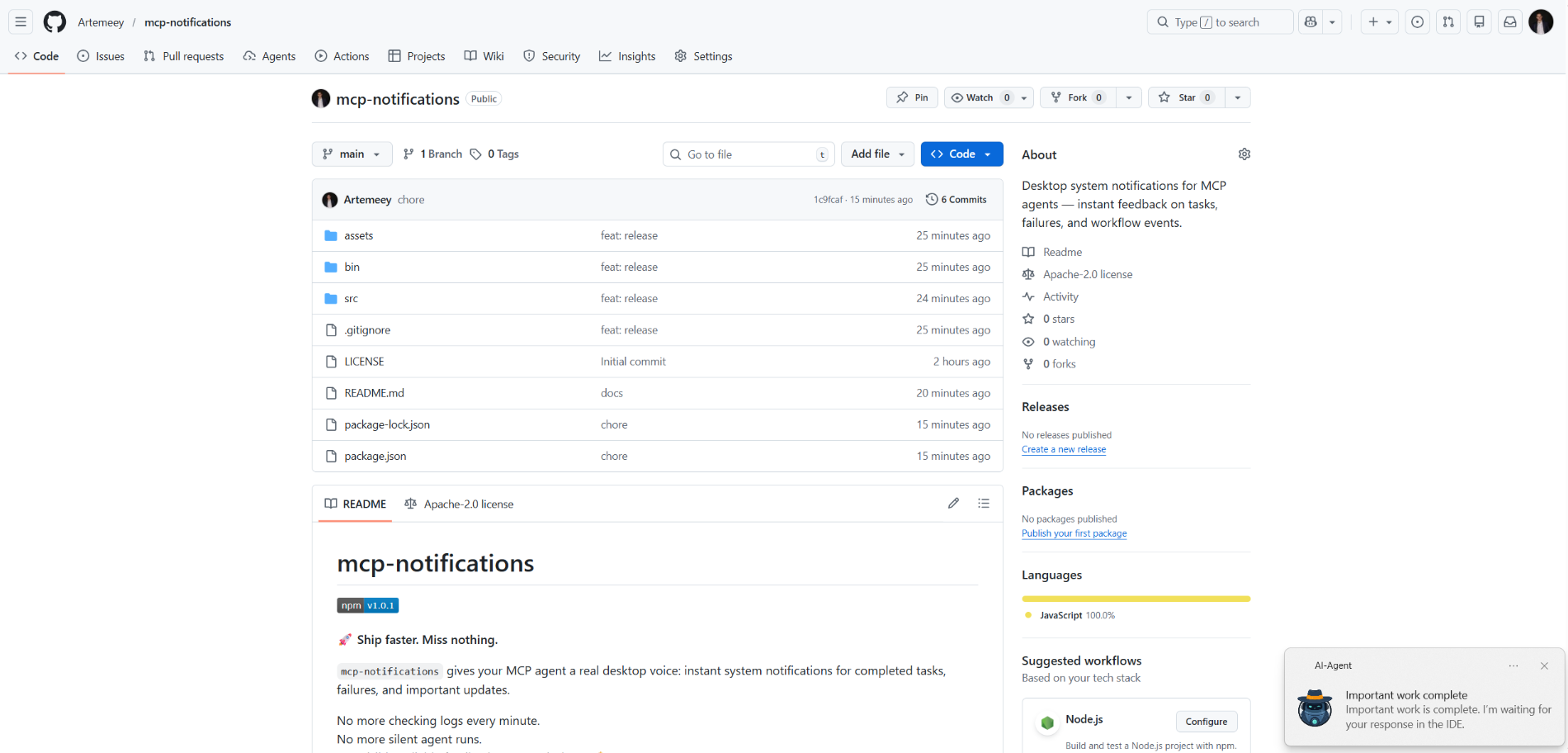
mcp-notifications lets your MCP agent send desktop notifications for completed tasks, failures, and important updates.
This is especially useful for console AI agents, because they usually have no built-in notifications by default.
No more checking chats every minute.
No more silent agent responses.
Just visible, reliable feedback on your desktop. 🔔
Common problem this solves
You give tasks to several AI agents, then wait and keep checking who already replied.
With mcp-notifications, this gets simpler: the agent can notify you on desktop when it needs your input or when work
is done.
Why teams install this
- ⚡ Immediate feedback from your MCP workflows.
- 🧠 Better focus: let the agent work while you stay on your main task.
- 🖥️ Native OS notifications via
node-notifier. - 🧵 Non-blocking behavior: notification sending is queued in background.
Install globally
Requirements:
- Node.js
>=20 - npm
>=10
npm i -g @topvisor/mcp-notifications
Executable name (use this in MCP config):
mcp-notifications
mcp-notifications is an MCP server entrypoint (stdio), not a one-shot notification command.
Setup: Codex
Add this to ~/.codex/config.toml:
[mcp_servers.notifications]
enabled = true
command = "mcp-notifications"
args = []
Restart Codex after config update.
Setup: Claude Agent
Add MCP server config to your Claude client config file:
{
  "mcpServers": {
    "notifications": {
      "command": "mcp-notifications",
      "args": []
    }
  }
}
Then restart Claude client.
AI Agent Notification Instructions
There are two approaches to notifications: manual and automatic.
Choose the one that works better for your workflow.
Manual
In a task where you want to be notified, explicitly ask the agent. Example:
Count files in the project; after the task is fully complete, notify me with sound.
You can also define sound, topic, and frequency rules inside a specific chat. Example:
Notify me about your replies without sound, include the reply text, and use title: "Large Refactoring"
Automatic
Automatic notifications can be configured globally or per project.
Example instruction to enable automatic notifications for agent replies:
Send `send_notification` after your replies (actual task time >5 seconds or many steps); `play_sound: false`; `app_id: '{put your chat name here}'`
Time is a rough threshold and depends on model behavior, so adjust this instruction to your own preferences.
In Skills
You can also enable notifications in specific skills. Example for a Review skill:
After the review, run `send_notification` with a short summary; `play_sound: true`; `app_id: 'Reviewer {put task id here}'`
Tool
send_notification
Input:
titlestring(required)messagestring(required)play_soundboolean(optional, default:false)iconstring(optional, absolute or relative path to image file)app_idstring(optional, Windows App User Model ID for toast source)
Example:
{
  "title": "Codex",
  "message": "Deployment completed successfully",
  "play_sound": true,
  "icon": "/opt/mcp-notifications/icons/custom.png",
  "app_id": "Topvisor.Codex"
}
app_id (Windows)
app_idcontrols the source shown in Windows toast notifications.- If
app_idis not set, Windows may showSnoreToastas the source. - You can pass
app_idin each tool call, or setMCP_NOTIFICATIONS_APP_IDas an environment variable for the server.
Backend selection
You can select notification transport via env MCP_NOTIFICATIONS_BACKEND:
auto(default): usespowershellin WSL if available, otherwisenode-notifierpowershell: forcepowershell.exeWindows toast transport (recommended for WSL)node-notifier: forcenode-notifierpackage
Chat Prompts To Test In Codex
Use these messages directly in chat:
Check send_notification
Send a notification without sound: title "Test", message "Check"
Send a notification with sound: title "Test", message "Check"
Send a notification with app_id "Topvisor.Codex": title "Test", message "Check"
Send 3 test notifications in a row without sound
Expected tool result in logs/response:
Notification queued
Behavior
- ✅ Uses standard system notification channels.
- 🔊 Uses the standard system notification sound when
play_sound: true. - 🤖 Uses bundled Topvisor robot image as default notification icon.
- 🧰 Returns quickly while notifications are delivered in background queue.
Example
The AI agent is waiting for you:
Reviews
No reviews yet
Be the first to review this server!
More Developer Tools MCP Servers
Fetch
Freeby Modelcontextprotocol · Developer Tools
Web content fetching and conversion for efficient LLM usage
Git
Freeby Modelcontextprotocol · Developer Tools
Read, search, and manipulate Git repositories programmatically
Toleno
Freeby Toleno · Developer Tools
Toleno Network MCP Server — Manage your Toleno mining account with Claude AI using natural language.
MCP Marketplace
Freeby mcp-marketplace · Developer Tools
Search and install MCP servers from inside your AI client.
mcp-creator-python
Freeby mcp-marketplace · Developer Tools
Create, build, and publish Python MCP servers to PyPI — conversationally.
FinAgent
Freeby mcp-marketplace · Finance
Free stock data and market news for any MCP-compatible AI assistant.