
Server data from the Official MCP Registry
The body an agent asks before it acts: decide, approve, and keep a signed record on your machine.
About
The body an agent asks before it acts: decide, approve, and keep a signed record on your machine.
Security Report
Valid MCP server (1 strong, 1 medium validity signals). No known CVEs in dependencies. ⚠️ Package registry links to a different repository than scanned source. Imported from the Official MCP Registry. 1 finding(s) downgraded by scanner intelligence.
9 files analyzed · 1 issue found
Security scores are indicators to help you make informed decisions, not guarantees. Always review permissions before connecting any MCP server.
Permissions Required
This plugin requests these system permissions. Most are normal for its category.
What You'll Need
Set these up before or after installing:
Environment variable: VERAX_ISSUER
Environment variable: VERAX_JWKS_URL
Environment variable: VERAX_AUDIENCE
Environment variable: VERAX_STATE_DIR
Environment variable: VERAX_POLICY_FILE
Environment variable: VERAX_BIND
Environment variable: VERAX_INVENTORY_FILE
How to Install
Add this to your MCP configuration file:
{
  "mcpServers": {
    "io-github-verax-ai-verax": {
      "env": {
        "VERAX_BIND": "your-verax-bind-here",
        "VERAX_ISSUER": "your-verax-issuer-here",
        "VERAX_AUDIENCE": "your-verax-audience-here",
        "VERAX_JWKS_URL": "your-verax-jwks-url-here",
        "VERAX_STATE_DIR": "your-verax-state-dir-here",
        "VERAX_POLICY_FILE": "your-verax-policy-file-here",
        "VERAX_INVENTORY_FILE": "your-verax-inventory-file-here"
      },
      "args": [
        "-y",
        "@verax-ai/body"
      ],
      "command": "npx"
    }
  }
}Documentation
View on GitHubFrom the project's GitHub README.
Verax
The body an agent asks before it acts.
Verax is an MCP server that sits between an agent and its tools. Every tool call passes a policy gate and leaves a signed decision record before anything runs; every call that ran leaves an effect row that is reconciled against its record afterwards. A refusal is recorded the same way as an approval. A call the policy will not decide alone is held until an operator on this machine approves it. The ledger stays on the machine the body runs on, and the body opens only when its authorization is configured: there is no default token.
By VERAX Teknoloji. Sister projects: Conarium · Tugra · Cedulon. Decision records use the Cedulon record format.
See it run
npx @verax-ai/body demo
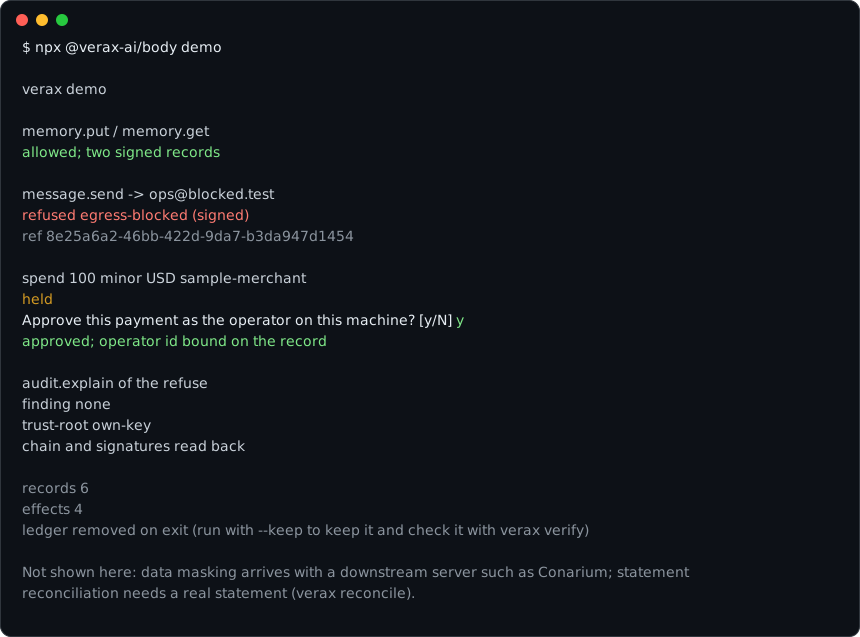
The recording is the output of one run in a terminal where the approval
question was answered y. That run took about a second; it is played back
slowly here so it can be read.
What it prints, without a terminal to answer the approval question:
verax demo

memory.put / memory.get
  allowed; two signed records

message.send -> ops@blocked.test
  refused egress-blocked (signed)
  ref 6c6e4925-b769-4a8b-8fc4-e2443613a5b6

spend 100 minor USD sample-merchant
  held
  no terminal to ask, so it stays held (run this in a terminal to be asked)

audit.explain of the refuse
  finding none
  trust-root own-key
  chain and signatures read back

records  5
effects  3
ledger   removed on exit (run with --keep to keep it and check it with verax verify)

Not shown here: data masking arrives with a downstream server such as Conarium; statement reconciliation needs a real statement (verax reconcile).
Node 22.6 or newer, @verax-ai/body 0.2.1 or later. The command records an
allowed memory write and read, a
signed refuse of a message to a host off the policy list, and a payment held
for the operator on this machine (approved when the terminal answers y).
--keep leaves the temporary ledger on disk. verax verify <dir> reads it
back without a body, as in Read the ledger back without us.
With Conarium
@verax-ai/body 0.2.2 and later accepts --with-conarium. 0.2.1 does not
carry the flag. The flag has npx download @conarium-ai/core from npm and
run it as a child process; that needs a network.
Conarium masks the rows, and its sample policy denies its public.secrets
table. Verax puts each call through the same gate as its own tools, keeps a
signed record and a hash of the answer, and refuses a downstream tool the
policy does not name before the child sees the call. When Conarium answers
with an error, the body tells the caller that it did, not what it said.
What it prints, without a terminal to answer the approval question:
verax demo

memory.put / memory.get
  allowed; two signed records

message.send -> ops@blocked.test
  refused egress-blocked (signed)
  ref 6c6e4925-b769-4a8b-8fc4-e2443613a5b6

spend 100 minor USD sample-merchant
  held
  no terminal to ask, so it stays held (run this in a terminal to be asked)

conarium.query customers
  allowed; masked by Conarium before the rows left it
  measured [MASKED_PII] on every email and card

conarium.query public.secrets
  allowed by this gate; Conarium answered with an error and no rows
  recorded as a failed call

conarium.list_tables
  refused no-rule (signed)
  refused by this gate; the downstream server never saw the call

audit.explain of the refuse
  finding none
  trust-root own-key
  chain and signatures read back

records  8
effects  5
ledger   removed on exit (run with --keep to keep it and check it with verax verify)

Not shown here: a real database (these are Conarium's sample rows); statement reconciliation needs a real statement (verax reconcile).
What ships
| Package | What it is |
|---|---|
@verax-ai/body | The MCP server and the verax command: serve, doctor, approve, operator, reconcile, witness, halt, unlock, desktop. |
@verax-ai/proxy | The decision proxy the body is built on: policy, signed records, ledger, explain, reconcile. |
@verax-ai/inventory | The roster document a body serves and the panel lists, with its strict parser. |
The three packages are published together and carry the same version; the
capability matrix in docs/STATUS.md names the current one,
and it is the version on npm. The body is also listed in the MCP registry as
io.github.verax-ai/verax. What that version carries, what it does not,
and the test holding each row up are in the capability matrix at the top
of docs/STATUS.md.
Read the ledger back without us
A ledger only the vendor's running service can read is evidence a buyer
rents, not evidence they hold. verax verify reads a state directory on
its own — no body listening, nothing on the network — and states four
things separately, because they fail separately:
$ verax verify ./verax-state
ledger        ./verax-state
decisions     6
effects       4 (4 bound to a decision, 0 with none)
signatures    6 verify, 0 do not
chain         unbroken
verified with the key carried in these files
              verified against the key carried in the records themselves: this
              shows the files are internally consistent, not that the key was
              ever trusted. Pin a key you hold to check that.

VERIFIED
That last pair of lines is the point. Checking a ledger against the key
lying next to it proves the files agree with each other and nothing more —
anything able to write the ledger could write that key too. Pass
--key <public.pem> to verify against a copy you hold, and the answer says
a key you supplied instead. --json prints the same result for a
pipeline; the exit code is 0 when it verifies and 1 when it does not, and a
directory with no ledger in it is never quiet success.
Install
npm install -g @verax-ai/body
verax --help
verax doctor
Node 22.6 or newer. The body speaks MCP over Streamable HTTP at /mcp on
VERAX_BIND (default 127.0.0.1:8787) and needs an issuer, a JWKS URL, an
audience, a state directory and a policy file before it listens; verax doctor names what is missing. The variables and the run steps are in
packages/body/README.md.
Tools
The policy decides which of these a token's scopes may call;
packages/proxy/policy/default.json denies what it does not name.
| Tool | Description |
|---|---|
memory.get | Reads one memory item behind the gate, stored per tenant. |
memory.put | Writes one memory item behind the gate, stored per tenant. |
audit.explain | Reads a decision back from the signed ledger, with its chain, its signatures and its findings. |
message.read | Reads the inbox. |
message.send | Writes to the outbox; reaches only hosts the policy allow-lists. |
spend | Authorizes a payment and records it, under a cap, a payee list and a daily limit from the policy; held for an operator when the policy says so. The body does not move money. |
What the body does beyond the gate
Each line below is a row in the capability matrix in
docs/STATUS.md, where it is stated against a version,
with what it does not do and the test that fails when it stops being
true.
- Approval: a held call is approved with
verax approveon this machine, or from the panel after a passkey sign-in (verax operator); the approver's operator id is bound into the signed record by hash. - Witness:
verax witnesssigns effect rows from a second process and writes durable checkpoints; without it the witness class staysself. - Halt and revoke:
verax haltturns every further call into a signed deny; a revoked token id is refused before any record is written. - Reconcile:
verax reconcilematches recorded spends against a card statement export and names the matched, ghost and authorized-but-unpaid rows. - Tenant key: memory and inbox are stored under a key derived from the token's issuer and subject; another tenant's id is answered with a signed deny.
- Bounds: rate and daily counters, a disk-low refusal (HTTP 507) when a deny could not be recorded, and an egress allow-list; counters that cannot be read fail closed.
- Doctor and heartbeat:
verax doctornames what is missing or stale before the first call finds out.
Connect a client
The body listens on http://127.0.0.1:8787/mcp by default. A client
configuration looks like this; the token comes from your issuer.
{
  "mcpServers": {
    "verax": {
      "url": "http://127.0.0.1:8787/mcp",
      "headers": { "Authorization": "Bearer <token from your issuer>" }
    }
  }
}
Status
What the tree carries and what stays unproven is stated, item by item, in
docs/STATUS.md. Nothing in this repository is a claim
beyond that file, and a paragraph there is not a release. The threat model is
in docs/THREAT_MODEL.md; how to report a
vulnerability is in SECURITY.md.
What else is in the tree
apps/panelis the account-for screen: the records list, the black box and the status view, read from the signed ledger. Private; it is not published. The panel session uses the code flow; the access token stays in memory and is dropped on refresh. Vite may still attachVERAX_DEV_TOKENfrom.env.localto/apiwhen the request has no Authorization header (desktop MCP brains and tests).scripts/dev-issuer.mjsis development only; not a production authorization server. It servesGET /authorize(PKCE S256) andPOST /token, writes a token to--out, and never prints one. It listens onVERAX_DEV_ISSUER_PORT(default 8790).NODE_ENV=productionexits.scripts/demo-box.mjsis development only: one process that starts the dev issuer and the body on loopback with a temporary ledger, mints itself a short-lived token through the issuer's code flow, and speaks MCP over stdio for a sandbox that cannot hold a token of its own, such as a directory's build check. The body is not changed by it: every call still passes the gate and is recorded,spendis always held, and no operator is there to approve it.NODE_ENV=productionexits. Not a deployment.
Developing
npm ci
npm test            # guards, typecheck, build, unit and cost suites, panel
npm run pack:smoke  # pack the three packages and install them elsewhere
CI runs the suite as a non-root user on Linux and again on Windows, plus the
proxy performance check. Releases go out from the Actions tab:
release.yml publishes the three packages with npm trusted publishing and a
provenance attestation, then mcp-registry.yml updates the registry record
once npm answers for the new version. Neither runs on push.
License
Apache-2.0.
Reviews
No reviews yet
Be the first to review this server!
More Developer Tools MCP Servers
Git
Freeby Modelcontextprotocol · Developer Tools
Read, search, and manipulate Git repositories programmatically
Fetch
Freeby Modelcontextprotocol · Developer Tools
Web content fetching and conversion for efficient LLM usage
Paperclip
Freeby Paperclipai · Developer Tools
Trending hip-hop artist momentum scores across four cultural dimensions.
Toleno
Freeby Toleno · Developer Tools
Toleno Network MCP Server — Manage your Toleno mining account with Claude AI using natural language.
mcp-creator-python
Freeby mcp-marketplace · Developer Tools
Create, build, and publish Python MCP servers to PyPI — conversationally.
MCP Marketplace
Freeby mcp-marketplace · Developer Tools
Search and install MCP servers from inside your AI client.