
Server data from the Official MCP Registry
Budgets, payee allowlists, price-spike checks and human approval for agents paying x402 paywalls
About
Budgets, payee allowlists, price-spike checks and human approval for agents paying x402 paywalls
Security Report
Valid MCP server (1 strong, 1 medium validity signals). No known CVEs in dependencies. Package registry verified. Imported from the Official MCP Registry.
6 files analyzed · 1 issue found
Security scores are indicators to help you make informed decisions, not guarantees. Always review permissions before connecting any MCP server.
Permissions Required
This plugin requests these system permissions. Most are normal for its category.
What You'll Need
Set these up before or after installing:
Environment variable: SPEND_GUARD_POLICY
Environment variable: SPEND_GUARD_RAILS
Environment variable: SPEND_GUARD_LEDGER
Environment variable: SPEND_GUARD_DASHBOARD_PORT
Environment variable: SPEND_GUARD_APPROVAL_TIMEOUT
Environment variable: SPEND_GUARD_MOCK_NETWORK
Environment variable: ARC_PRIVATE_KEY
Environment variable: NEAR_ACCOUNT_ID
Environment variable: NEAR_PRIVATE_KEY
How to Install
Add this to your MCP configuration file:
{
  "mcpServers": {
    "io-github-vulinh1704-spend-guard": {
      "env": {
        "ARC_PRIVATE_KEY": "your-arc-private-key-here",
        "NEAR_ACCOUNT_ID": "your-near-account-id-here",
        "NEAR_PRIVATE_KEY": "your-near-private-key-here",
        "SPEND_GUARD_RAILS": "your-spend-guard-rails-here",
        "SPEND_GUARD_LEDGER": "your-spend-guard-ledger-here",
        "SPEND_GUARD_POLICY": "your-spend-guard-policy-here",
        "SPEND_GUARD_MOCK_NETWORK": "your-spend-guard-mock-network-here",
        "SPEND_GUARD_DASHBOARD_PORT": "your-spend-guard-dashboard-port-here",
        "SPEND_GUARD_APPROVAL_TIMEOUT": "your-spend-guard-approval-timeout-here"
      },
      "args": [
        "-y",
        "@vulinh1704/spend-guard"
      ],
      "command": "npx"
    }
  }
}Documentation
View on GitHubFrom the project's GitHub README.
Spend Guard
A spending guard for AI agents that pay for APIs in USDC.
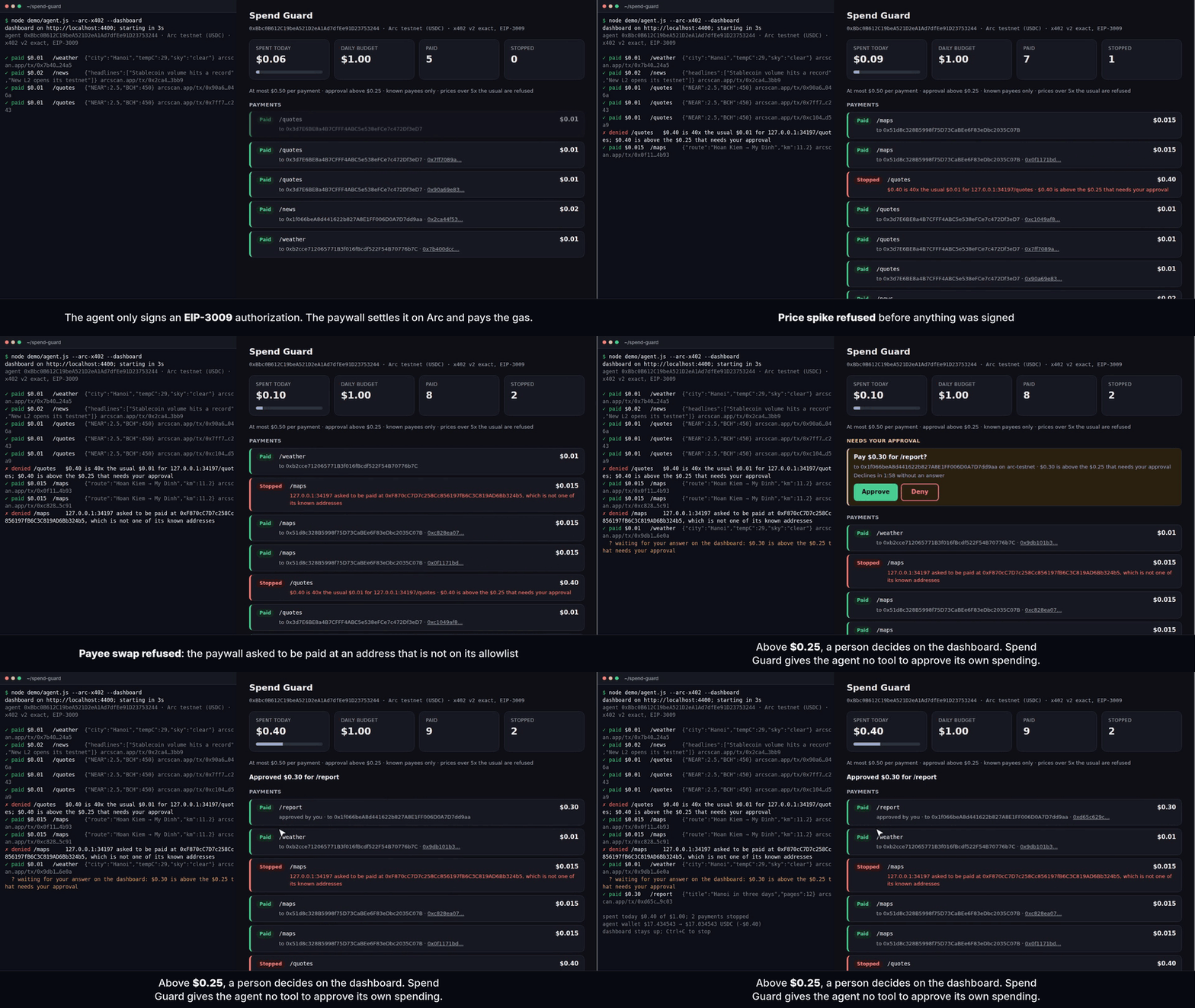
A real run on Arc testnet with x402 exact (node demo/agent.js --arc-x402 --dashboard), trimmed and sped up: the guard refuses a 40x price spike and a swapped payout address before anything is signed, and a $0.30 payment goes out only after a person clicks Approve on the dashboard.
Agents are starting to pay per call over HTTP 402: the server answers 402 Payment Required with a price, the agent pays and gets the data (the x402 protocol). An agent that can pay can also be talked into paying: a prompt injection, a retry loop, or a paywall that raises its price or swaps its payout address. Spend Guard sits between the agent and its money. Every payment is checked against budgets, a payee allowlist and the endpoint's usual price, and anything unusual waits for a person to approve it. All of this happens before any USDC leaves and before any authorization is signed. It pays on Circle's Arc testnet by plain USDC transfer, by x402 exact (EIP-3009) and by Circle Gateway nanopayments, from a local key, and in NEAR on NEAR testnet. A rail for Circle developer-controlled wallets is tested offline only. Claude and other MCP clients can use it as an MCP server.
Status: testnet only, not audited. On npm as @vulinh1704/spend-guard and in the official MCP Registry as io.github.vulinh1704/spend-guard. MIT licensed.
Quickstart (1 minute, no keys)
You need git and Node 22.22.2 or later. No keys and no wallet: the payments are mocked, and nothing leaves your machine after the install.
git clone https://github.com/vulinh1704/spend-guard
cd spend-guard
npm ci
node demo/agent.js                       # a scripted agent against a demo paywall that turns bad
node demo/agent.js --dashboard           # the same run, paced, with the live page on http://localhost:4400
With --dashboard, open http://localhost:4400 while it runs. The $0.30 /report waits there for Approve or Deny, and is declined after 120 seconds without an answer. The page stays up until you press Ctrl+C. If 4400 is taken, the demo takes a free port and prints it; DASHBOARD_PORT picks another.
What it stops
The demo paywall behaves for a few calls and then turns bad. /quotes raises its price 40x, and /maps asks to be paid at a look-alike address. /report stays honest but costs more than the agent may pay without asking. This is the offline demo, node demo/agent.js:
✓ paid $0.01   /weather  {"city":"Hanoi","tempC":29,"sky":"clear"}
✓ paid $0.02   /news     {"headlines":["Stablecoin volume hits a record","New L2 opens its testnet"]}
✓ paid $0.01   /quotes   {"NEAR":2.5,"BCH":450}
✓ paid $0.01   /quotes   {"NEAR":2.5,"BCH":450}
✓ paid $0.01   /quotes   {"NEAR":2.5,"BCH":450}
✗ denied /quotes   $0.40 is 40x the usual $0.01 for 127.0.0.1:33955/quotes; $0.40 is above the $0.25 that needs your approval
✓ paid $0.015  /maps     {"route":"Hoan Kiem → My Dinh","km":11.2}
✓ paid $0.015  /maps     {"route":"Hoan Kiem → My Dinh","km":11.2}
✗ denied /maps     127.0.0.1:33955 asked to be paid at rnaps.paywall.testnet, which is not one of its known addresses
✓ paid $0.01   /weather  {"city":"Hanoi","tempC":29,"sky":"clear"}
  ? asks you: $0.30 is above the $0.25 that needs your approval → no
✗ declined /report   $0.30 is above the $0.25 that needs your approval

spent today $0.10 of $1.00; 3 payments stopped
The same run on Arc testnet with x402 exact (node demo/agent.js --arc-x402, 31 Oct 2026) paid in real test USDC. The agent only signed. The paywall settled each signature on chain and paid the gas, so the agent's balance fell by exactly the $0.10 it spent:
agent 0xBbc0B612C19beA521D2eA1Ad7dfEe91D23753244 · Arc testnet (USDC) · x402 v2 exact, EIP-3009
✓ paid $0.01   /weather  … https://testnet.arcscan.app/tx/0x92414aea1d896cd7ebd032c85ca32a84764d743931e61f4474a92f434a61fae3
✗ denied /maps     … asked to be paid at 0xF870cC7D7c258Cc856197fB6C3C819AD6Bb324b5, which is not one of its known addresses
agent wallet $17.999436 → $17.899436 USDC (-$0.10)
| Rule | What it catches |
|---|---|
| A per-payment limit, a daily budget and a per-call cap for each service | overpriced calls; a loop's total stops at the daily budget |
| Payee allowlist per service | a paywall that starts asking to be paid somewhere else |
| Price spike against the endpoint's usual price | a sudden 5x, 40x, 1000x |
| Human approval above a threshold, or for an unknown service | large payments, a payment to a host the policy doesn't list, such as one an injected page pointed the agent to |
| One decision at a time (with a ledger file, across processes too) | parallel tool calls racing the daily budget |
Every decision, paid or not, is recorded with its reasons. The rules and their exact messages are in docs/policy.md.
How it works
agent ── payingFetch(url) ──► paywall: 402 + offer (PAYMENT-REQUIRED)
              │
              ▼
            Guard ── policy: budgets, payees, usual price ── ledger
              │  └─ flagged? ask the person on the dashboard
              ▼
            Rail ── USDC transfer · EIP-3009 signature · Gateway authorization · Circle wallet
              │
payingFetch ──► paywall: PAYMENT-SIGNATURE ──► 200 + data + PAYMENT-RESPONSE (settlement)
The guard decides before a rail moves money or signs anything. A rail that signs uses the payee and amount the guard approved, never the paywall's own numbers, and it pins the chain and token it signs for. More in docs/architecture.md.
Rails
| Rail | How the agent pays | Status |
|---|---|---|
Arc USDC transfer (--arc) | ERC-20 transfer from the agent's key. The paywall checks the receipt's USDC Transfer event. | Works on Arc testnet, for example this payment. |
x402 exact on Arc (--arc-x402) | Signs an EIP-3009 transferWithAuthorization for USDC. The paywall verifies and settles it, and pays the gas. | Works on Arc testnet. The demo paywall is its own settler. |
Circle Gateway (--gateway) | Signs a Gateway authorization against USDC deposited once in Circle's Gateway Wallet. Circle settles the payments in batches. | Works on Arc testnet, with no Circle account or API key. One earlier run's payments landed in one batch transaction. |
| Circle Wallets | A Circle developer-controlled wallet transfers or signs, so no private key sits in the agent's process. | Tested offline against Circle's SDK. Not run against Circle yet, because it needs your Circle account (setup). |
NEAR testnet (--near) | Native NEAR transfer. | Works on NEAR testnet. |
| Mock | Nothing moves. | Tests and the offline demo. |
| Bitcoin Cash, Concordium | Planned. |
Details for each rail are in docs/rails.md.
x402 v2 and the exact scheme (EIP-3009)
payingFetch speaks x402 v2. It reads the offer from the PAYMENT-REQUIRED header, and still reads v1 JSON bodies. For an exact offer in USDC on Arc that names the token's EIP-712 domain, the agent signs a transferWithAuthorization and sends no transaction. The signature is the payment, so the guard decides first and counts it as spent when it is signed. Each signature is for the approved payee and amount only, has a fresh random nonce, and is valid for at most 120 seconds. Offers for another chain (the same key works on Arc mainnet), another token, or Permit2 and escrow flows are refused before anything is signed, with the reason.
node scripts/arc-testnet-wallet.js       # agent key and demo payees in .env; fund the agent at https://faucet.circle.com (Arc Testnet)
node scripts/arc-facilitator.js          # the demo paywall's settling key, topped up with a little test USDC for gas
node demo/agent.js --arc-x402 --dashboard
Circle Gateway nanopayments
The agent deposits USDC into Circle's Gateway Wallet once. After that each call is an off-chain authorization: no gas and no transaction per call, so a $0.01 call costs $0.01. Circle settles the payments on Arc in batches a few minutes later. A Gateway authorization stays valid for at least 7 days, so the guard decides before it is signed. The rail also signs nothing the deposit can't cover, counting what is signed but not settled yet.
node scripts/gateway-deposit.js 1        # approve and deposit 1 test USDC (two Arc transactions)
node demo/agent.js --gateway --dashboard # nanopayments to an x402 v2 seller that settles each one with Circle
node scripts/gateway-status.js           # Gateway balance, and each payment's batch transaction on Arc
Circle Wallets
With CircleWalletRail, Circle holds the key (MPC) and signs when asked. The agent's process has a testnet API key and an entity secret, but no private key, and Spend Guard still checks every payment before Circle is asked to send or sign. Circle's own controls (custody, screening, DENIED) still apply after the guard says yes. docs/circle-wallets.md explains the setup, which needs your own Circle developer account, and how the two layers fit together.
Use it from Claude or any MCP client
spend-guard mcp serves the guard over stdio and gives an MCP client three tools:
pay_and_fetchfetches a URL and pays its x402 paywall through the guard.spending_statusandspending_policyare read-only views of the budget, recent payments and the rules.
There is no tool to approve a payment or to change the policy. Payments the policy flags wait for you on the dashboard. They are declined after 55 seconds without an answer, and a call the client cancels never pays.
The config goes in .mcp.json (Claude Code, project scope) or claude_desktop_config.json (Claude Desktop). Cursor and other clients take the same mcpServers shape.
From npm. The default mock rail pays nothing, so this is a safe first try:
{
  "mcpServers": {
    "spend-guard": {
      "command": "npx",
      "args": ["-y", "@vulinh1704/spend-guard", "mcp"],
      "env": { "SPEND_GUARD_POLICY": "/abs/path/policy.json" }
    }
  }
}
The mock rail pretends to pay on near-testnet, so this policy must allow that network: list "networks": ["near-testnet"], or leave networks out and the server allows the networks of the rails it runs. A policy that lists only Arc networks leaves the mock rail nothing it may pay. To have something to pay, run the demo paywall from a clone, node demo/paid-api.js, and ask the agent to fetch http://localhost:4402/weather. demo/mcp-policy.json is a mock policy that knows its payees.
From a clone, and for the rails that pay. Node reads the keys from .env with --env-file, which npx can't pass on, so they stay out of the client's config:
{
  "mcpServers": {
    "spend-guard": {
      "command": "node",
      "args": ["--env-file=/abs/path/spend-guard/.env", "/abs/path/spend-guard/bin/spend-guard.js", "mcp"],
      "env": { "SPEND_GUARD_POLICY": "/abs/path/policy.json", "SPEND_GUARD_RAILS": "arc,gateway" }
    }
  }
}
Or in Claude Code: claude mcp add spend-guard -- npx -y @vulinh1704/spend-guard mcp, or from a clone claude mcp add spend-guard --env SPEND_GUARD_POLICY=/abs/path/policy.json --env SPEND_GUARD_RAILS=arc -- node --env-file=/abs/path/spend-guard/.env /abs/path/spend-guard/bin/spend-guard.js mcp
A policy.json for the arc,gateway config. Its networks are the ones those two rails pay on; with other rails, list theirs or leave networks out:
{ "networks": ["arc-testnet", "arc-testnet-gateway"], "dailyUsd": 1, "perPaymentUsd": 0.5, "askAboveUsd": 0.25, "spikeRatio": 5, "unknownService": "ask",
  "services": { "api.example.com": { "payTo": ["0xPayeeAddress"], "maxUsd": 0.1 } } }
| Variable | Meaning |
|---|---|
SPEND_GUARD_RAILS | mock (default, pays nothing), near, arc, gateway, or a comma list |
SPEND_GUARD_POLICY | the policy file. Without one, every service is unknown, so every payment asks you. Without networks in it, the networks of the rails you run are allowed. |
SPEND_GUARD_LEDGER | decisions file, read back on start, so a restart keeps today's spend. Servers on one file share one budget. Default ~/.spend-guard/ledger.jsonl; off keeps it in memory. |
SPEND_GUARD_DASHBOARD_PORT | dashboard port on 127.0.0.1, default 4400; 0 picks a free one. If it is taken, a free one is used and named on stderr. off means no dashboard, and flagged payments are declined. |
SPEND_GUARD_APPROVAL_TIMEOUT | seconds a payment waits for you (default 55). Raise it together with your client's tool timeout. |
SPEND_GUARD_MOCK_NETWORK | the network the mock rail pretends to pay on (default near-testnet, which the demo paywall asks for) |
ARC_PRIVATE_KEY | for arc and gateway. Testnet keys only. |
NEAR_ACCOUNT_ID, NEAR_PRIVATE_KEY | for near. Testnet keys only. |
Keys come from .env through --env-file and never go in the client's config. Run the paying agent without shell or browser tools: with them it could read .env, or press Approve itself.
Try it without a model: node scripts/mcp-demo.js (mock), or node scripts/mcp-demo.js --arc (real test USDC on Arc).
Approve on the dashboard
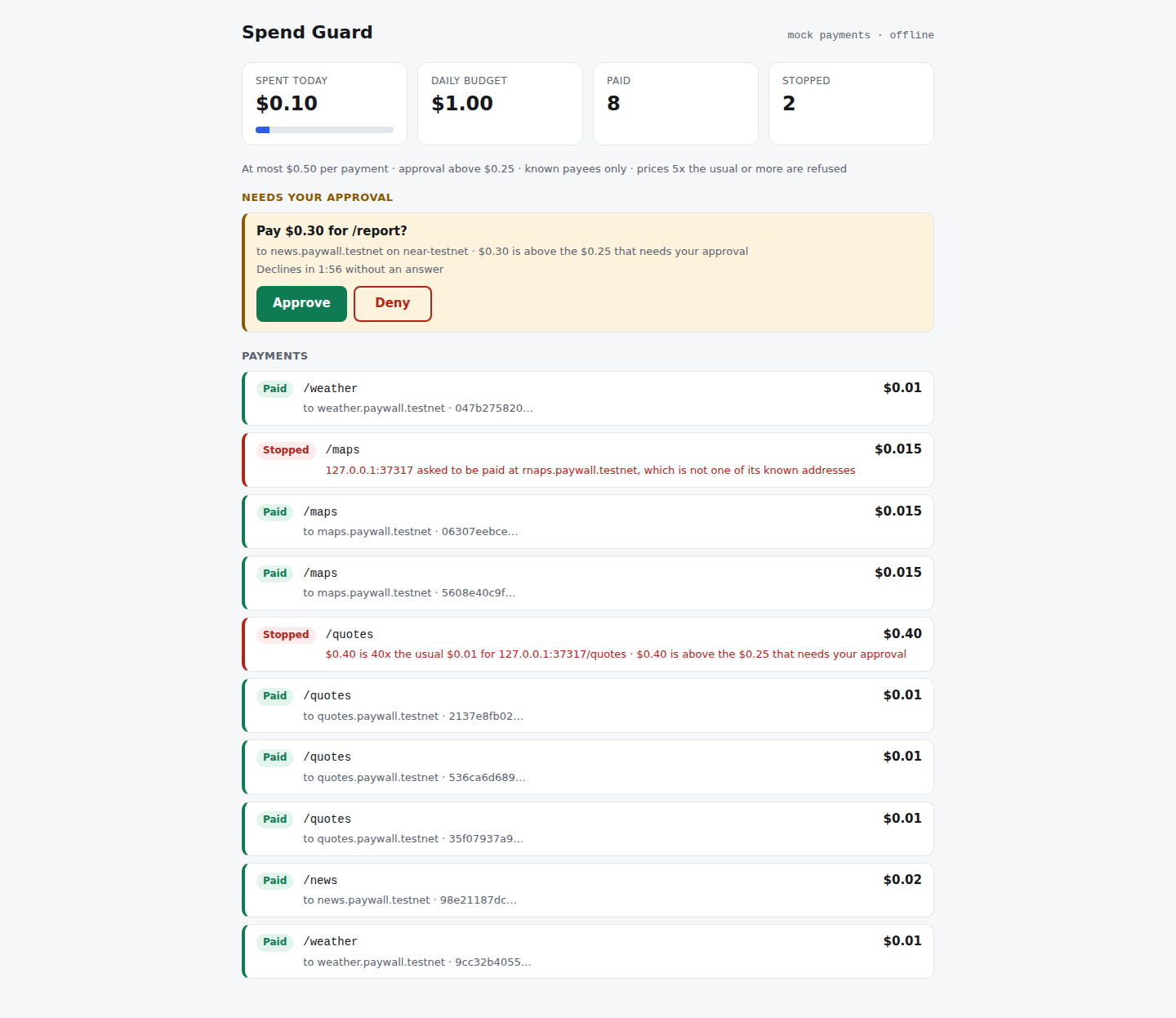
The dashboard is a live page on http://localhost:4400. It shows the budget, every decision with its reasons and a link to its transaction, and an Approve or Deny card with a countdown for each flagged payment. It listens on 127.0.0.1 only and answers to localhost names only, and an approval is accepted only from the page itself (same Origin, loopback peer, JSON body). It has light and dark themes and a responsive layout (it answers on localhost only, so approving from a phone is on the roadmap), and is checked with Mantis (scripts/check-dashboard.sh: 0 errors and 0 warnings on mobile and desktop, light and dark).
node demo/agent.js --dashboard # the offline demo, paced for watching; /report waits for your answer
Install and test
npm ci
npm test                                 # 189 tests, offline: no network, no keys
node demo/agent.js                       # offline demo, mock payments
You need Node 22.22.2 or later, because near-api-js 7 does (Circle's SDK needs Node 22). The testnet demos read keys from .env, which is git-ignored, and the setup scripts write them there. Testnet tokens have no value. Never point the scripts at mainnet.
| Demo | Needs |
|---|---|
node demo/agent.js --arc | node scripts/arc-testnet-wallet.js, then test USDC from https://faucet.circle.com |
node demo/agent.js --arc-x402 | the above, plus node scripts/arc-facilitator.js |
node demo/agent.js --gateway | the above, plus node scripts/gateway-deposit.js 1 |
node demo/agent.js --near | node scripts/near-testnet-account.js and node scripts/near-demo-payees.js |
Add --dashboard to any of them to watch on the live page.
Use it as a library
import { Guard, payingFetch } from '@vulinh1704/spend-guard';
import { ArcRail } from '@vulinh1704/spend-guard/rails/arc';
import { GatewayRail } from '@vulinh1704/spend-guard/rails/gateway';

const guard = new Guard({
  policy: {
    networks: ['arc-testnet', 'arc-testnet-gateway'],
    dailyUsd: 5, perPaymentUsd: 1, askAboveUsd: 0.25, spikeRatio: 5, unknownService: 'ask',
    services: { 'api.example.com': { payTo: ['0xPayeeAddress'], maxUsd: 0.5 } },
  },
  rails: [new ArcRail({ privateKey: process.env.ARC_PRIVATE_KEY }), new GatewayRail({ privateKey: process.env.ARC_PRIVATE_KEY })],
  approve: async (intent, verdict) => askTheHuman(verdict.reasons), // never the model
});

const res = await payingFetch(guard, 'https://api.example.com/data'); // pays a 402 through the guard
payingFetch throws GuardRefused with the reasons when the guard says no. Approvals is the queue the dashboard and the MCP server use for approve. Install it with npm install @vulinh1704/spend-guard (Node 22.22.2 or later).
Docs
- Architecture: one paid request, step by step.
- Policy reference: every field, rule and message.
- Rails: each rail, what the paywall checks, and how to write one.
- Circle Wallets: setup, and Circle's controls next to the guard's.
- Threat model: what it stops, what it can't, and the known gaps.
- Publishing: releasing to npm and the MCP Registry.
- CHANGELOG, CONTRIBUTING, SECURITY.
Roadmap
Not built yet. This is the order I plan to build them in:
- Circle Wallets live. Run the rail against Circle's testnet with a developer account, then offer it in the MCP server, so an agent pays from a wallet whose key never leaves Circle.
- Settle through Circle instead of my own settler. Use Circle's facilitator for x402
exacton Arc where it is available, and Gateway on more chains from the same deposit. - Close the known gaps. Count gas in the budgets, keep Gateway's unsettled count across restarts, and accept smart-wallet payers (ERC-1271), such as Circle SCA wallets, whose gas Circle's Gas Station can sponsor.
- A hosted policy and approvals page for teams.
- Mainnet, only after an external review of the guard and the rails.
License
MIT
Reviews
No reviews yet
Be the first to review this server!
More Developer Tools MCP Servers
Rea
Freeby Morluto · Developer Tools
Reverse engineer anything from your terminal or agent with one CLI and MCP server.
Paperclip
Freeby Paperclipai · Developer Tools
Trending hip-hop artist momentum scores across four cultural dimensions.
Fetch
Freeby Modelcontextprotocol · Developer Tools
Web content fetching and conversion for efficient LLM usage
Git
Freeby Modelcontextprotocol · Developer Tools
Read, search, and manipulate Git repositories programmatically
Toleno
Freeby Toleno · Developer Tools
Toleno Network MCP Server — Manage your Toleno mining account with Claude AI using natural language.
MCP Marketplace
Freeby mcp-marketplace · Developer Tools
Search and install MCP servers from inside your AI client.