
Server data from the Official MCP Registry
MCP server for a project's context (AGENTS.md), memory, and identity — base or drop-in extension.
About
MCP server for a project's context (AGENTS.md), memory, and identity — base or drop-in extension.
Security Report
Valid MCP server (2 strong, 4 medium validity signals). No known CVEs in dependencies. Package registry verified. Imported from the Official MCP Registry.
5 files analyzed · 1 issue found
Security scores are indicators to help you make informed decisions, not guarantees. Always review permissions before connecting any MCP server.
Permissions Required
This plugin requests these system permissions. Most are normal for its category.
What You'll Need
Set these up before or after installing:
Environment variable: MCP_CONTEXT_CARD_ROOT
How to Install
Add this to your MCP configuration file:
{
  "mcpServers": {
    "io-github-wolfe-jam-mcp-context-card": {
      "env": {
        "MCP_CONTEXT_CARD_ROOT": "your-mcp-context-card-root-here"
      },
      "args": [
        "-y",
        "mcp-context-card"
      ],
      "command": "npx"
    }
  }
}Documentation
View on GitHubFrom the project's GitHub README.
mcp-context-card



Get one. Or add it to yours. The essential MCP server for a project's context, memory, and identity — discoverable to any MCP client, and rendered as one card you can read.
| Light | Dark |
|---|---|
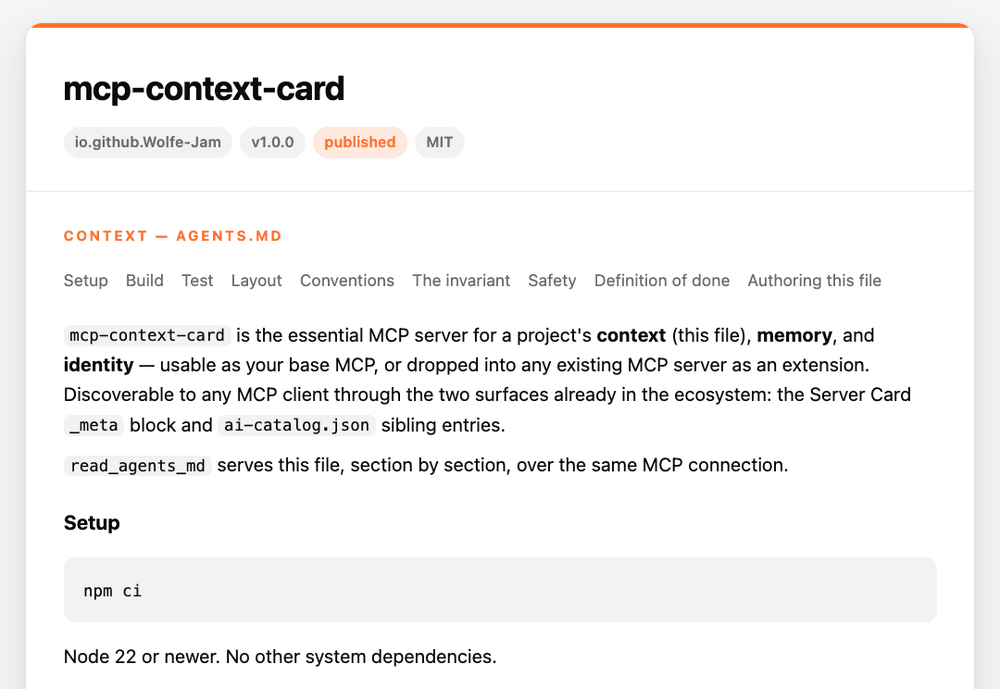 | 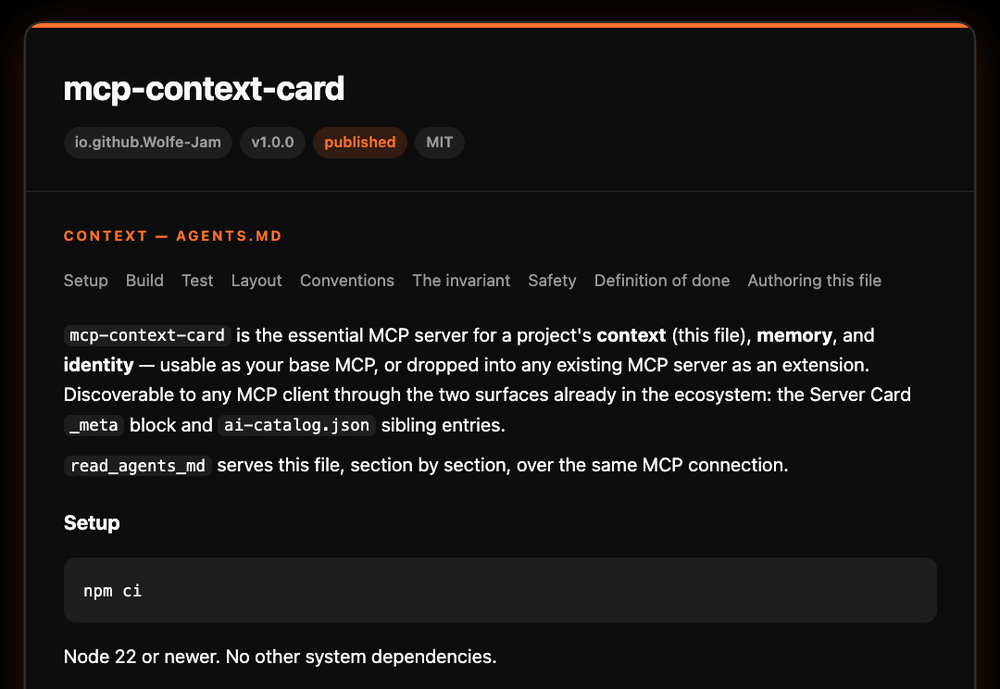 |
See your own project's business card — run this in its folder. It writes
context-card.html and opens it in your browser. The front is the card: name,
title, one-liner. Flip it for the back: About, Context, Memory, Discovery.
npx mcp-context-card card
context — the project's AGENTS.md, served whole or one section at a time.
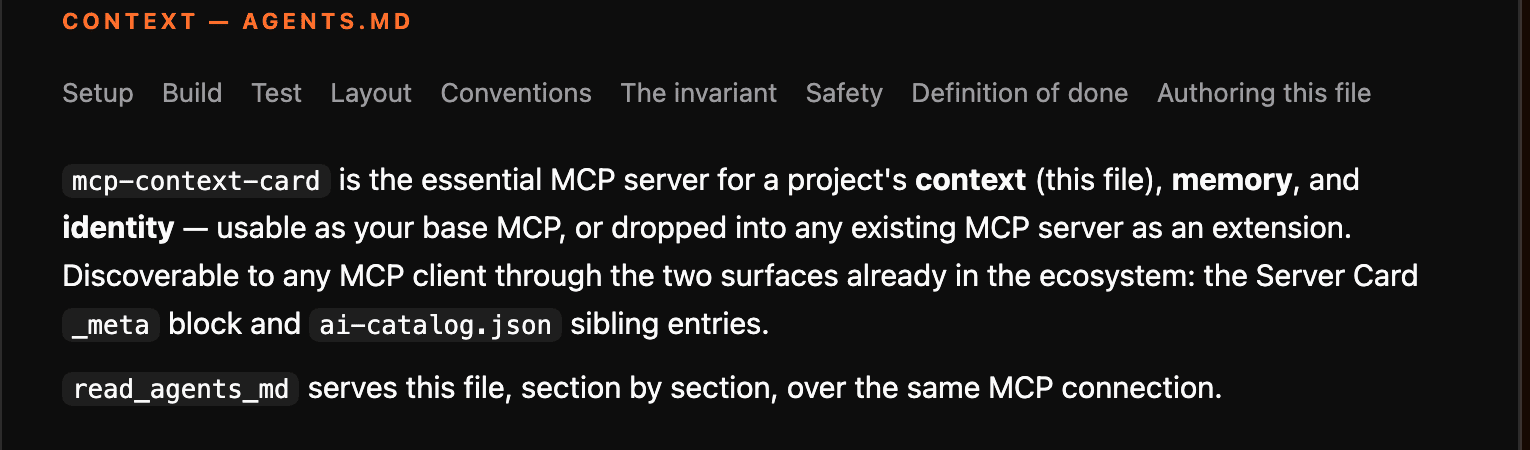
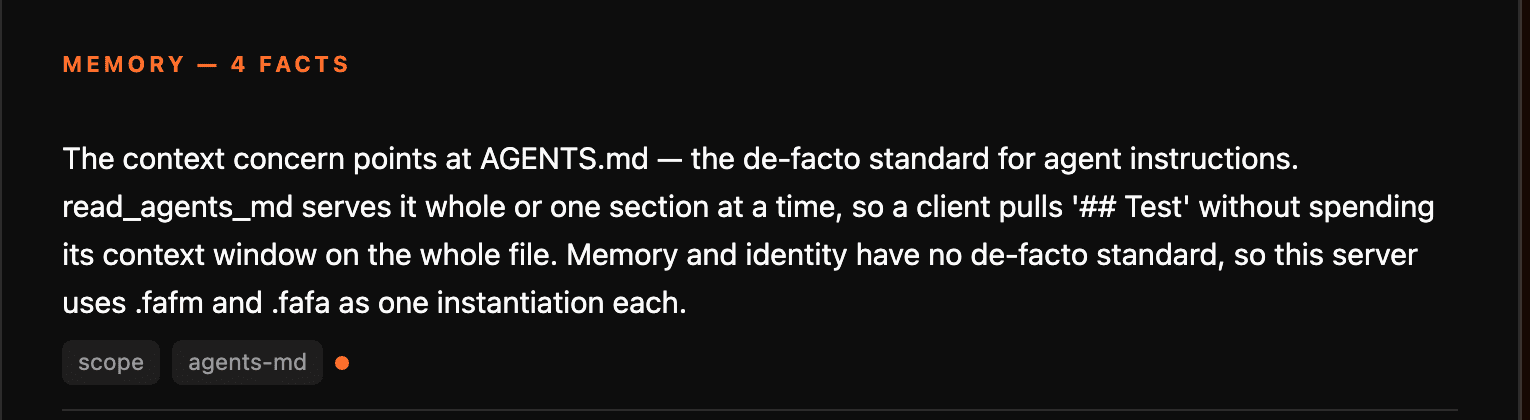
memory — facts that persist across sessions, in a file.
identity — what this server is, from its own .fafa (agent.fafa, else .well-known/fafa).

Discovery goes through two surfaces already in the ecosystem: the Server Card
_meta block and ai-catalog.json sibling entries.
Pick one
| You want to… | |
|---|---|
Add an AGENTS.md — you don't have one | author_agents_md drafts one from your repo's real facts |
Improve an AGENTS.md — you have one, make it the best it can be | the same tool, automatically — drop in a project.faf and it upgrades to BEST: goal, who it's for, why |
| Get a new MCP server base — context, memory, identity, wired | stand this up as-is; a host has all three before you write a tool of your own |
| Improve your MCP with context, memory, ID — you already run one | run it alongside your existing server; nothing to migrate, it composes |
A base MCP — or an extension for any other
Context, memory, and identity are essential — every MCP host needs an agent
that knows a project's instructions, remembers facts across sessions, and can
say what it is. mcp-context-card is those three, done once:
- Stand it up as your base MCP. Point a host at it and an agent already
has
AGENTS.mdserved section‑by‑section,remember/recall/forgetmemory that survives a restart, and awhoamiidentity — before a single tool of your own is written. - Or extend any existing MCP with it. Run it alongside a server you already have — filesystem, git, a database, your own — and that agent gains context, memory, and identity discovery it didn't have. Nothing to migrate; it composes.
Ten tools, two discovery surfaces already in the ecosystem (Server Card
_meta, ai-catalog.json), and a rendered card. MIT, on npm.
It composes:
- serve · discover · render — this server
- author BETTER, keep true —
agents-md-facts(author_agents_mdwraps it for the facts layer; adds a BEST layer of its own fromproject.fafwhen one exists) - files · shell · git —
server-filesystem,server-git/ github‑mcp‑server, your test runner's MCP
Vendor-free — context is plain Markdown (AGENTS.md); the memory and
identity formats are swappable examples. It reads and writes only its own
three files (AGENTS.md, project.fafm, and agent.fafa or .well-known/fafa), plus the
context-card.html it saves on request — no general file access, no shell,
no search.
The card
The screenshot at the top of this page is exactly this: the same sources rendered as a business card in one self‑contained HTML page. The view for people: read it, screenshot it, drop it in a PR, put it on a status page.
- Front: the name, a title (what it is and its version: "MCP server", "A2A
agent", from where the project's
.fafasays it runs) and a one-liner (the start of its description). - Back (Flip): tabs for About (the identity in full),
Skills (when the
.fafalists capabilities), Context (AGENTS.md), Memory and Discovery. Long content scrolls inside the card. - Landscape or portrait: the ▭ ▯ button switches the view;
--portrait/?layout=portraitsets it. - Light or dark card: the card's colour is its own, like a printed card.
--theme/?theme=sets it (default: follow your OS), and ◐ switches it. The page around it always follows your OS.
Flip, tabs and the view switch are plain CSS, so they work with scripts off.
The one small inline script adds Expand all, opens a #section link on the
back, and opens every section for printing. --expanded / ?expand=all
renders both faces flat, every section open, for a screenshot or print.
npx mcp-context-card card            # at a terminal: writes context-card.html and opens it
npx mcp-context-card card --portrait # the tall view
npx mcp-context-card card --expanded # both faces flat, every section open
npx mcp-context-card card > x.html   # piped/redirected: raw HTML to stdout
GET /card                            # live, on the HTTP transport
GET /card?layout=portrait&theme=light&accent=%230066cc
In a chat, hosts that support MCP Apps
show the card inline when render_context_card runs; the model gets a short
summary instead of the page. Everywhere else, save_context_card writes
context-card.html into the project, opens it in your browser when the
server runs locally, and replies with the card as Markdown (identity, the
AGENTS.md sections, memory, discovery), a link to the full card, and its
address to copy. The Markdown is a tl;dr by default: five facts, each cut to
its first sentence as stored, so it stays small however much a project
remembers. detail: "full" lists every fact whole. The server's
instructions tell the model to show that rather than paste the HTML into
the chat.
Light, dark, or auto. The colour is the owner's: set it in the project's
.fafa (metadata.cards.accent: "#0066cc"), or pass any hex with --accent
or ?accent. With none, the card is drawn in ink, black or white; no colour
is guessed.
This repo's own card, live: auto ·
light ·
dark
(in the AAIF orange its .fafa declares).
Add it to your setup
No AGENTS.md yet?
The author_agents_md tool authors one — BETTER from your repo's real
facts (build/test commands, entry points, toolchain conventions, via
agents-md-facts), or
BEST when a project.faf exists: the same facts, plus its structured
goal, who it's for, and why, as a section ahead of them. Nothing to
configure — the tier follows what's actually there.
(The ladder this follows.)
To author or keep the facts layer true outside a session:
npx agents-md-facts          # author / refresh AGENTS.md
npx agents-md-facts --check  # fail if missing or stale (CI, pre-commit)
See the card
One command, no host, no config — from your project directory:
npx mcp-context-card card
At a terminal it writes context-card.html and opens it in your browser. Piped
or redirected (> card.html, a script, CI) it writes raw HTML to stdout instead;
--stdout forces that from a terminal too. --expanded opens every section.
Wire it into a host
goose, Claude Desktop, Cursor, or any stdio host:
{
  "mcpServers": {
    "context-card": {
      "command": "npx",
      "args": ["-y", "mcp-context-card"]
    }
  }
}
No path to configure: the server asks the host which project you're in (MCP
roots — goose sends its session's working directory), then falls back to the
directory it was started in if that has an AGENTS.md. list_context_sources
reports which project it picked and how. To pin one project instead, set
"env": { "MCP_CONTEXT_CARD_ROOT": "/abs/path/to/your/project" }; that always
wins. Identity is optional. Over HTTP instead:
PORT=8080 npx mcp-context-card. Requires Node ≥22.
HTTP mode is local by default, as the MCP transports spec asks: it binds
127.0.0.1, refuses foreign browser origins with 403, and refuses DNS names
rebound to this machine. HOST=0.0.0.0 exposes it (a container or hosted
deploy). There is no authentication or rate limiting, so put an exposed server
behind your own.
Memory is session data: an exposed server shows only its count on /card, and
never serves or lists project.fafm, unless you set
MCP_CONTEXT_CARD_PUBLISH_MEMORY=1. Details:
docs/TRANSPORT.md.
If command: "npx" fails to spawn (spawn npx ENOENT — seen on Cursor, whose
host process doesn't inherit a shell PATH), point command at node and
the installed dist/bin.js instead — see
docs/WIRING.md. Transport choice is
in docs/TRANSPORT.md.
Extending an MCP you already run: most hosts accept more than one
mcpServers entry — add context-card alongside server-filesystem,
server-git, or your own, and every agent in that host gains context,
memory, and identity discovery without anything else changing.
Your identifiers
The AI Catalog names each entry urn:air:{domain}:{namespace}:{name}, and
the domain is yours. It comes from your project's .fafa: run
npx faf-cli card init (or --domain example.com), and it writes
agent.id: urn:air:example.com:agent:<short-name>. Your catalog then publishes
urn:air:example.com:context:<short-name> and so on, with no code to change.
This repo's own .fafa says faf.one; that's our example, and yours says yours.
With no .fafa, no domain is invented: the served catalog uses the host it's
served from (localhost when you run it locally), and the static
.well-known/ai-catalog.json uses plain <short-name>:<namespace> IDs.
Why
AGENTS.md is the de-facto standard for telling a coding agent how to work in a
repo. But a client has to know the file exists and read the whole thing into
context. There is no standard way for a server to say "here is my AGENTS.md,
here is what I remember, here is who I am" — so every server that wants this
grows its own shape.
mcp-context-card answers all three through mechanisms that already exist:
- Server Card
_meta(SEP‑2127) — one reverse‑DNS‑namespaced key per concern, readable in‑band as an MCP resource and atGET /mcp/server-card(the 1.x/.well-known/mcp/server-cardstill answers). ai-catalog.json— the Server Card plus sibling entries keyed by media type, atGET /.well-known/ai-catalog.json.
The context concern points at AGENTS.md (text/markdown). Memory and identity
have no de‑facto standard yet, so the examples here use
.fafm and
.fafa — one instantiation each,
swap in your own.
The wire‑level detail is in docs/MECHANISMS.md.
Tools
| Tool | What it's for |
|---|---|
author_agents_md | draft an AGENTS.md — BETTER from the repo's facts (via agents-md-facts), BEST when a project.faf exists — ready to drop in |
read_agents_md | return the project's AGENTS.md — whole, or one section by heading |
list_agents_md_sections | the headings, so a client pulls one section instead of the whole file |
remember | write a fact that will still be there next session |
recall | read a fact stored in a previous session |
forget | drop or correct a stale fact |
whoami | this server's name, vendor, version, status, license |
list_context_sources | what this project publishes, in what media types, via which surface |
render_context_card | the whole card as one self‑contained HTML page (also GET /card); hosts that support MCP Apps show it inline |
save_context_card | write the card to context-card.html in the project and open it in your browser; returns the card as Markdown plus a link to the full version |
Seven tools only read. remember and forget write the memory file, and
save_context_card writes context-card.html, so those three are marked
destructive and a host can ask before running them. Every tool carries a
title and MCP tool annotations.
The demo
npm run demo walks through context, memory, identity and discovery, live,
over both transports:
- Context — list the
AGENTS.mdsections, then pull just## Test. - Memory —
remember()a fact, stop the server process, start a new one,recall()the same fact. Only the file carries it across. - Identity —
whoami(), and the Server Card_metablock read back from a live client. - Discovery —
list_context_sources(), then the same server over stateless HTTP with its.well-knownroutes andGET /card.
210 tests on Linux, macOS, and Windows, coverage‑gated in CI.
npm run wjttc runs the WJTTC certification suite (seven tiers, from protocol
and Server Card conformance to stdio/HTTP parity and the shipped package). Two spawn a real
child process and check a remembered fact survives the restart — one against
an existing project.fafm, one starting from a project that has never had
one; another checks the stdio and HTTP tool surfaces match, and another checks
every tool's title and behaviour hints against what it actually does.
src/conformance/discovery.ts checks any server's Server Card, AI Catalog and
transport security against the specs, one MUST or SHOULD at a time.
Layout
| Path | What |
|---|---|
src/server.ts | the ten tools + the Server Card and card resources |
src/agents-md.ts | reads and section‑splits AGENTS.md |
src/author.ts | author_agents_md — BETTER via agents-md-facts, BEST when project.faf exists |
src/md.ts | a minimal dependency‑free Markdown → HTML renderer |
src/render-card.ts | the card — reads identity + AGENTS.md + memory + discovery into a card; agent-business-card draws it as one HTML page |
src/memory.ts | file‑backed remember / recall / forget |
src/identity.ts | whoami (.fafa → package.json fallback) + the _meta block |
src/server-card.ts | the MCP Server Card (SEP-2127, schema v1) |
src/catalog-gen.ts | writes ai-catalog.json: the Server Card + its sibling entries |
src/transport/http.ts | the stateless Streamable HTTP app (Hono) |
src/transport/guard.ts | Origin and Host checks (DNS-rebinding protection) |
src/conformance/discovery.ts | a portable Server Card / AI Catalog / transport checker |
src/bin.ts | the entry point — stdio · --http · card · --help · --version |
Related
- Server Card SEP‑2127 · ai-catalog · AGENTS.md
mcp-project-context— an earlier take on the context concern alonetext/markdown(AGENTS.md) ·application/vnd.fafm+yaml·application/vnd.fafa+yaml
License
MIT.
This repo dogfoods what it serves — its AGENTS.md is a real, current file, and
it ships a project.faf as the structured source behind it.
Reviews
No reviews yet
Be the first to review this server!
More Developer Tools MCP Servers
Rea
Freeby Morluto · Developer Tools
Reverse engineer anything from your terminal or agent with one CLI and MCP server.
Paperclip
Freeby Paperclipai · Developer Tools
Trending hip-hop artist momentum scores across four cultural dimensions.
Git
Freeby Modelcontextprotocol · Developer Tools
Read, search, and manipulate Git repositories programmatically
Toleno
Freeby Toleno · Developer Tools
Toleno Network MCP Server — Manage your Toleno mining account with Claude AI using natural language.
MCP Marketplace
Freeby mcp-marketplace · Developer Tools
Search and install MCP servers from inside your AI client.
mcp-creator-python
Freeby mcp-marketplace · Developer Tools
Create, build, and publish Python MCP servers to PyPI — conversationally.