
Server data from the Official MCP Registry
Local-first memory for AI coding agents: shell history with exit codes, git diffs, docs, MCP.
About
Local-first memory for AI coding agents: shell history with exit codes, git diffs, docs, MCP.
Security Report
NexusMem is a well-architected local-first memory system with proper permission scoping for its developer tool purpose. The codebase demonstrates good security practices overall: no hardcoded credentials, proper environment variable usage, and careful data isolation. However, several medium-severity findings warrant attention: shell command execution with user-controlled input, local Ollama model invocation without validation, and incomplete input sanitization in certain code paths. These are appropriately scoped to the tool's function but require careful usage. Supply chain analysis found 1 known vulnerability in dependencies (1 critical, 0 high severity). Package verification found 1 issue.
4 files analyzed · 10 issues found
Security scores are indicators to help you make informed decisions, not guarantees. Always review permissions before connecting any MCP server.
Permissions Required
This plugin requests these system permissions. Most are normal for its category.
How to Install
Add this to your MCP configuration file:
{
  "mcpServers": {
    "io-github-yaminbkk-nexusmem": {
      "args": [
        "-y",
        "nexusmem"
      ],
      "command": "npx"
    }
  }
}Documentation
View on GitHubFrom the project's GitHub README.
NexusMem





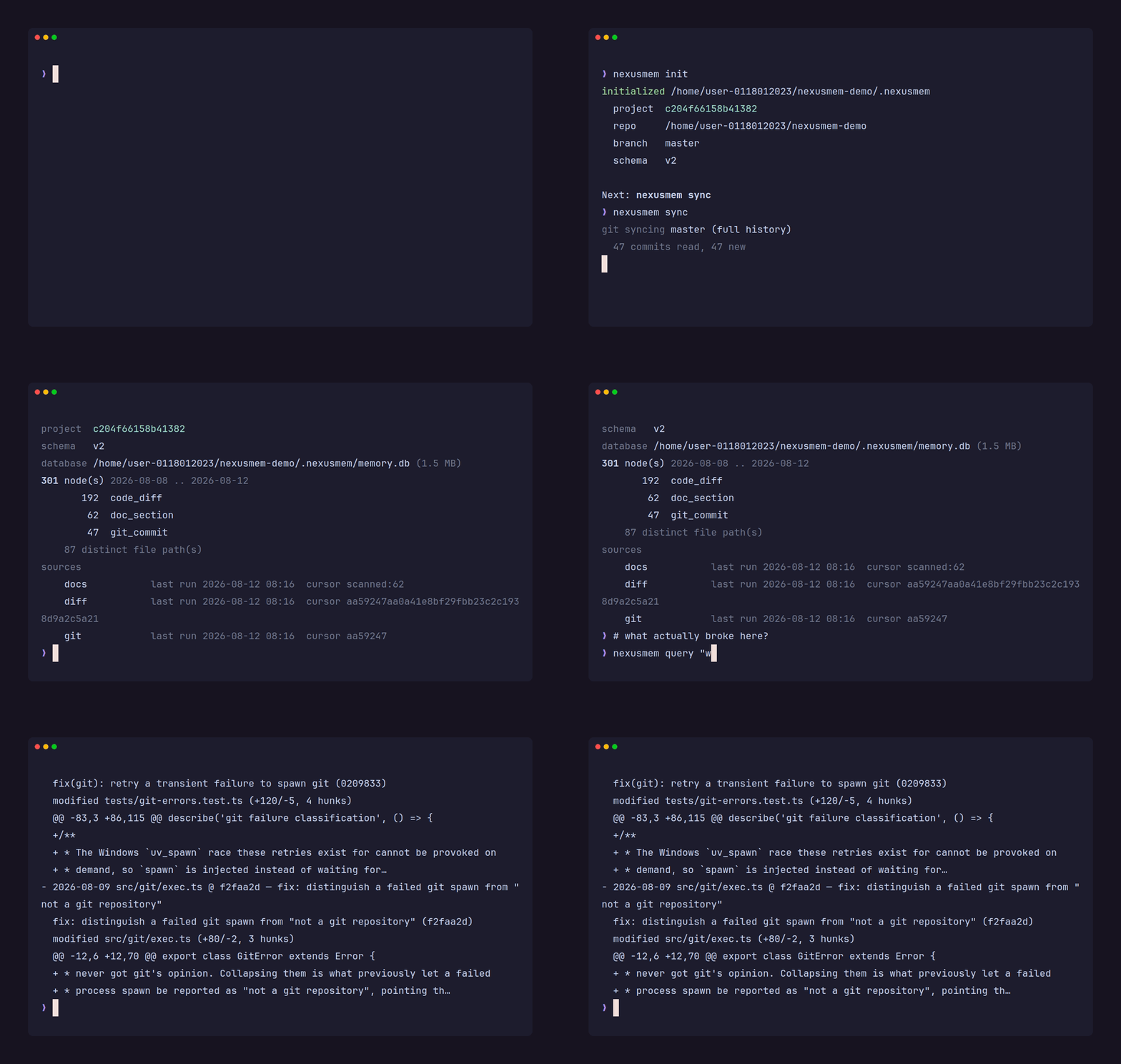
Your coding agent can read git log. It cannot read the four things you tried last Tuesday that
didn't work.
NexusMem records what actually happened on your machine (shell commands and their exit codes, git history down to the patch of each changed file, project docs, optionally your assistant transcripts) into a local SQLite database, and serves back a ranked, token-budgeted slice of it on demand. Everything stays on disk. No account, no cloud, no telemetry.
The shell history is the part worth caring about. Git tells an agent what shipped. Shell history tells it what was attempted, in what order, and which commands exited non-zero. That information exists nowhere else, and it disappears when your terminal scrollback rolls over.
Try it
From inside any git repository:
npx nexusmem init
npx nexusmem sync
Then ask it something. Real output from this repository, top 2 of 5 hits:
$ nexusmem query "windows spawn failure"

Relevant history for: windows spawn failure

- 2026-08-09 fix: distinguish a failed git spawn from "not a git repository"
  readRepoInfo collapsed three unrelated failures into one error: git running and reporting
  the path is not a work tree, git not being installed, and the process failing to spawn at
  all. Dogfooding hit the third case in two separate sessions...
- 2026-08-09 README.md — Before a tagged release
  - [ ] Retry on transient process-spawn failures on Windows
A commit and a docs section, ranked against each other, inside whatever token budget you gave it. Nothing was summarized by a model on the way out; the ranker just decided what not to send. (One optional source, session summaries, does run a local model — but at ingest time, never on the way out. What you query is always stored text.)
For a sense of what actually accumulates, here is nexusmem status on this repo after two days:
527 node(s)  2026-08-08 .. 2026-08-09
       321  shell_command
       130  conversation_turn
        60  doc_section
        16  git_commit
Sixteen commits. Three hundred and twenty-one shell commands. The commits were already retrievable by any agent with a terminal. The rest was not.
That conversation_turn row only appears because this corpus was synced with --conversation.
Assistant transcripts are the one source that is off by default and stays off until you opt in, since
they are the likeliest place for a pasted credential to be sitting. A default install indexes git
commits, their diffs, shell and docs.
Requirements: Node 22 or newer, and git. Node 20 will not work, because better-sqlite3 ships no
prebuilt binary for it and Node 20 went end-of-life in April 2026. Ollama is optional and only
affects semantic search (see below).
Optional: exact shell capture
Scraped history files (PSReadLine, .bash_history, .zsh_history) give you command text and not
much else. The hook gives you working directory, exit code and a real timestamp:
nexusmem hook install
It wraps your existing PowerShell prompt rather than replacing it, is idempotent, and
nexusmem hook remove undoes it cleanly.
Exit codes are what make this worth installing. A failed command is a stronger signal than a successful one, and without the hook there is no way to tell them apart.
Failure → fix chains (opt-in)
nexusmem sync --link-failures
After a normal sync, this walks every failed shell_command (non-zero exit code) and looks for
whatever later resolved it, using two independent heuristics: a later command in the same project
and working directory, exact same normalized text, that exited 0 within 24h (same-command
retry); and, separately, the best full-text match among nearby conversation turns or session
summaries, requiring every significant word of the failing command to appear, not just one
(conversation bridge). A failure can be linked by either, both, or neither.
Both links are surfaced in query results. The conversation-bridge heuristic originally matched on any shared word, and dogfooding against this repo's own real history found it wrong on roughly half its links — a shared word as generic as "npm" was enough to link an unrelated discussion. Requiring every significant word fixed that: re-dogfooded against the same corpus, every resulting link (the full set produced, not a sample) checked out correct on manual review of the full text, not just the summary.
When a linked failure appears in a result set, its fix rides along immediately after it, inheriting
the failure's own relevance score rather than needing to match the query on its own merits. That is
the point: a query about why something failed shouldn't need to separately guess the words used in
whatever fixed it. This works across projects too — query --all-projects chains a failure to its
fix using whichever project's own database recorded the link, since links are always local to the
project they were found in.
$ nexusmem query "why did npm whoami fail"

- 2026-08-12 shell: npm whoami  (exit 1)
- 2026-08-12 shell: npm login   (exit 0)  -- linked as the fix
How retrieval works
Every source normalizes to the same MemoryNode shape, so a commit, a shell command and a docs
section compete on equal terms. Retrieval runs BM25 over FTS5 and, if an embedding model is
reachable, a vector search over sqlite-vec, then fuses the two with Reciprocal Rank Fusion.
RRF fuses on rank position only, never on raw scores. That is the entire reason it is safe here: a BM25 cost and a vector distance live on unrelated, unbounded scales, and position is the only thing they agree on. No hand-tuned normalization constant sits between them.
Ranking then multiplies three factors:
score = relevance × signal^0.215 × recency^0.288
relevance comes from the query. signal (a fix: commit outranks a chore:; a command that
exited non-zero outranks one that succeeded) and recency are priors that hold before any query
exists. Each factor is floored into [floor, 1] rather than [0, 1], so one weak dimension cannot
zero out a strong match.
Those exponents are derived, not tuned. Priors kept overturning the query: on one real query a fix:
commit took rank 1 from a better-matching docs section on a 44% signal edge against a 15% relevance
deficit. So the priors get a shared budget — across their whole range they may overturn at most a
2× relevance gap — split evenly between them, and each is raised to the power that makes its own span
worth exactly its share (span^exponent = √2). Priors still order equally-relevant hits exactly as
before, since the transform is monotonic. They just cannot outvote the question anymore.
The budget is shared rather than per-prior for a reason found by dogfooding, not by reading the
arithmetic: the score multiplies the priors, so capping each at 2× separately left the pair free to
overturn 4×. That describes every commit made during an active working day — fresh and high-signal at
once — so the failure landed on precisely the days with the most worth remembering. A query about the
PowerShell hook returned two unrelated same-day fix: commits at ranks 3 and 4 while the section that
answered it sat at rank 6. Adding a third prior now re-divides the same budget instead of enlarging it.
Without Ollama, vector search is skipped and you get BM25 only. That path is fully supported, not a
degraded error state; sync and query both succeed and simply do less.
Session summaries (optional, local model)
With sources.session.enabled, each finished session becomes one distilled node next to the raw
exchanges — what was decided and why, rather than forty individual turns. It runs a local Ollama
chat model (qwen2.5:3b by default); nothing is downloaded automatically and nothing leaves the
machine.
nexusmem scan-session --dry-run
That prints the exact prompt a session would produce, after redaction and budget trimming, without calling the model.
Three things bound the cost. A session is only summarized once it has been quiet for
settleMinutes (default 30), so a session in progress is not re-summarized on every sync. The
prompt is hashed, and an unchanged hash skips the model entirely — on this repo a steady-state sync
of 14 summarized sessions takes 0.25s and makes no model calls. And maxSessions (default 10) caps
how many reach the model per run; the rest are reported as queued and picked up next sync.
What it is actually like, measured on 14 real sessions with qwen2.5:3b. The summaries
themselves are good: decisions with their reasons, in the shape the prompt asks for. Titles are less
reliable — the model returned a usable one about a third of the time, and otherwise produced a
conversational preamble, a stray bullet, or a bare "Summary of the Session". Those are rejected and
the title falls back to the first line of the question that opened the session, which is always
specific even when it is not elegant. Compliance was worst on long sessions and on transcripts not
in English. A larger model (qwen2.5:7b) is the lever if the titles matter to you; set
sources.session.model.
Use it from an agent
{
  "mcpServers": {
    "nexusmem": {
      "command": "npx",
      "args": ["-y", "nexusmem", "mcp"]
    }
  }
}
Three tools over stdio: search_memory returns the packed context block, sync_project ingests, and
get_status reports what is currently remembered. Each takes an explicit projectRoot, because an
MCP tool call carries no shell working directory. sync_project runs init for you if the
repository has not been set up.
What it costs you
Two numbers get conflated in tools like this, so they are kept apart here.
Packer efficiency is how much the ranker trims from its own candidate set. On this repository's corpus it runs 81–84%. It is useful for tuning the ranker and useless as a claim about your bill, because the baseline is hypothetical: without NexusMem those candidates were never going into your context window in the first place.
End-to-end saving compares the packed context NexusMem actually sends against reading, in full,
the same files its own ranking identified as relevant to the query. Measured with
scripts/benchmark.ts (npm run bench), which anyone who clones this repo
and points it at a synced corpus can re-run from scratch:
| Corpus | Commits | Query set | vs. full file content | vs. git log -p on those files |
|---|---|---|---|---|
| This repo | 62 | 16 real prompts, verbatim from this project's own history | 95% (median 94%) | 98% (median 97%) |
vitejs/vite | 9,567 | 16, mechanically sampled — see below | 99% (median 98%) | ~100% (median ~100%) — see caveat |
Both clear the original >70% target ("cut API token spend versus sending full context"), and the vite run is the first measurement at the scale that target was always described as applying to.
Read the methodology before quoting either number, because it is a narrower claim than it looks:
- The file set each query is graded against comes from NexusMem's own ranking — whichever files the packed nodes for that query touch, not an outside judge's idea of the right answer. This isolates what the pack step (rank → budget → excerpt) saves once retrieval has already picked a candidate set; it does not independently verify that the candidate set was the right one to pick.
- The vite query set is not hand-picked: an even sample, across the full commit history, of
well-explained
fix/feat/perf/refactorcommits turned into "why does vite<description>" from the commit's own conventional-commit text, plus rationale-bearing doc section headings. This repo's own query set instead reuses real historical prompts verbatim fromconversation_turnnodes — several are broad task instructions rather than narrow questions, which pulls a wider file set into scope and is part of why its number, while still high, sits below vite's. Both derivations are mechanical and disclosed inscripts/benchmark.ts, neither is cherry-picked per-query. git log -pon a file touched by thousands of commits is enormous — one vite query's baseline hit 7.5M tokens because a file in its resolved set has that much history. That is itself a finding, not noise: at this scale, "just read the file's history instead" stops being a viable alternative at all, which is a big part of why that column rounds to ~100%.- This supersedes the previous ~40% figure, which was hand-tallied from two hand-picked queries against this repo alone, never instrumented, and used an unstated baseline. It was not wrong so much as underspecified — this number replaces it with a stated method and a script that reproduces it, rather than being a claim that the product got better.
One thing that is not a percentage: shell commands and conversation turns have no cheap grep
equivalent. Without something recording them, they are gone, not merely more expensive to find.
Latency on a ~530-node corpus, warm, p50 over 10 runs:
| Operation | |
|---|---|
| BM25 retrieval (FTS5) | ~1.1 ms |
Vector KNN (sqlite-vec) | ~3.2 ms |
| Fuse, rank, pack | ~0.6 ms |
| Query embedding (local Ollama) | ~55–77 ms |
| End-to-end hybrid | ~56 ms |
All the SQLite work totals about 5 ms. The embedding call is the only thing on this path worth optimizing, and it is somebody else's process.
Where it breaks
- Shell history without the hook is unscoped. Scraped history has no directory context, so it is
attributed to whichever repository you ran
syncfrom. Bounded to a tail window, and an approximation rather than a guarantee. - Japanese and Chinese depend on the vector pass. FTS5's
unicode61tokenizer splits on whitespace, so languages without space boundaries get no useful BM25 recall. - Rebasing strands nodes. Rewritten history leaves nodes for unreachable commits. They describe
real events so they are not wrong, but a targeted prune does not exist yet.
sync --rebuildforces a clean re-scan. - Multi-line PowerShell input is read as separate commands. A function typed across several lines at the prompt is not reconstructed.
- Scrape-fallback ids drift if the history file is trimmed from the front between syncs. Installing the hook fixes this.
- Session-summary titles depend on the model following instructions, and a 3B model often does not. The fallback keeps them specific rather than generic, but see the section above for what to expect.
- Changing the embedding model re-embeds everything. Vectors from two models are not comparable
and
nodes_vecrecords no per-row provenance, sosyncdrops the lot and rebuilds rather than ranking across a mixture. It says so when it happens. Nodes are untouched and BM25 keeps working throughout. - Diff indexing is bounded, and deliberately lossy. A first sync indexes the patches of the most
recent 200 commits (later syncs only walk
cursor..HEAD); merge commits contribute none, since their patch exists only in a combined format this parser does not read; and binaries, lockfiles and build output are skipped so a dependency bump cannot bury the corpus. All of it is still recorded as agit_commitnode. A patch longer thanlimits.maxBodyCharsis truncated, so the tail of a very large change is not indexed. The caps live undersources.diffinconfig.json. - Cross-project recall favours breadth. Each repository's hits are fused by rank, so a project whose best match is mediocre still contributes a rank-1 item, and rank 1 is worth the same in every list. Adding a repository that has little to say about your question still pushes a few of its results into the budget. Signal, recency and the budget are what hold that in check; there is no per-project quality weight.
- The project registry is an index, not a source of truth. It can point at a database that has moved or been deleted; those are reported and skipped, never silently pruned, because an unmounted drive is not a deleted project.
- Conversation chunking is unevaluated. Splitting long replies at heading boundaries measurably helped, but it has never been tested systematically.
- A chunked node's sibling count in one result is capped, not tuned.
conversation_turnanddoc_sectionboth split one reply or file into several nodes; at most 2 of them may appear together in a packed result. Found live: a query for "token" returned 9 of its top 12 hits as different pieces of one heavily-sectioned reply, crowding out the node that actually answered it. The cap of 2 is a judgement call, not a measured optimum, same as the ranking priors' budget above. - The size of the prior budget is a judgement call, not a measured optimum. Priors are now bounded jointly rather than one at a time, which closed a real 4× hole (see the ranking section), but the 2× budget itself has never been tuned against a labelled relevance set — there isn't one. It is a defensible constant, not a result. What is measured is the direction: on four real queries against this repo's own memory, switching to the joint cap moved the section that answered the question up in three of them (the rationale section for "why BM25 before vector search" went from rank 4 to rank 1) and displaced no query's correct top hit.
Commands
init, sync, query <text>, status, projects, mcp, and hook install|remove|status.
There are also five dry-run previews (scan-git, scan-diff, scan-shell, scan-docs,
scan-conversation)
that write nothing and print the nodes ingestion would create along with their signal scores. That
is the intended way to tune scoring against a real repository before committing to a change. Add
--json to pipe them somewhere.
Every command takes -C <path> to target another repository. On sync, --conversation opts the
transcript source in for one run without persisting it, --no-embed skips the vector pass,
--link-failures builds the failure → fix chains described above, and --rebuild drops the
project's nodes and re-ingests from scratch.
Recall across projects
query --all-projects searches every repository you have run NexusMem in, not just the current one,
and tags each result with the repository it came from:
$ nexusmem query --all-projects "why was the retry budget raised"
scope   2 project(s): NexusMem, uploader

- 2026-08-12 [uploader] fix: raise the retry budget after the S3 upload timeouts
- 2026-08-12 [uploader] retry.ts @ 8d0f98b — fix: raise the retry budget after the S3 upload timeouts
  @@ -1 +1 @@
  -export const RETRY_BUDGET = 3;
  +export const RETRY_BUDGET = 5;
- 2026-08-09 [NexusMem] fix(git): retry a transient failure to spawn git
Databases stay per-repository — there is no shared global store, and deleting one repo's
.nexusmem/ still removes exactly that repo's memory. What makes the others findable is a plain
index at ~/.nexusmem/projects.json, written by init and refreshed by every sync. nexusmem projects shows what is in it, and --prune forgets entries whose database is gone.
Ranking across repositories uses reciprocal rank fusion per project rather than raw BM25, because a BM25 cost is computed against its own corpus and means different things in a 50-node and a 50,000-node database. The trade is stated in Where it breaks.
The MCP search_memory tool takes the same switch as allProjects: true.
On disk
<repo>/.nexusmem/
  .gitignore     '*' — the workspace ignores itself, so init never edits a file it doesn't own
  config.json    validated on read; a corrupt config fails loudly rather than silently
  memory.db      SQLite in WAL mode

~/.nexusmem/
  projects.json      which repositories exist, for cross-project recall; a corrupt one reads as empty
  shell-history.jsonl  the hook's log, if you installed it
NEXUSMEM_HOME overrides the user-scoped directory.
Node ids are content-addressed from sha256(projectId + kind + naturalKey), so running sync twice
cannot produce duplicates and ingestion stays correct even if a cursor is lost. Project identity
comes from the normalized origin URL when there is one, falling back to the absolute path, so two
clones of the same repo share one memory namespace.
Deleting .nexusmem/ loses nothing that sync cannot rebuild.
Status
Ingestion, hybrid retrieval, budgeted packing and the MCP server all work and are covered by 342 tests running on Linux and Windows across Node 22 and 24.
Development
npm install
npm run typecheck
npm test
npm run build
Tests are behavioral rather than snapshot-based, and several are regressions tied to specific
observed failures. tests/git-errors.test.ts injects a fake spawn to exercise the Windows
process-spawn faults, which cannot be provoked on demand.
On how this was built
This started as an experiment in whether a local context-memory engine for coding agents was viable, prototyped with Claude Code. The code was written through AI-assisted workflows; the architecture, the design decisions and the specifications were human-directed.
That is worth stating plainly because it should change how you read the code, not whether you trust it. Audits, corrections and PRs are genuinely welcome, and the commit history is deliberately detailed about why things are the way they are, including the times an earlier assumption turned out to be wrong.
License
MIT
Reviews
No reviews yet
Be the first to review this server!
More Developer Tools MCP Servers
Fetch
Freeby Modelcontextprotocol · Developer Tools
Web content fetching and conversion for efficient LLM usage
Toleno
Freeby Toleno · Developer Tools
Toleno Network MCP Server — Manage your Toleno mining account with Claude AI using natural language.
mcp-creator-python
Freeby mcp-marketplace · Developer Tools
Create, build, and publish Python MCP servers to PyPI — conversationally.
MarkItDown
Freeby Microsoft · Content & Media
Convert files (PDF, Word, Excel, images, audio) to Markdown for LLM consumption
MCP Marketplace
Freeby mcp-marketplace · Developer Tools
Search and install MCP servers from inside your AI client.
FinAgent
Freeby mcp-marketplace · Finance
Free stock data and market news for any MCP-compatible AI assistant.