
Server data from the Official MCP Registry
LaTeX editor for AI agents: live PDF preview, PDF comments that drive edits, git history
About
LaTeX editor for AI agents: live PDF preview, PDF comments that drive edits, git history
Security Report
MagicTeX is a well-structured LaTeX editor MCP server with appropriate security controls for its purpose. Authentication is not required (standard for local/agent tools), permissions align with the stated purpose (file I/O, network access for WASM assets, process spawning for compilation), and code quality is generally solid with good error handling and input validation. Minor findings include broad exception handling and some unvalidated shell invocations, but these do not constitute critical vulnerabilities given the tool's design constraints. Supply chain analysis found 3 known vulnerabilities in dependencies (0 critical, 2 high severity). Package verification found 1 issue.
3 files analyzed · 8 issues found
Security scores are indicators to help you make informed decisions, not guarantees. Always review permissions before connecting any MCP server.
Permissions Required
This plugin requests these system permissions. Most are normal for its category.
How to Install
Add this to your MCP configuration file:
{
  "mcpServers": {
    "io-github-zoelinuts-magictex": {
      "args": [
        "-y",
        "magictex-mcp"
      ],
      "command": "npx"
    }
  }
}Documentation
View on GitHubFrom the project's GitHub README.
MagicTeX — LaTeX Editor for AI Agents







English · 简体中文 · 日本語 · 한국어 · Español · Français · Deutsch · Português
MagicTeX is a LaTeX editor built for AI agents — an Overleaf-like
one-window workspace for Claude Code, served by an MCP server, with no local TeX
install and no Overleaf account: live PDF preview, a source editor with a Visual
(WYSIWYG) mode, change history, and comments you anchor on the rendered PDF that
become edit instructions for the agent. (npm package: magictex-mcp.)
It compiles with a WASM TeX Live 2026 engine (texlyre-busytex) running inside a headless browser, so there's nothing multi-gigabyte to install — just a one-time WASM asset download.
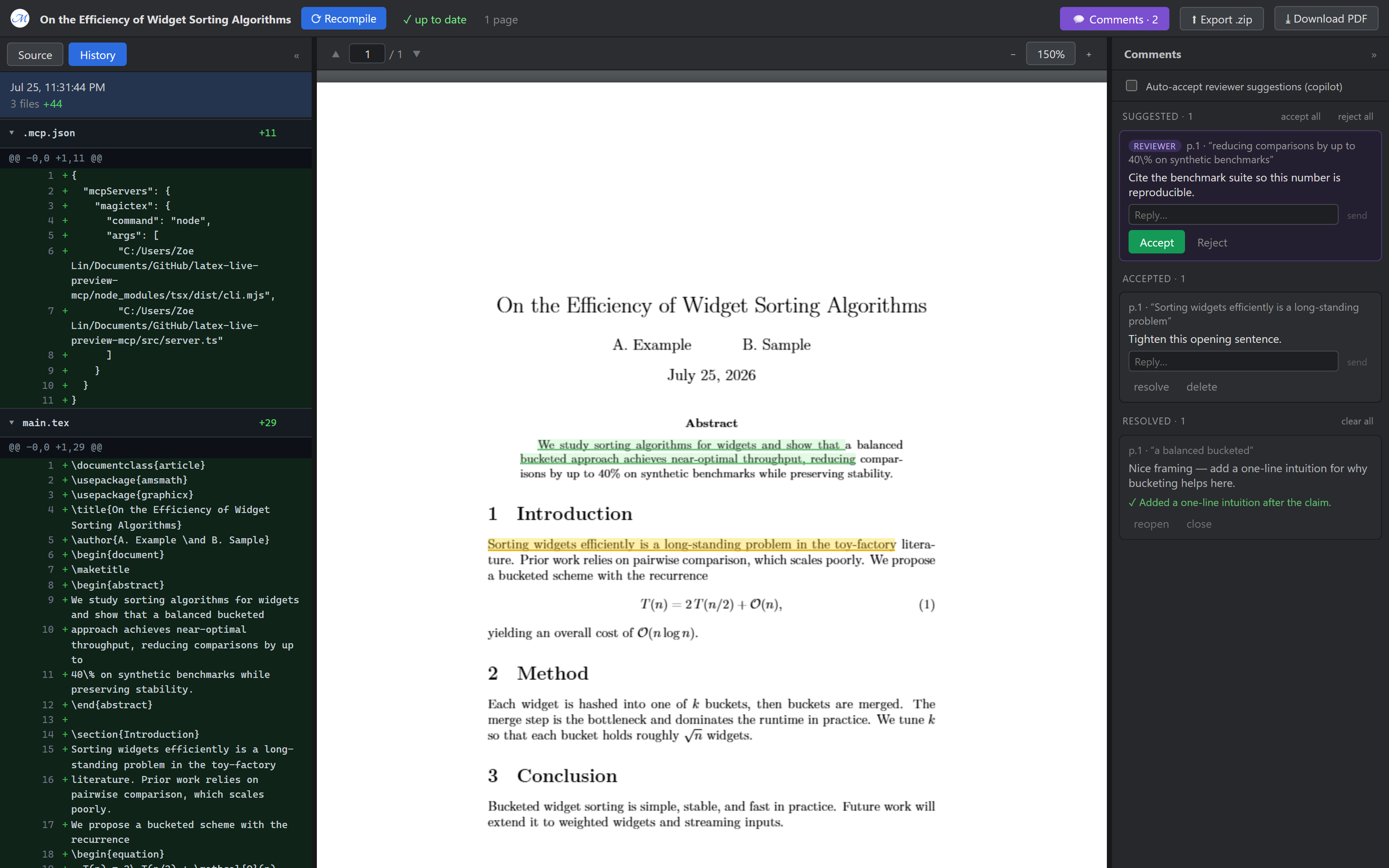
See it before you install
A guided walkthrough of the comment → agent loop lives at zoelin.dev/tools/magictex, built from real tool output. It's a replay, not a hosted instance — the TeX engine is a one-time ~650 MB download and the agent half is Claude itself, so MagicTeX runs next to your project rather than in a web page.
The workspace
One browser window (inspired by Typst's one-surface editor and LiquidText's anchored annotations):
┌──────────────────────────────────────────────────────────────┐
│  ✓ up to date · 13 pages        Export .zip · Download PDF   │
├────────────┬──────────────────────────────┬──────────────────┤
│ Source /   │          PDF (live)          │    Comments      │
│ History    │  select text → 💬 comment    │  accepted → ask  │
│  editor,   │  highlights stay anchored    │  Claude to       │
│  timeline  │  auto-reloads on every edit  │  address them    │
│  + diffs   │                              │  → resolved ✓    │
└────────────┴──────────────────────────────┴──────────────────┘
- Comment → Claude loop (the point of it all). Review the rendered document
like a supervisor marking up a printout: select text, attach a comment
("tighten this paragraph"). Then tell Claude to "address my comments" — it
pulls them via
check_commentsas located work items (page + quoted passage- the source
file:lineit anchors to + your ask), edits the source, and resolves each card with a note. You interact with the document; Claude interacts with the source. Run it hands-off with/loop— seedocs/AGENT-LOOP.md.
- the source
- Editable source panel. A CodeMirror LaTeX editor with the project's files — save (Ctrl+S) recompiles and refreshes the PDF, Typst-style. Or keep using your own editor: any save triggers the same live loop.
- Live reload. A file watcher recompiles on every save — Claude's edits, the built-in editor's, or your external editor's.
- Change history. Each successful compile is auto-snapshotted to a hidden
git ref (
refs/latex-preview/checkpoints) — never touching your branches,git log, or working tree. The History tab shows the timeline and each checkpoint's colorized diff beside the PDF. - Get to Overleaf. Download PDF, Export .zip (clean build-inputs
bundle), and a one-click Open in Overleaf link for public GitHub repos;
Premium Git-bridge sync is a documented
git push. Seedocs/USER-GUIDE.md. - Review workflow (reviewer → gate → resolver). A reviewer/defender agent posts
comments via
add_comment; you Accept/Reject them (or flip Auto-accept for copilot mode); an author loop resolves the accepted ones. Comments carry roles and a reply thread. Seedocs/AGENT-LOOP.md. - Save vs. recompile, your call. The built-in editor auto-saves every 30s without recompiling; Ctrl+S / Save / Recompile rebuild the PDF on demand. (Flip ⚡ Live for recompile-as-you-type.) Your own editor and Claude's edits still auto-recompile via the watcher.
- Real projects. Auto-detects the main file, gathers multi-file
\input/\include,.bib, in-repo.cls/.sty/.bstand figures, runs BibTeX and reruns when needed; common missing packages are auto-injected. - Compile backend. Uses your local latexmk when you have one — full package
fidelity, output matching Overleaf — and the bundled zero-install WASM TeX Live
when you don't. Force either with
backend: "system"/"wasm". Every compile reports which one ran. - Document classes.
IEEEtranis bundled, because no venue class ships in the WASM TeX Live and a missing class can't be worked around the way a package can. Conference classes (NeurIPS, ICML, CVPR, ACL, AAAI …) carry no redistributable licence, so put the.clsfrom the author kit beside your source — it's picked up automatically. - MCP tools:
render_preview(compile + open the workspace),check_comments/resolve_comment/add_comment/reply_to_comment(the review loop),show_diff(side-by-side diff as an image — useful on image-capable clients). - Actionable errors. Failed compiles return parsed
{file, line, message}errors so Claude can self-correct, and show in the workspace.
Setup
MagicTeX is on npm as magictex-mcp and
listed in the official MCP registry as
io.github.ZoeLinUTS/magictex — so any client that reads the registry can find it.
There's nothing to clone and no TeX install; npx fetches it on first use.
-
Add it to your paper project's
.mcp.json(see.mcp.json.example):{ "mcpServers": { "magictex": { "command": "npx", "args": ["-y", "magictex-mcp"] } } }For local development from a clone, point it at the source instead:
"command": "npx", "args": ["tsx", "/absolute/path/to/magictex-mcp/src/server.ts"] -
Restart Claude Code (or
/mcpreconnect) so it picks up the server. -
Ask Claude to render. e.g. "render a preview of this paper" → the first call downloads the WASM TeX Live assets (~650 MB, one time), compiles, and opens the live preview tab. Subsequent edits reload it automatically.
The WASM assets are not in this repo. They're fetched on first run into a
per-user cache — ~/Library/Caches/magictex on macOS, $XDG_CACHE_HOME/magictex
on Linux, %LOCALAPPDATA%\magictex on Windows — so upgrading MagicTeX doesn't
re-download them, and a checkout, a global install and an npx run share one copy.
Set MAGICTEX_ASSETS_DIR to put them elsewhere. To pre-fetch:
npx texlyre-busytex download-assets <that directory>.
Install as a Claude Code plugin (slash commands)
For a low-typing workflow, install MagicTeX as a plugin — one install gives you the MCP server and the slash commands:
/plugin marketplace add ZoeLinUTS/MagicTeX-mcp
/plugin install magictex
Then, in your paper project, use the workflow commands for the common flows:
/magic-latex— compile and open the workspace (the live preview)./ai-review [skill]— review the paper with a skill (defaultacademic-paper-revision; pass any skill name) and post comments for you to Accept/Reject. Missing skills are reported with an install hint./address-comments— resolve your accepted comments (loop it with/loop 60s /address-comments).- ⚡
/ultra-agents [skill] [depth]— fully autonomous: review, auto-accept, fix, repeat, up todepthrounds (default 2), stopping early the moment a round finds nothing new. No per-round approval — that's the point, and the risk.depth > 5asks you to confirm before starting. Ends with a summary (what was raised, what changed, which checkpoints to look at) — every round is still an ordinary, revertible checkpoint. Seedocs/AGENT-LOOP.md.
One command per tool
Every MCP tool also has a slash command with the same name, so you can drive any
single step by typing the tool name. The rule to teach: the tool is X → type
/X.
| Type this | Runs tool | What it does |
|---|---|---|
/render_preview | render_preview | Compile the paper and open/refresh the live preview. |
/check_comments | check_comments | List the comments you've accepted, as edit instructions (no edits yet). |
/resolve_comment [id] [note] | resolve_comment | Mark a comment done after the edit; it turns green for your review. |
/add_comment ["quote"] [note] | add_comment | Anchor a comment onto a passage for you to Accept/Reject. |
/reply_to_comment [id] [text] | reply_to_comment | Add a threaded reply to a comment. |
/show_diff [checkpoint] | show_diff | Side-by-side visual diff as an image (current changes, or a checkpoint). |
/list_checkpoints [limit] | list_checkpoints | Recent checkpoints with their sha, newest first — find one to pass into /show_diff. |
You never have to type these — plain English works too ("render a preview", "address my comments"). The commands are just a fast, teachable shorthand.
The plugin bundles the MCP server (
npx magictex-mcp), so installing the plugin is all you need — the.mcp.jsonabove is the alternative if you'd rather not install a plugin. The slash commands work either way.
Tools
The MCP surface, for any client that speaks MCP. (In Claude Code you can just ask in plain English, or use the slash commands above — these are the underlying tools.)
| Tool | Parameters | What it does |
|---|---|---|
render_preview | mainFile? · engine? (pdflatex | xelatex | lualatex, default xelatex) · backend? (wasm | system | auto, default auto — local latexmk if installed, else the bundled WASM engine) | Compiles the project and opens/refreshes the live workspace. The main file is auto-detected by scanning for \documentclass if omitted. |
check_comments | includeResolved? (default false) | Returns the accepted comments as located work items — page, quoted passage, the source file:line, and the ask. Reviewer suggestions awaiting your decision are reported but not returned as work. |
add_comment | quote · comment · role? (reviewer | defender) · page? · accepted? | Anchors a comment onto a passage. Posts as a suggestion awaiting your Accept/Reject unless accepted is set — that flag is what makes autonomous mode autonomous. |
resolve_comment | id · note | Marks a comment done after the edit, with one line describing what changed. It turns green in the workspace for your review. |
reply_to_comment | id · text · role? (author | reviewer | defender) | Adds a threaded reply, so a disagreement can be worked out on the comment instead of in chat. |
show_diff | checkpoint? | Renders a side-by-side diff as an image, shown inline in the conversation. Defaults to the current uncommitted changes; pass a checkpoint sha for a saved version. |
list_checkpoints | limit? (default 10, max 50) | Recent checkpoints with their sha, newest first — use it to find one to pass to show_diff. |
The headline workflows are built on top of these, not among them. /magic-latex,
/ai-review, /address-comments and ⚡ /ultra-agents are Claude Code plugin
commands that orchestrate the tools above — /ultra-agents chains review →
auto-accept → fix for as many rounds as you allow, and is the reason add_comment
takes an accepted flag. They are not part of the MCP surface, so another MCP client
sees the seven tools only. See the plugin section
and docs/AGENT-LOOP.md.
See it in the terminal
These are real tool outputs, captured verbatim from an actual run against the sample paper — not mocked up. This is what you see in Claude Code while the browser workspace (screenshot above) reflects the same state live.
You type:
/magic-latex
Claude calls render_preview and replies:
✓ Compiled main.tex with xelatex in 1900ms — 2 files. Workspace (live preview,
source editor, history, PDF comments — auto-reloads on edits):
http://127.0.0.1:52042/app
You (or a reviewer skill) leave a comment, then ask what's ready to act on. Claude
calls check_comments:
1 accepted comment — edit each at its source location per the instruction, then
call resolve_comment with its id and a one-line note:

[id: 2fce9e3c8b5f] p.1 — "Sorting widgets efficiently is a long-standing problem"
  ↳ source: main.tex:15
  → Tighten this opening sentence.

(1 reviewer suggestion still awaits the human's accept in the workspace — not
actionable yet.)
Claude makes the edit and calls resolve_comment:
✓ Resolved comment 2fce9e3c8b5f ("Sorting widgets efficiently is a long-standing
problem…") — the card now shows: Rewrote the opening sentence.
Ask again, and the accepted queue is empty — only the still-unaccepted suggestion remains, waiting on you:
No accepted comments. (2 already resolved.)

(1 reviewer suggestion still awaits the human's accept in the workspace — not
actionable yet.)
How it works
Claude edits .tex ─┐
 file watcher ─────┼─▶ compile coordinator ─▶ headless Chromium ─▶ WASM TeX ─▶ PDF
 render_preview ───┘         (serialized)         (engine host)                │
                                                                               ▼
                     your workspace (/app)  ◀── WebSocket "reload" ◀── local HTTP server
                     Source · PDF · History · Comments        (serves /app + /latest.pdf)
The WASM engines need DOM/Worker globals, so the server hosts a hidden headless
Chromium as its compile worker; the workspace you open is a lightweight React +
pdf.js app with no WASM in it. See docs/ARCHITECTURE.md.
flowchart LR
  H["👤 You<br/>Source · PDF · History · Comments"]
  A["🤖 Claude Code<br/>+ review / author agents"]

  H <-->|"select text →<br/>anchor comment"| SRV["Preview server<br/>HTTP + WebSocket · serves /app"]
  A -->|"7 MCP tools"| MCP["MCP server<br/>render_preview · show_diff · list_checkpoints<br/>check / resolve / add / reply_comment"]

  SRV --> CO["Compile coordinator<br/>(serialized)"]
  MCP --> CO
  A -. edits source .-> FILES[("Paper files · git repo")]
  FILES --> WATCH["File watcher"] --> CO
  CO --> ENG["WASM busytex<br/>(headless Chromium)"] --> PDF["/latest.pdf"]
  PDF -. live reload .-> H
  CO --> CK["git checkpoints<br/>(hidden ref) → History"]

  SRV <--> CJSON[(".latex-preview/<br/>comments.json")]
  MCP <--> CJSON
  CJSON -->|"check_comments<br/>(your accepted asks)"| A
Both front doors — you in the workspace, agents through the 7 MCP tools — meet at
the same coordinator, comment store, and git history. You act on the rendered
document (anchor a comment); Claude acts on the source (reads your comments via
check_comments, edits, resolve_comment). That shared substrate is what makes
the comment loop, the review workflow, and traceable history possible.
Requirements
- Node 20.19+ (the floor
chokidarandplaywrightactually need; the server checks at startup and says so) - Playwright's Chromium (installed automatically; ~150–300 MB) — or set it to reuse your installed Chrome.
- ~650 MB disk for the one-time WASM TeX Live assets — all of it fetched on the
first run, in three package sets (basic 87 MB, recommended 190 MB, extra 324 MB,
plus the 31 MB engine). A normal paper only loads the basic set; the larger two
sit on disk until something needs them. Cached per user, not per install, so
upgrading MagicTeX doesn't re-download them. Override the location with
MAGICTEX_ASSETS_DIR. - A local TeX install is optional. See below for when it matters.
Do I need a local TeX distribution?
No — the bundled WASM engine compiles with nothing installed, which is the whole
point. But it ships a subset of TeX Live, so some things aren't in it: svg,
most venue document classes, and various less common packages. When one is
missing you'll be told, rather than handed a silently wrong PDF.
Install a distribution when you want output that matches Overleaf exactly. MagicTeX picks it up on its own — no configuration:
| macOS | MacTeX |
| Linux | texlive-full, via your package manager |
| Windows | TeX Live, or MiKTeX plus Strawberry Perl |
latexmkis what MagicTeX looks for onPATH, but it isn't something you install on its own — it's a driver script that comes inside the distributions above. Check withlatexmk -version, notwhich latexmk:latexmkis a Perl script, and MiKTeX putslatexmk.exeon yourPATHwithout shipping a Perl to run it with — so the file is found and still cannot execute. On macOS you may needeval "$(/usr/libexec/path_helper)"or a fresh terminal first.
Every compile tells you which one ran — xelatex · system or xelatex · wasm.
Development
npm install
npm run typecheck    # tsc for the server and the UI
npm run build:ui     # build the React workspace to ui/dist
npm test             # the unit suite — engine-free, no browser, seconds
npm start            # run the server on stdio (for a manual MCP client)
Two tiers, on purpose. npm test covers the comment store, anchor matching, line
and column geometry, the history repo, asset paths, compile-log classification, the
preview server's shutdown, and an MCP workflow E2E — all without a browser or a TeX
engine, so it stays fast and deterministic. CI (.github/workflows/ci.yml) runs
typecheck + UI build + that suite on Node 20 and 22 for every push and pull request.
The things a unit test structurally cannot see — highlight geometry at several zoom
levels, what a failed render actually tells the reader, whether shutting down closes
the server and warns any open window — live in scripts/smoke-*.mjs and run against
a real browser and a real compile in .github/workflows/smoke-macos.yml. Each of
those exists because something shipped broken that the unit suite was green through.
Please keep both green and add coverage with changes.
Documentation
- User guide — everyday use, the comment loop, Visual mode, the file tree, getting your paper into Overleaf, package coverage.
- The agent loop — comments as triggers, running it hands-off with
/loop, the reviewer → gate → resolver workflow, and ⚡/ultra-agents. - Roadmap — what's shipped for concurrent agents, and what real parallel multi-agent editing still needs.
- Architecture — why a headless browser, what every module does, the compile flow.
All four are translated into the same 8 languages as this README — each page has its own language switcher at the top.
Roadmap
Multiple Claude Code sessions can already work the same project concurrently without
corrupting comments or the checkpoint history (see docs/ROADMAP.md)
— true parallel multi-agent editing (reviewer/author/defender on their own git branches,
merged back together) is the next milestone.
Sponsor this project
MagicTeX is free and open source (AGPL-3.0). If it saves you time on your papers, please consider sponsoring the project — it funds continued development. A ⭐ on the repo helps too.
Acknowledgements
MagicTeX is written and maintained by Zoe Lin, built with Claude Code.
Thanks to David Turnbull, who told me the story of Knuth spending ten years
building his own typesetter rather than accept how his book looked — the story this
project keeps arguing with. And to the maintainers of
texlyre-busytex, without whose WASM
TeX Live none of this would run locally at all.
License
AGPL-3.0-or-later — matching the texlyre-busytex engine it builds on.
See THIRD_PARTY_NOTICES.md.
Reviews
No reviews yet
Be the first to review this server!
More Developer Tools MCP Servers
Paperclip
Freeby Paperclipai · Developer Tools
Trending hip-hop artist momentum scores across four cultural dimensions.
Fetch
Freeby Modelcontextprotocol · Developer Tools
Web content fetching and conversion for efficient LLM usage
Git
Freeby Modelcontextprotocol · Developer Tools
Read, search, and manipulate Git repositories programmatically
Toleno
Freeby Toleno · Developer Tools
Toleno Network MCP Server — Manage your Toleno mining account with Claude AI using natural language.
MCP Marketplace
Freeby mcp-marketplace · Developer Tools
Search and install MCP servers from inside your AI client.
mcp-creator-python
Freeby mcp-marketplace · Developer Tools
Create, build, and publish Python MCP servers to PyPI — conversationally.