
Server data from the Official MCP Registry
Local proof facts for AI coding clients: intent, tests, Graph Ops, and review evidence.
About
Local proof facts for AI coding clients: intent, tests, Graph Ops, and review evidence.
Security Report
Code Factory is a sophisticated code audit and verification tool with generally sound security practices. The codebase demonstrates careful input validation, proper error handling, and well-scoped permissions appropriate to its purpose. However, there are some code quality concerns around broad exception handling, subprocess usage without explicit shell=False declaration, and limited logging of security-relevant events that warrant attention. Supply chain analysis found 5 known vulnerabilities in dependencies (0 critical, 3 high severity). Package verification found 1 issue.
4 files analyzed · 14 issues found
Security scores are indicators to help you make informed decisions, not guarantees. Always review permissions before connecting any MCP server.
Permissions Required
This plugin requests these system permissions. Most are normal for its category.
How to Install
Add this to your MCP configuration file:
{
  "mcpServers": {
    "io-github-zrk222-code-factory": {
      "args": [
        "factoryline-code-factory"
      ],
      "command": "uvx"
    }
  }
}Documentation
View on GitHubFrom the project's GitHub README.
Code Factory
Code Factory + ForgeLine (CF/FL) is a robust, local-first code-audit factory. It starts by collecting local software review evidence for the candidate change. It connects requirements, architecture checks, Python AST security analysis, behavioral test evidence, workflow integrity, specialty AI review, and actionable repair. Its receipts support review; the tool does not certify software, guarantee that defects are absent, or approve a release.
0.47.0 audit workflow preview
Fixed: editor audit views now expose missing and incomplete checks.
Changed: Junie's route connects a diff to bounded evidence and a concrete
repair handoff. Added: project-neutral factory audit workflows contracts
with hash-bound candidate and execution evidence, plus VS Code/Open VSX 1.1.0
evidence tree, JetBrains 1.1.0 CF + ForgeLine tab, and a native
OpenCode plugin.
Candidate detection fixes: the Python scanner flags tests without a local
assertion, constant-true assertions, and reflexive comparisons. Declared tenant
reads can be checked with factory audit security --tenant-read-call db.get;
this checks the declared tenant_id parameter binding, not tenant authentication.
The unchanged eight-case public regression corpus now gives 6 true positives,
2 true negatives, and no false positives or false negatives locally, with the
same tenant-read contract applied to defective, repaired, and clean inputs.
This is a small development regression result, not independent accuracy,
runtime coverage, or release approval. CI verification is still required.
The autonomous ops plan explains the
proposed Observer Agent loop and its gates. These versions remain release
candidates until each channel has a verified provider publication receipt.
Graph Ops in action
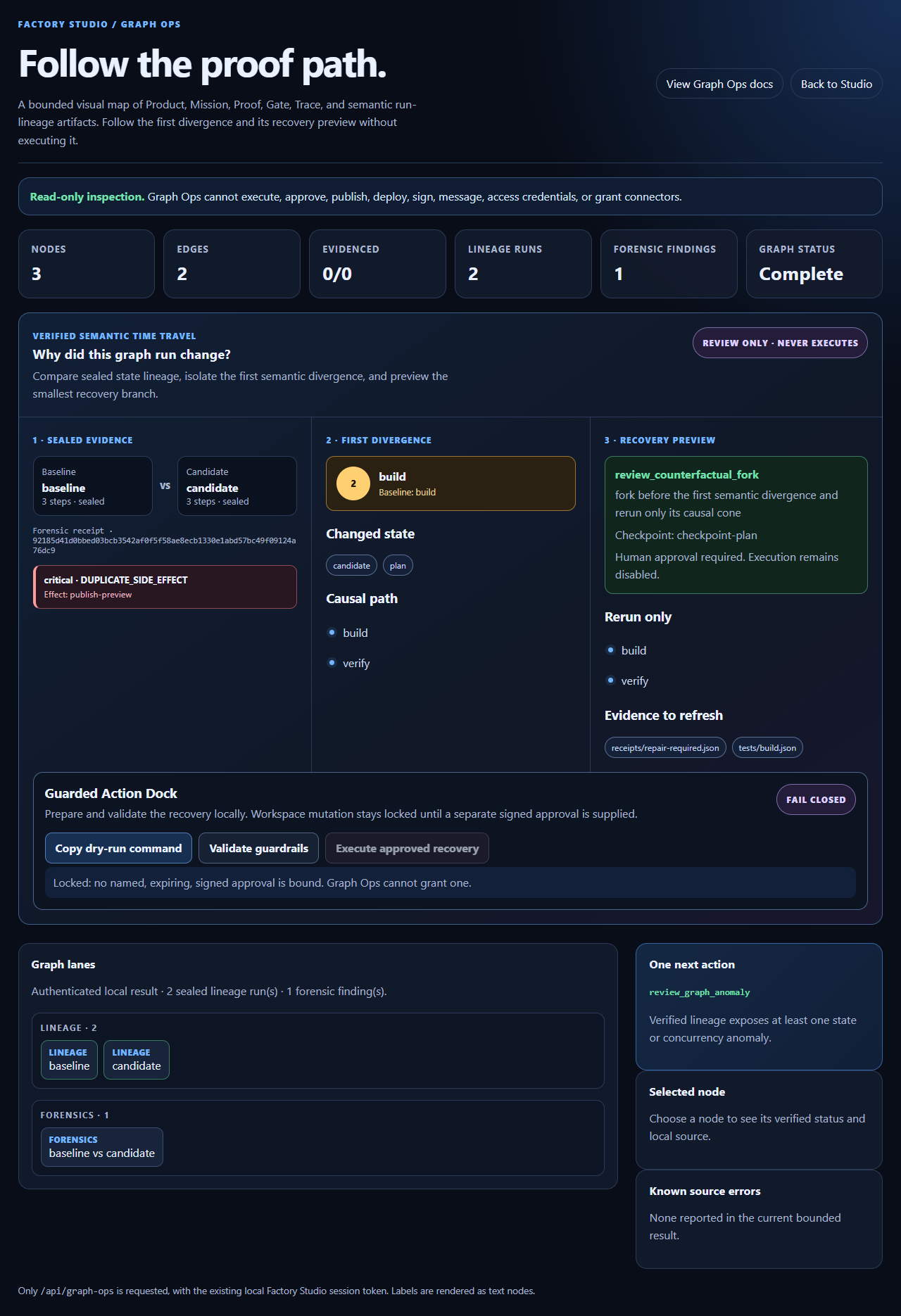
This full-page local capture shows Graph Ops tracing a change from sealed lineage through a forensic finding to a proposed recovery path. The guarded action remains locked; the dashboard is a read-only inspection surface.
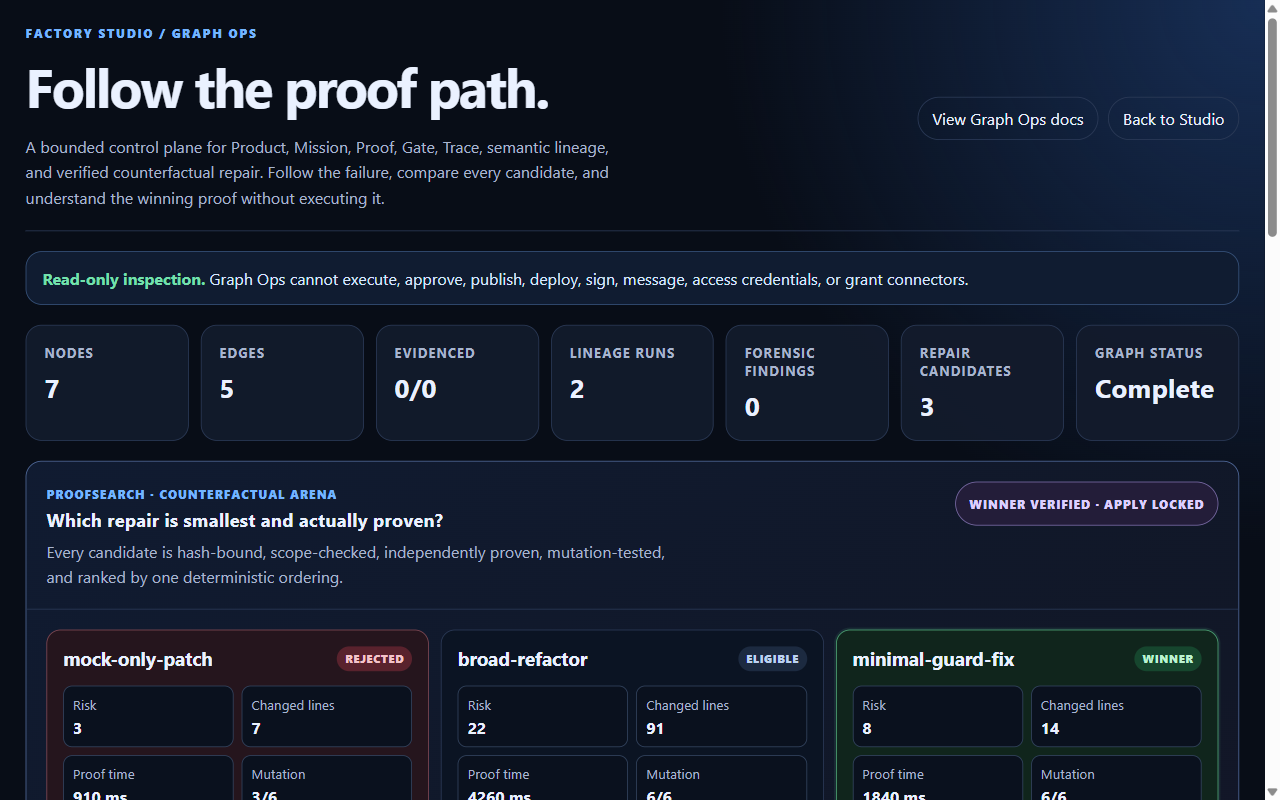
The Counterfactual Arena compares repair candidates and shows their evidence and risk. Winner controls and the Evidence Frontier show how a reviewer can inspect the rationale and choose the next proof.
The current Graph Ops UI also separates native deep-scan progress, evaluated deep-audit receipts, six runtime lanes, and individual JUnit test cases. Each panel labels its evidence state and next repair. Filter or search the recorded tests, then load more cases as needed; an inventory or a missing report never appears as a passing run. The JUnit reader accepts up to 10,000 cases and marks larger or malformed reports incomplete. A JUnit report is local observation without a current-candidate binding.
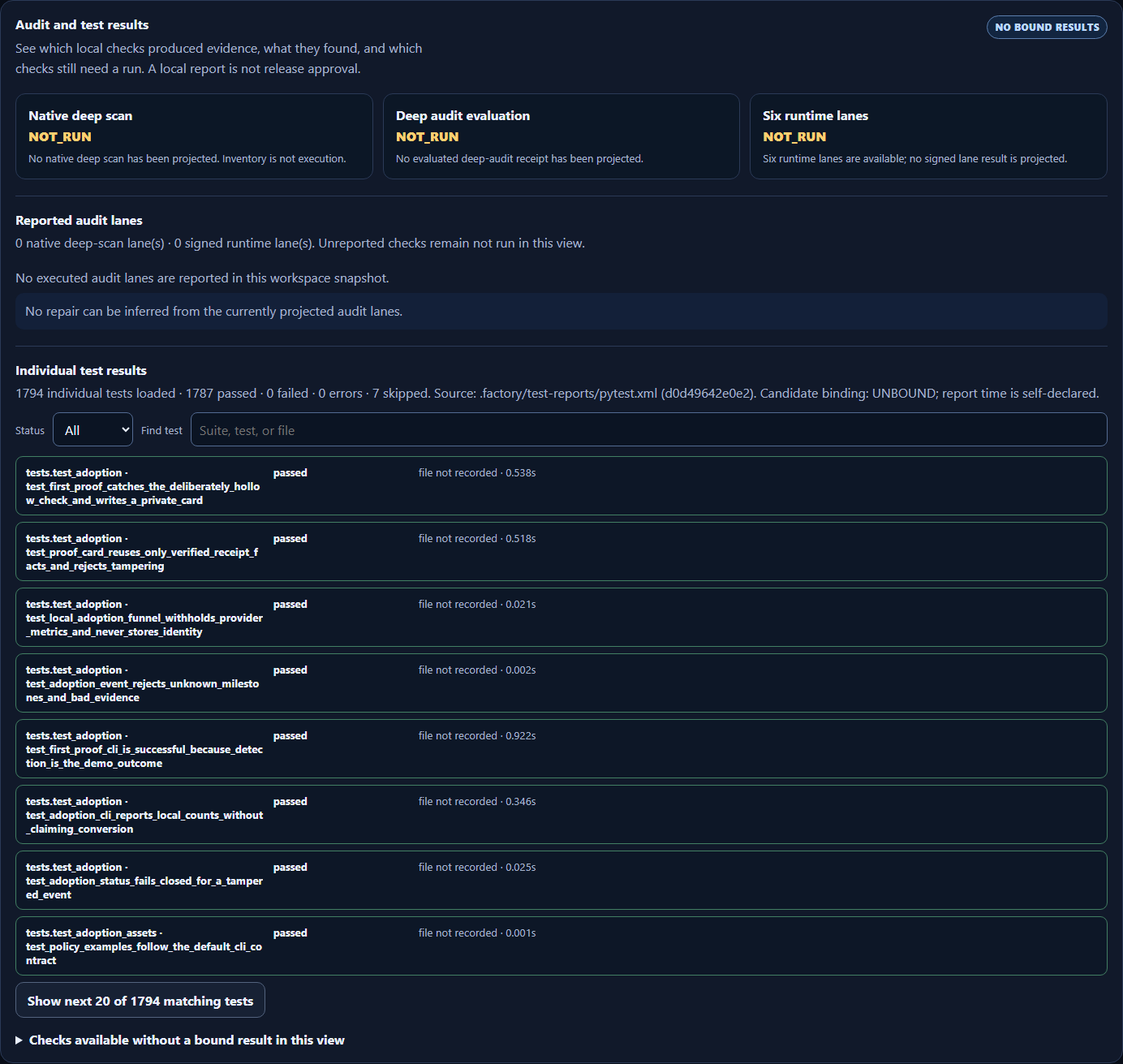
This local UI capture shows each reported test case with its status. The audit cards keep checks without a bound result explicitly marked not run.
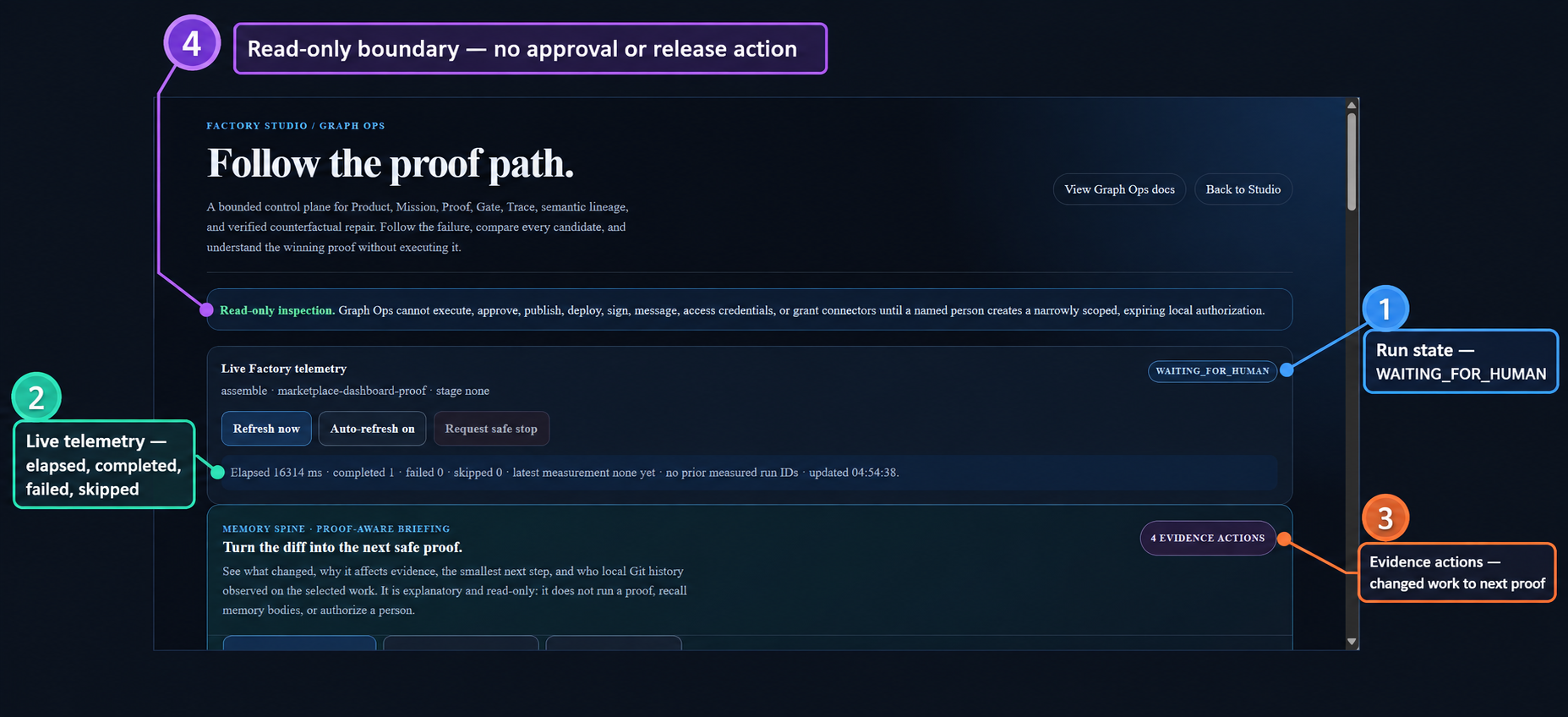
The labels explain an original local Assembly capture. That pictured run is waiting for human input; it does not imply release approval or that every check passed.
Install and start
python -m pip install factoryline-code-factory
factory --help
factory guide
In an interactive terminal, factory checks PyPI and caches the result for up
to 24 hours, then prints a notice when a newer version is available. Two
simultaneous first runs can both check. It never downloads or installs the
update. The check is quiet in CI, JSON output, server/MCP, help, version, and
non-interactive runs; set FACTORY_DISABLE_UPDATE_CHECK=1 to turn it off. The
plain PyPI request does not include a project path, account identifier, or
usage data.
Run repository commands from the project being reviewed. factory guide is a
read-only orientation; it does not run tests or agents.
Inspect this repository
These commands show the current architecture policy, the bounded static security scan, and the runtime-audit setup:
factory architecture health --root . --json
factory audit security --root . --json
factory runtime-audit status --root . --json
factory audit security checks a limited set of source patterns. It is not a
penetration test. The runtime audit needs a separately reviewed plan and its
own environment evidence. A status of NOT_RUN or a clean static scan is not a
complete project audit.
To display individual tests in Graph Ops, run your suite with a JUnit report at
.factory/test-reports/pytest.xml (for example,
python -m pytest --junitxml=.factory/test-reports/pytest.xml). The local
Studio reads the report and labels its candidate binding UNBOUND; it does
not infer that those results still apply after source changes.
The prior snapshot's repository self-audit receipt records A (97.9/100) and 1,055/1,085 functions attributed to test intent (97.24%). That static measurement applies to its recorded source digest; it is not a grade for later edits, runtime coverage, or certification.
ForgeLine 0.10.8 computes Python complexity for public module functions and
public class methods in its recorded metrics.scope.code_files; names starting
with _ are excluded. Its AST metric counts branches, boolean alternatives,
exception handlers, with, and assertions. Ruff C901 uses a different McCabe
metric and also checks private functions. CI therefore runs
python -m ruff check --select C901 factoryline tests separately at limit 10.
The ForgeLine maximum must not be read as the maximum of every Python function.
CI also checks action and reusable workflow references for immutable commit
pins; the generic workflow evidence validator alone does not inspect those refs.
Release controls
Candidate preflight requires release-cadence admission and strict architecture health. Protected main requires CI and a separate specialty AI source review; the coordinator records that assessment, separately from test evidence. It is not a second human approval. Provider publication and marketplace approval are separate outcomes. See release channels.
Architecture health checks growth budgets. ForgeLine's repository inventory
and feature QA are separate checks. The current gap review
records how the published ForgeLine 0.10.7 graded this source F/70.7 while
parser-corrected ForgeLine 0.10.8 grades it A/95.1. CF 0.47.0 requires 0.10.8
and checks real MJS, TS, and TSX feature QA during factory doctor --strict.
Static signals are neither executed coverage nor a security certification.
More detail
Reviews
No reviews yet
Be the first to review this server!
More Developer Tools MCP Servers
Git
Freeby Modelcontextprotocol · Developer Tools
Read, search, and manipulate Git repositories programmatically
Fetch
Freeby Modelcontextprotocol · Developer Tools
Web content fetching and conversion for efficient LLM usage
Worldmonitor
Freeby Koala73 · Developer Tools
Live markets, conflicts, country risk, chokepoints, energy, and China decision signals. 86 tools.
Toleno
Freeby Toleno · Developer Tools
Toleno Network MCP Server — Manage your Toleno mining account with Claude AI using natural language.
mcp-creator-python
Freeby mcp-marketplace · Developer Tools
Create, build, and publish Python MCP servers to PyPI — conversationally.
MCP Marketplace
Freeby mcp-marketplace · Developer Tools
Search and install MCP servers from inside your AI client.