
Server data from the Official MCP Registry
Bug reports, ideas, roadmap and changelog: search, triage and close the loop with customers.
About
Bug reports, ideas, roadmap and changelog: search, triage and close the loop with customers.
Remote endpoints: streamable-http: https://ozvi.io/mcp
Security Report
Valid MCP server (2 strong, 2 medium validity signals). No known CVEs in dependencies. Imported from the Official MCP Registry.
Endpoint verified · Requires authentication · 1 issue found
Security scores are indicators to help you make informed decisions, not guarantees. Always review permissions before connecting any MCP server.
Permissions Found in Source Code
Found by scanning the linked source code. This listing connects to a hosted endpoint, so none of this runs on your machine: it describes what the server software does where it is hosted.
How to Connect
Remote Plugin
No local installation needed. Your AI client connects to the remote endpoint directly.
Add this to your MCP configuration to connect:
{
  "mcpServers": {
    "io-ozvi-ozvi": {
      "url": "https://ozvi.io/mcp"
    }
  }
}Documentation
View on GitHubFrom the project's GitHub README.
Ozvi
Source-available bug reports and an idea board that look like your product.
Website · Live demo · Docs · Videos · @ozvi/widget · @ozvi/sdk
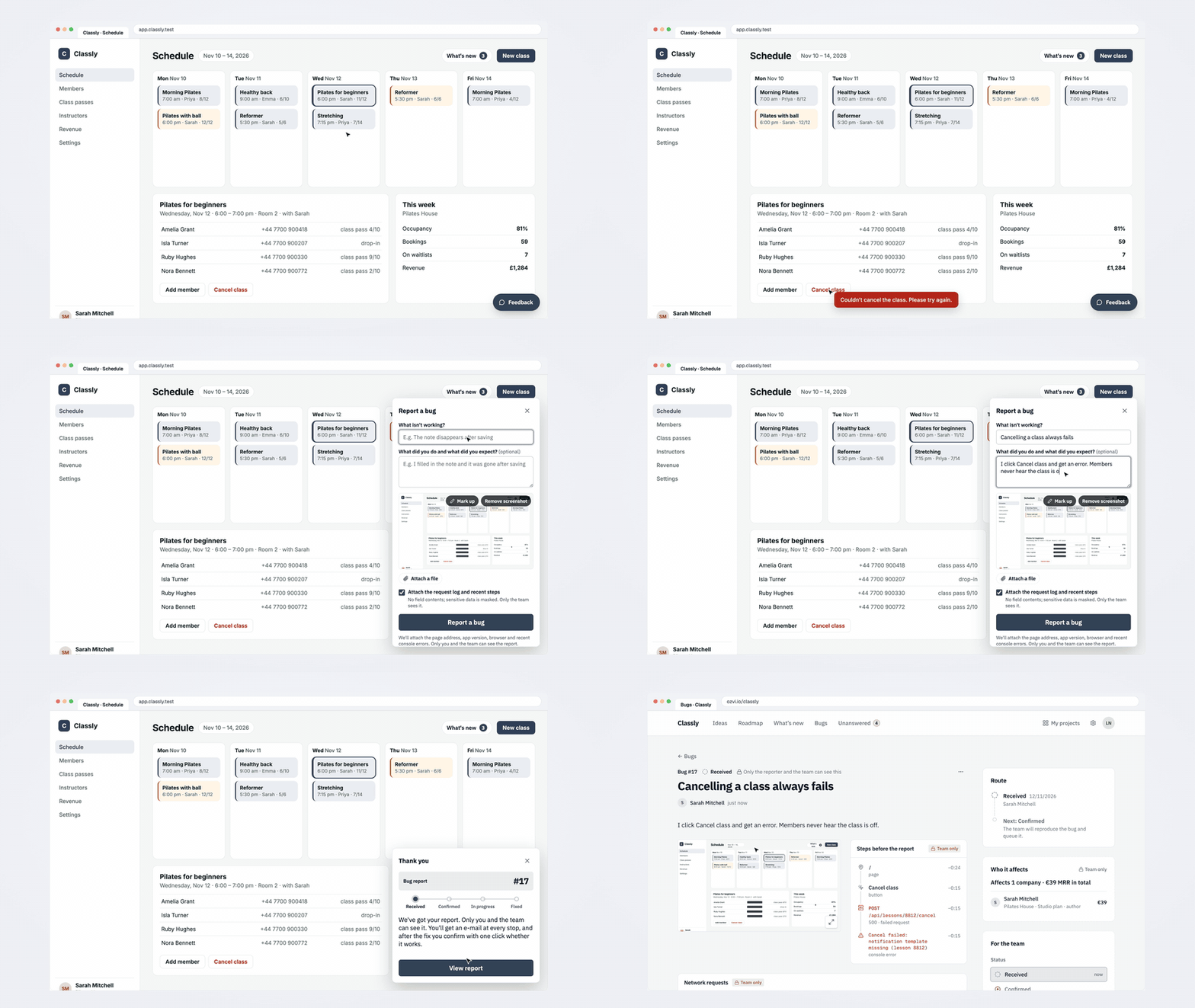
- Two spaces. A private bug flow with automatic context (page, app version, browser, console errors, a screenshot with form values, e-mails, phone numbers and card numbers covered in the browser) and a public idea board with voting, roadmap and changelog.
- Closing the loop. "Fixed in 2.15.1 — does it work for you?" goes to the reporter, linked GitHub issues and releases set it for you, and publishing a changelog entry e-mails everyone who voted.
- Your design. One
theme.json(colours, fonts, radius, density) styles the board, the widget and the e-mails. - Your login. Users stay signed in from your app via a signed token or OIDC; boards can also offer sign-in by e-mailed code.
- Your tools. A built-in MCP server (personal tokens or OAuth connectors) lets Claude and other agents search, summarise, triage and publish — with confirmation for anything irreversible and user text always handed over as data. Webhooks for Slack, Discord or your backend.
- Optional AI. Duplicate detection (embeddings via any OpenAI-compatible endpoint, or fuzzy text matching with none), thread summaries, changelog drafts and a weekly team digest written by the model you choose: Claude natively or any OpenAI-compatible API (OpenAI, Mistral, Ollama, vLLM…).
Self-hosting is free with every feature (FSL-1.1-ALv2, see Licence). The same image runs the hosted cloud.
Embed in your app
<script src="https://feedback.example.com/widget.js" defer></script>
<ozvi-widget project="myapp" token-url="/api/ozvi-token" app-version="1.4.0"></ozvi-widget>
// npm i @ozvi/sdk   (MIT, zero deps; Python and PHP without a library: ozvi.io/docs/widget#sign-in)
import { signOzviToken } from "@ozvi/sdk";
app.get("/api/ozvi-token", requireLogin, (req, res) =>
  res.json({ token: signOzviToken({ id: req.user.id, email: req.user.email, name: req.user.name }, process.env.OZVI_SSO_SECRET) }));
Screenshots cover form values, e-mails, phone numbers, IBANs, card numbers and tokens on their own; mark anything else sensitive (names, notes) with data-ozvi-mask, or set OzviConfig.mask = "all" to cover all text. More: docs/INTEGRACIA.md.
Self-host
cd deploy && cp .env.example .env && docker compose up -d
docker compose exec ozvi node ozvi.mjs project:create myapp "My app" --origin https://app.example.com
Images are public on ghcr.io/xzamiska/ozvi (amd64 and arm64; tags such as 1.2.8, 1.2, 1, latest). An optional updater container backs up the database, installs a new version on request or at night and rolls back when it is not healthy. Release notes: ozvi.io/releases.
See docs/SELFHOST.md. Moving from Fider: docs/MIGRACIA-Z-FIDERU.md. Cloud mode: docs/CLOUD.md. Decisions: docs/adr.
Optional: OZVI_AI_PROVIDER (anthropic or openai for any OpenAI-compatible API) + OZVI_AI_API_KEY + OZVI_AI_MODEL turn on AI writing help (see docs/SELFHOST.md); OZVI_EMBEDDINGS_URL + OZVI_EMBEDDINGS_MODEL turn on embedding-based duplicates.
Connect an AI assistant
claude mcp add --transport http ozvi https://feedback.example.com/mcp --header "Authorization: Bearer ozvi_pat_…"
Or add https://feedback.example.com/<project>/mcp as a custom connector in Claude — sign-in and consent happen on the board. Tools: packages/mcp/README.md.
Develop
pnpm install
cp .env.example .env
pnpm dev            # Postgres 17 + Mailpit in Docker, migrations, web on :3300
pnpm test
With pnpm dev and OZVI_DEV_LOGIN=1 (in .env.example): http://localhost:3300/dev/login?project=billiwo&as=team signs you in as an admin, http://localhost:3300/demo shows the widget inside a fake host app, Mailpit is on http://localhost:8046.
| Path | What |
|---|---|
apps/web | Next.js board, roadmap, changelog, admin, /app (cloud), widget API, MCP, workers, Fider importer |
packages/db | Drizzle schema and migrations (Postgres 17) |
packages/theme | theme.json schema, presets, CSS variables, contrast checks |
packages/sdk | signOzviToken for host-app SSO (MIT) |
packages/widget | Embeddable <ozvi-widget> (Preact, shadow DOM, ~10 kB gzip) |
packages/mcp | MCP tools served at /mcp |
Licence
FSL-1.1-ALv2 (Functional Source License, Apache 2.0 future licence): use, modify and self-host Ozvi for any purpose except offering it as a competing commercial service. Each release becomes Apache 2.0 two years after it is published.
packages/sdk and packages/widget are MIT so they can ship inside closed-source host apps.
Reviews
No reviews yet
Be the first to review this server!
More Developer Tools MCP Servers
Rea
Freeby Morluto · Developer Tools
Reverse engineer anything from your terminal or agent with one CLI and MCP server.
Paperclip
Freeby Paperclipai · Developer Tools
Trending hip-hop artist momentum scores across four cultural dimensions.
Scrapling
Freeby D4Vinci · Developer Tools
Web scraping with stealth HTTP, real browsers, and Cloudflare bypass. CSS selectors supported.
Git
Freeby Modelcontextprotocol · Developer Tools
Read, search, and manipulate Git repositories programmatically
Toleno
Freeby Toleno · Developer Tools
Toleno Network MCP Server — Manage your Toleno mining account with Claude AI using natural language.
MCP Marketplace
Freeby mcp-marketplace · Developer Tools
Search and install MCP servers from inside your AI client.