
Server data from the Official MCP Registry
Will this LLM fit on your GPU, multi-GPU rig or Mac? Exact VRAM & KV-cache math. Read-only.
About
Will this LLM fit on your GPU, multi-GPU rig or Mac? Exact VRAM & KV-cache math. Read-only.
Remote endpoints: streamable-http: https://fitllm.run/api/mcp
Security Report
Valid MCP server (1 strong, 1 medium validity signals). No known CVEs in dependencies. Imported from the Official MCP Registry.
3 tools verified · Open access · No issues found
Security scores are indicators to help you make informed decisions, not guarantees. Always review permissions before connecting any MCP server.
Permissions Found in Source Code
Found by scanning the linked source code. This listing connects to a hosted endpoint, so none of this runs on your machine: it describes what the server software does where it is hosted.
How to Connect
Remote Plugin
No local installation needed. Your AI client connects to the remote endpoint directly.
Add this to your MCP configuration to connect:
{
  "mcpServers": {
    "run-fitllm-fitllm": {
      "url": "https://fitllm.run/api/mcp"
    }
  }
}Documentation
View on GitHubFrom the project's GitHub README.
FitLLM Engine
FitLLM is an open-source, zero-dependency engine that checks whether a local LLM fits on a GPU or Apple Silicon Mac using architecture-aware memory math.




Live: https://fitllm.run · Bilingual · Free · No ads · No login
Open engine: fitllm-engine (MIT · npm
fitllm-engine·npx fitllm)Zero dependencies. One readable file:
engine.js. Conformance-vector tested. MIT.
Install
# self-contained binary — no Node required
curl -fsSL https://fitllm.run/install.sh | sh

# Homebrew (tap) — the trust line is required for any third-party tap
brew tap click6067-ship-it/fitllm
brew trust click6067-ship-it/fitllm
brew install fitllm

# Windows (Scoop)
scoop install https://raw.githubusercontent.com/click6067-ship-it/fitllm-engine/master/packaging/fitllm.json

# already have Node? nothing to install
npx fitllm "Gemma 4 12b" --gpu "RTX 4090"
Binaries for macOS (arm64/x64), Linux (x64/arm64, glibc and musl) and Windows x64 are attached to every release with a .sha256 next to each one; install.sh verifies the checksum and installs nothing if it does not match.
Two things stated plainly rather than buried: each binary embeds its JavaScript runtime, so it is 60–94 MB — much larger than an equivalent Rust or Go tool, which is the price of not forking the engine into a second language. And this is a Homebrew tap (click6067-ship-it/homebrew-fitllm), not homebrew-core: core's bar for a self-submitted project is 225 stars / 90 forks / 90 watchers, which this project does not meet yet.
Quick start
npx fitllm "Gemma 4 12b" --gpu "RTX 4090"     # one line, exit 0 fits / 1 won't — run before you download
npx fitllm --top --gpu 4090                    # what can this hardware run?
npx fitllm --top --detect --json               # detect every supported local GPU; agent-ready JSON
npx fitllm Qwen/Qwen3-32B --detect --json      # public Hugging Face ID or URL; unsupported configs fail closed
npx fitllm "Gemma 4 12b" --detect --json --why # include architecture, evidence, assumptions, and exact memory inputs
npx fitllm scan                                # what you already downloaded — does it fit this machine?
npm install fitllm-engine                      # use the same engine as a library (see Usage)
fitllm scan — start from what you already have
Instead of typing a model name, read the ones already on disk:
$ fitllm scan
Hardware: RTX 4090 (24GB) · quant Q4_K_M · ctx 8,192

ollama (3)
  ✓ FITS  qwen3:0.6b  →  Qwen3-0.6B
          1.2 GB used, 22.8 GB free  (on disk: 0.5 GB · Q4_K_M)
  ?       some-finetune:latest  —  not in the catalog, no verdict  (on disk: 6.7 GB · Q5_K_M)
It reads Ollama through its loopback API and LM Studio through lms ls --json. Both are read-only: no pull, no load, no settings written, and nothing is sent anywhere. A non-loopback OLLAMA_HOST is refused rather than queried.
A model the catalog does not know gets no estimate — only the size and quant the runtime itself reported. Guessing from a similar name would hand you another model's numbers, which is worse than no number.
Verification status, stated plainly: the Ollama path is exercised end-to-end in CI against a real Ollama install (verify-install-paths.yml). The LM Studio path is covered by fixtures only — there is no LM Studio on the machine this was written on, so it has not been run against the real CLI.
Remote MCP server
Connect any Streamable HTTP MCP client to https://fitllm.run/api/mcp:
{
  "mcpServers": {
    "fitllm": {
      "url": "https://fitllm.run/api/mcp"
    }
  }
}
Tools
check_llm_fit— check one model against a GPU, multi-GPU rig, or Mac and return the verdict, memory breakdown, and a fix when it does not fit.what_fits_on_hardware— rank the supported local models that fit the given GPU, multi-GPU rig, or Mac.list_supported— list the built-in model and hardware names accepted by the fit checker.
The server is read-only, stateless, and requires no authentication.
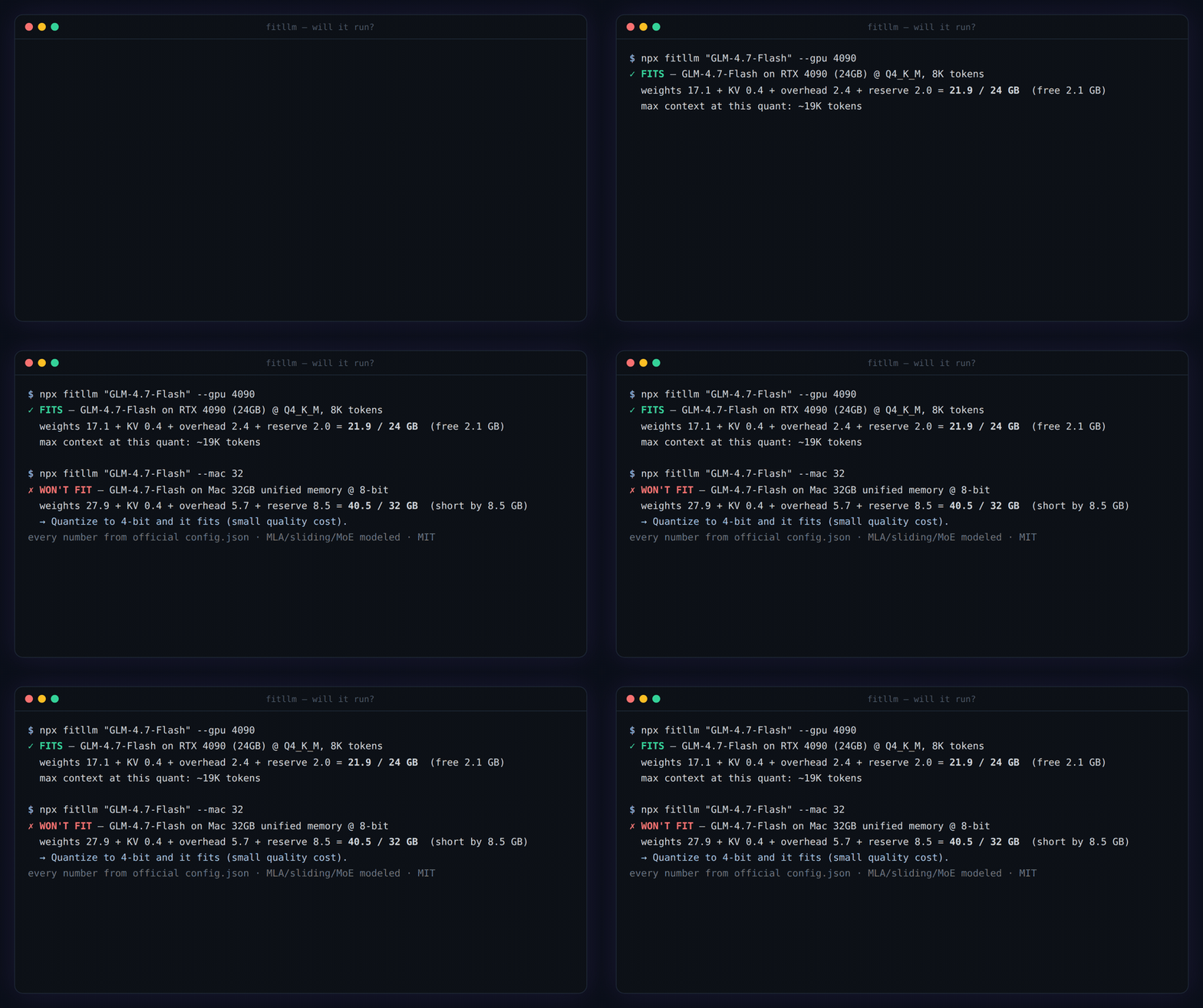
npx fitllm "GLM-4.7-Flash" --gpu 4090     # ✓ FITS — 21.9/24 GB, free 2.1 GB
npx fitllm "gpt-oss-120b" --mac 64        # ✗ WON'T FIT → what to change to make it fit
npx fitllm "Qwen 3.6 35B" --gpu "5090 + 3090"   # multi-GPU rig — VRAM pools (56GB), even mixed cards
npx fitllm --top --detect --json          # detect hardware + what fits, for people or agents
npx fitllm "Gemma 4 12b" --detect         # one verdict on this machine
--detect reads all nvidia-smi adapters, uses Apple Silicon unified memory on arm64 macOS, and can resolve an exact catalog GPU name through Windows/WSL PowerShell. It never uses Win32_VideoController.AdapterRAM, serials, PNP IDs, or full environment dumps. Intel-only, ambiguous, and unsupported adapters stop with exit 2 instead of borrowing a nearby GPU's memory.
Why a CLI? The "will it run?" question is born in the terminal — one line before ollama pull. No install, no tab-switching, and it reads your actual hardware with --detect instead of asking you to know your VRAM. Exit code 0/1 makes it a pre-download guard:
# in your model-pull script — stop BEFORE the 40 GB download:
npx fitllm "gpt-oss-120b" --detect || { echo "won't fit — aborting pull"; exit 1; }
Put the guard in the download path
The CLI exit contract composes directly with model runtimes. The download or launch runs only after a FITS or TIGHT verdict; invalid inputs stop with exit 2.
npx fitllm "Gemma 4 12b" --detect && ollama pull gemma4:12b
npx fitllm "Llama-3.1-8B-Instruct" --detect && llama-cli -m ./Meta-Llama-3.1-8B-Instruct-Q4_K_M.gguf
For CI, use the repository's composite Action. It needs no secret and returns the full --json --why result as steps.preflight.outputs.result:
permissions:
  contents: read
steps:
  - name: Check model memory before download
    id: preflight
    uses: click6067-ship-it/fitllm-engine@v2.18.0
    with:
      model: Gemma 4 12b
      gpu: RTX 4090
      ctx: '8192'
Set exactly one of gpu or mac. The Action preserves the CLI contract: exit 0 means fits/tight, 1 means it will not fit, and 2 means the request is invalid. Inputs cross the GitHub expression boundary through environment variables and are passed to Node as a Bash argument array.
Agents can collect a typed measurement without uploading anything:
npx fitllm measure "Qwen 3.6 27B" --detect --measured 15.3 --kind system_total_peak --unit GiB --runtime "llama.cpp b6400"
The command validates the conditions and prints a candidate JSON object plus a prefilled GitHub issue URL. Submission remains a human action.
If you run Ollama, you do not have to measure anything yourself — it already reports the resident size of a loaded model:
ollama run qwen3:0.6b        # in one shell
npx fitllm measure --from-ollama   # in another
This reads GET /api/ps and GET /api/version over loopback. It is read-only: it does not load, unload, pull, or change anything, and it submits nothing — you get the candidate and the issue link, and you decide.
What it verifies, and what it does not. The number is idle_resident: weights plus KV resident in VRAM with the model loaded and idle. It is not peak memory during generation, so it checks part of a prediction rather than all of it, and the candidate says so.
When it refuses. If size_vram differs from size, or is zero, no candidate is produced. Ollama's documentation does not define what those fields mean when they disagree, and partial residency is something this engine deliberately does not model — a number nobody can interpret is worse than no number. Models outside the catalog are skipped too: with no prediction, there is nothing to compare against. Public Hugging Face IDs (org/model) are fetched with a bounded config/index reader and accepted only when parseHfConfig() supports the architecture.
This is the open calculation core of FitLLM. The math is open so you can audit it.
Ask an LLM "does Qwen 3.6 fit my GPU?" and it pattern-matches to an architecture from its training cutoff — and usually says no. Catalog-based calculators lag new releases. The CLI, API, and MCP use a curated catalog pinned to official configs. The web calculator can additionally inspect a pasted Hugging Face ID's official config.json live, so supported architectures work on day-one releases — including the hybrid / sliding-window / MoE structures that naive formulas get wrong.
Covers Apple Silicon unified memory (M1–M6, Pro/Max/Ultra — up to the 512GB Mac Studio), NVIDIA GPUs (RTX 20/30/40/50, workstation RTX 6000 Ada / RTX PRO 6000, datacenter A100/H100/H200/B200), AMD Radeon (RX 7000/9000, PRO W7900) and multi-GPU presets (2×3090, 2×4090, 4×3090) — with GGUF Q-tier weight quantization kept separate from KV-cache quantization. Hardware entries carry their source URLs per-value in engine.js; new entries require ≥2 independent sources (CONTRIBUTING).
Why most LLM memory calculators are wrong
Almost every "can I run this LLM?" calculator estimates the KV cache with the textbook formula:
KV ≈ 2 × num_layers × num_kv_heads × head_dim × context_length × bytes
That assumes every layer keeps a full-context KV cache with one uniform head shape. True for Llama-1/2 — wrong for most 2025–2026 models:
| Model | What naive formulas miss | Naive KV | FitLLM KV | Off by |
|---|---|---|---|---|
| Gemma 4 31B @131K, 8-bit | 50 of 60 layers are sliding-window (keep only the last 1024 tokens); the 10 global layers use a different head shape (4 KV-heads × 512, not 16 × 256) | ~60 GB | ~5.4 GB | 11× |
| Qwen 3.6 27B @131K, 8-bit | 48 of 64 layers are linear attention (Gated DeltaNet) — no growing KV cache | ~16 GB | ~4 GB | 4× |
| Qwen 3.8 27B @256K, F16 KV | same shape, newest generation: KV lives on 16 of 64 layers only | 64.0 GiB | 16.0 GiB | 4× |
| GLM-4.7-Flash @128K, bf16 | MLA: K/V compressed into one shared latent (512+64 dims, cached once — not per-head K and V) | ~117 GB | ~6.6 GB | 17.8× |
| Plain dense (Llama, Mistral…) | nothing — standard transformer | same | same | 1× ✅ |
An 11× error flips the verdict: a naive calculator says Gemma 4 31B won't fit in 64 GB at long context, when it fits comfortably.
The five things they ignore
- Sliding-window attention (Gemma 2/3/4, gpt-oss): most layers only keep the last N tokens, so their KV stops growing. Only the global layers scale with full context.
- Hybrid / linear attention (Qwen 3.6 / 3.8, many 2026 models): linear-attention layers use a fixed-size recurrent state, not a growing KV cache. That state is modeled too, as its own component (
linearState) — it is a constant per sequence, so it never inflates the context curve. - MLA — Multi-head Latent Attention (GLM-5.2, GLM-5.3, GLM-4.7-Flash, DeepSeek family): the cache is a single low-rank latent (
kv_lora_rank+ RoPE dims) shared across all heads — per-head "2 × heads × head_dim" formulas over-count by an order of magnitude. Verified against the DeepSeek-V2 paper (arXiv:2405.04434) and the official DeepSeek-V3 inference code. - Heterogeneous head dims + MoE: global layers can use a different
head_dim(Gemma 4: 512 vs 256). MoE keeps every expert in memory while activating only a few per token. - PLE — Per-Layer Embeddings (Gemma 4 e2b/e4b): the pinned llama.cpp/GGUF path assigns the
per_layer_token_embdinput-layer tensor to CPU/host buffers instead of accelerator memory, so only the non-PLE weights are counted against VRAM for the verified Gemma 4 e2b/e4b entries. Counting all 5.1B params against a GPU over-predicts e2b's resident weights by ~1.9× and flips small-card verdicts. This deduction is conditional and rests on that placement alone: the host memory the tensor needs is not budgeted by the GPU verdict, a runtime that loads PLE tensors onto the accelerator (vLLM, for example) invalidates the estimate, and unverified families keep their full weights resident. On Apple Silicon unified memory the full weights stay counted. The exact premise and its pinned sources are listed under Structural premises; a direct measurement on a Gemma 4 GGUF is welcome in issue #7.
This engine models each layer type separately, verified against official HuggingFace config.json files.
What it computes
Total = Parameters (quantization-adjusted)
      + KV cache (per layer kind: sliding / global / linear / dense)
      + Runtime overhead (quant metadata + KV block padding + activations + fixed)
      + macOS base (Apple Silicon unified memory)
Plus a parseHfConfig() that turns configs from verified, modeled Hugging Face architecture families into the model shape above; unsupported structures fail closed instead of returning a guess. (No token/s prediction — deliberately: speed depends on runtime/backend in ways a static model can't claim honestly. Fit is a verifiable claim; speed is not.)
Structural premises
Some verdicts are valid only under a structural premise about the artifact or the runtime path. The engine derives the active premises from the same normalized model fields the calculation uses and attaches them to affected results as structuralAssumptions, an array of { id, statement }. Unaffected results, such as plain GQA models, carry no such key, so legacy JSON shapes are unchanged. The CLI prints each active premise as a premise [id]: line in text mode and includes the array in --json (also per row in --top --json); --why and the composite Action forward the same array. There is no runtime selector, no confidence score, and no speed claim: a premise tells you what the memory math assumes, not how fast the model runs.
mla-compressed-latent-cache— KV memory assumes a compressed-latent MLA artifact or mode; legacy non-MLA GGUF or an explicitly uncompressed mode invalidates this estimate. Sources: DeepSeek-V3 inferencemodel.py· llama.cppconvert_hf_to_gguf.py· llama.cppllama-kv-cache.cpp.ple-llamacpp-non-gpu-residency— GPU weight memory excludes the verified Gemma 4 PLE tensors only because the pinned llama.cpp/GGUF path assigns the per_layer_token_embd input-layer tensor to CPU/host buffers instead of accelerator memory; that host memory is not budgeted here, and a runtime that loads PLE onto the accelerator invalidates this estimate. Sources: Gemma 4 E2Bconfig.json(text bodymodel_typeis exactlygemma4_text) · pinned llama.cpp8b4b3558f1459c13e4aa38d5c94d306a00dc6acd: input-layer device assignment ·PER_LAYER_TOKEN_EMBDas an input-layer tensor · Gemma 4 construction · loader header · loader implementation. The deduction applies only to the catalog entriesGemma 4 e2bandGemma 4 e4b(pleOffloadVerified: true) and to parsed configs whose text body is exactlygemma4_textand whose full profile (layer count,hidden_size,intermediate_sizeand both PLE dimensions) matches a pinned official E2B/E4B config with a checkpoint that reconciles against the config's own dense body. A look-alike field on any other family, an altered dimension or layer count, or an inconsistent checkpoint keeps the full weights resident on the GPU, so an unverified config cannot flip a verdict toward "fits".mtp-ordinary-generation— KV memory assumes ordinary non-speculative generation; an MTP draft context is not included. Sources: llama.cppllama-hparams.cpp· llama.cppllama-model.cpp· llama.cppconvert_hf_to_gguf.py· vLLMqwen3_next_mtp.py.
Resident scope. SSD/NVMe streaming, expert paging, swap and general CPU/RAM offload stay outside ordinary FitLLM fit verdicts. The one disclosed structural exception is a placement fact, not storage paging: for the verified Gemma 4 e2b/e4b entries the discrete-GPU verdict excludes the per-layer-embedding (PLE) tensor because the pinned llama.cpp/GGUF path deterministically assigns that input-layer tensor to CPU/host buffers instead of accelerator memory (premise ple-llamacpp-non-gpu-residency, shown with the verdict). That host/system memory is not budgeted by the discrete-GPU verdict, a runtime that loads PLE onto the accelerator invalidates the PLE estimate, and on Apple unified memory the full weights stay counted.
npx fitllm "GLM-4.7-Flash" --gpu "RTX 4090"          # text adds:  premise [mla-compressed-latent-cache]: KV memory assumes …
npx fitllm "GLM-4.7-Flash" --gpu "RTX 4090" --json   # adds "structuralAssumptions": [{ "id": "…", "statement": "…" }]
npx fitllm "Llama-3.1-8B-Instruct" --gpu "RTX 4090" --json   # plain GQA: no structuralAssumptions key at all
Usage
// from npm:  npm install fitllm-engine
import { simulate, structuralAssumptions, LOCAL_MODELS, GPUS, gpuDevice, parseHfConfig } from 'fitllm-engine';
// …or vendored single-file:
// import { simulate, structuralAssumptions, LOCAL_MODELS, GPUS, gpuDevice, parseHfConfig } from './engine.js';

const model = LOCAL_MODELS.find((m) => m.name === 'Gemma 4 31b');
const sim = simulate(model, /*ram*/ 64, /*ctx*/ 131072, /*bits*/ 8);
// → { used, free, verdict: 'yes'|'tight'|'no', param, kv, rt, os, maxContext, ... }

// affected results carry the active structural premises; plain GQA results have no such key:
const gpu = gpuDevice(GPUS.find((g) => g.name === 'RTX 4090'));
const mla = simulate(LOCAL_MODELS.find((m) => m.name === 'GLM-4.7-Flash'), gpu, 8192, { weightBpw: 4.8944, kvBits: 16 });
mla.structuralAssumptions; // → [{ id: 'mla-compressed-latent-cache', statement: '…' }]
structuralAssumptions(model, gpu); // → [] for an unaffected model (pure; same inputs as the calculation)

// a config from a modeled Hugging Face architecture family:
const m = parseHfConfig('Qwen/Qwen3-32B', configJson, totalSizeBytes);
Verification
From a repository checkout, recompute the typed measured-vs-predicted ledger with npm run benchmark:accuracy (or add -- --json). Run the pinned estimator differential with npm run benchmark:differential. To recapture its uncut source output from a separately downloaded official llmfit release artifact:
npm run benchmark:capture:llmfit -- --binary /path/to/llmfit --artifact /path/to/llmfit-v1.1.12-x86_64-unknown-linux-gnu.tar.gz
The differential is labeled architecture_differential_not_runtime_accuracy: it demonstrates how estimators treat GQA, sliding-window attention, and MLA, but it is not runtime measurement evidence. The methodology, competitor input format, checksums, and precommitted kill conditions are in benchmarks/README.md. The current evidence does not clear the comparative accuracy claim gate.
- Architecture values checked against official HuggingFace
config.json. - Gemma 4 31B full-context KV reproduces 20.78 GiB, matching the published architecture analysis. Reproduce it by hand:
global: 10 layers × 2(K,V) × 4 heads × 512 dim × 2 B × 262,144 = 21,474,836,480 B
local:  50 layers × 2(K,V) × 16 heads × 256 dim × 2 B × 1,024  =    838,860,800 B
total = 22,313,697,280 B ÷ 1024³ = 20.78 GiB
- MLA per-token cost: GLM-4.7-Flash = (512 + 64) × 2 B × 47 layers = 54,144 B/token — pinned by conformance vectors.
All figures are estimates — real usage varies with the runtime (MLX/Ollama/llama.cpp), OS state, and quantization scheme.
Conformance vectors
vectors/fit-vectors-v1.json pins 33 language-neutral test vectors (exact KV bytes, per-token costs, fit verdicts) derived by hand from official config.json values — e.g. "Gemma 4 31B at 262,144 ctx, bf16 = exactly 22,313,697,280 bytes". Any implementation in any language conforms if every vector passes — run ours with node vectors/run.mjs.
Why this matters: the formulas are easy to copy; a verified answer key is not. If you port this engine to Python, Rust or Go, you don't become an untrusted fork — pass the vectors and you're a conformant implementation of the same standard. Port the engine, keep the vectors.
The Fit Census — every model × every device, one truth table
census/ holds 10,530 verdicts (30 models incl. draft tier × 93 GPUs/Macs × quant tiers) computed by this engine — as CSV/JSON you can import, chart or cite, plus a starter matrix ("biggest model that fits comfortably per device"). Regenerate it yourself: npm run census. Real-world measurements land next to predictions via fixtures/ PRs — predicted vs. measured, in public.
Embed a fit badge
Show whether a model runs on given hardware — live from the engine, one line in any README or model card:


Params: model (name, fuzzy), gpu (name, fuzzy) or ram (GB, Apple unified memory), optional quant (GGUF tier / 4|8|16), ctx, kv. Verdict color: green fits · yellow tight · red won't fit.
Why embed it? The #1 question under every model card and local-AI tutorial is "will it run on my machine?" The badge answers it live from the engine — recomputed when the data updates, not a stale claim frozen into your README. If you publish models or write guides: one line replaces a whole FAQ paragraph and cuts the "it OOM'd on my 8GB card" issues before they're filed.
Ask your AI assistant (MCP)
The engine runs as a public MCP server at https://fitllm.run/api/mcp — connect it once and your assistant answers "can I run X on my Y?" with this engine's math instead of guessing from stale training data (LLMs routinely get KV-cache math wrong — see the 17.8× table above).
- Claude (web / desktop / mobile): Settings → Connectors → Add custom connector → paste
https://fitllm.run/api/mcp - Claude Code:
claude mcp add --transport http fitllm https://fitllm.run/api/mcp - Cursor / Windsurf: add to
mcp.json→{ "mcpServers": { "fitllm": { "url": "https://fitllm.run/api/mcp" } } } - ChatGPT: Settings → Apps → Advanced → Developer mode → add MCP server (Plus/Pro)
Tools: check_llm_fit (verdict + full memory breakdown + fix suggestion — supports multi-GPU rigs like "RTX 5090 + RTX 3090"), what_fits_on_hardware (ranked list for your machine), list_supported. Resources: fitllm://models, fitllm://hardware, fitllm://census, fitllm://engine. Intentionally open: read-only, stateless, no auth, no secrets — every call is a pure function of public data.
Listed on: official MCP registry (run.fitllm/fitllm) · Glama · mcp.so · Smithery
For agents & scripts — plain HTTP API
No MCP client? One GET, no auth, no key — JSON by default, plain text for curl:
curl 'https://fitllm.run/api/check?model=gemma%204%2031b&gpu=4090'
# multi-GPU rigs: gpu=5090%2B3090 · Mac: ram=64 · usage: curl https://fitllm.run/api/check
Open data: the full Fit Census (10,530 verdicts, CC0) at fitllm.run/data and on Hugging Face Datasets. Try the engine in-browser: HF Space demo.
Principles
No ads. No login. No affiliate links. Output is never for sale. Fit is a winnable, verifiable claim; raw tok/s is not — so this engine refuses speed predictions rather than dress a guess as precision.
Help calibrate
Ran a model and measured real peak memory? Report a measurement — it improves the estimates for everyone.
Built by
yongha — GitHub. Powers fitllm.run.
License
MIT © click6067-ship-it
Reviews
No reviews yet
Be the first to review this server!
More Developer Tools MCP Servers
Git
Freeby Modelcontextprotocol · Developer Tools
Read, search, and manipulate Git repositories programmatically
Fetch
Freeby Modelcontextprotocol · Developer Tools
Web content fetching and conversion for efficient LLM usage
Worldmonitor
Freeby Koala73 · Developer Tools
Live markets, conflicts, country risk, chokepoints, energy, and China decision signals. 89 tools.
Paperclip
Freeby Paperclipai · Developer Tools
Trending hip-hop artist momentum scores across four cultural dimensions.
Toleno
Freeby Toleno · Developer Tools
Toleno Network MCP Server — Manage your Toleno mining account with Claude AI using natural language.
mcp-creator-python
Freeby mcp-marketplace · Developer Tools
Create, build, and publish Python MCP servers to PyPI — conversationally.