
Server data from the Official MCP Registry
Read projects, logs and deployments on a self-hosted Windlass server; deploy, roll back, promote.
About
Read projects, logs and deployments on a self-hosted Windlass server; deploy, roll back, promote.
Remote endpoints: streamable-http: https://{host}/api/v1/mcp
Security Report
Valid MCP server (1 strong, 1 medium validity signals). No known CVEs in dependencies. Imported from the Official MCP Registry. 1 finding(s) downgraded by scanner intelligence.
Endpoint verified · Open access · 1 issue found
Security scores are indicators to help you make informed decisions, not guarantees. Always review permissions before connecting any MCP server.
Permissions Found in Source Code
Found by scanning the linked source code. This listing connects to a hosted endpoint, so none of this runs on your machine: it describes what the server software does where it is hosted.
How to Connect
Remote Plugin
No local installation needed. Your AI client connects to the remote endpoint directly.
Add this to your MCP configuration to connect:
{
  "mcpServers": {
    "run-windlass-windlass": {
      "url": "https://{host}/api/v1/mcp"
    }
  }
}Documentation
View on GitHubFrom the project's GitHub README.
Windlass
A self-hosted panel for Docker Compose that never rewrites your compose file.


Windlass gives one server Git deployments, HTTPS domains, logs, a terminal, metrics,
backups and users, and does all of it by running the real docker compose CLI on your own
compose.yaml. No Swarm, no Postgres, no Redis: one Go binary, one SQLite file and Caddy.
The process idles at about 24 MB, and CI fails any build that reaches 40 MB.
curl -fsSL https://get.windlass.run | sudo sh
Runs on Linux, x86_64 or arm64. Claiming the instance and setting the panel domain are under Install.
Why Windlass
- Your compose file stays yours. Windlass adds no labels, networks or renamed volumes to
it. Routes go to Caddy through its API, so
docker compose up -dby hand still works, and the panel reads the same files you edit. - The panel is not in the request path. Stop Windlass and your sites keep serving: the containers are ordinary Compose containers with a restart policy, and Caddy keeps its routes. See life without the panel.
- Nothing to migrate off. Everything that defines an app is a plain file in
/var/lib/windlass/projects/<name>/. Uninstall Windlass and you keep a folder of Compose projects that run withdocker composealone. - Small enough for the cheapest VPS. No database server or cache to feed besides your apps.
- Staging that promotes what it tested. A project can have a staging copy with its own
domains,
.envand data. Pushes reach staging first, and Promote deploys the same commit and image digests to live. See Staging. - An MCP server for AI agents. Claude Code, Cursor, VS Code or Codex can read projects,
logs and deployments, and with a Deploy only token can deploy, roll back and promote. The MCP
server cannot edit a compose file or
.env. Its eval results across Claude models are published. See AI agents (MCP) and Evals.
Status
Windlass is in production use: real projects are deployed and served with it. It is still
0.x, so a release can contain a breaking change; when one does, its release notes say so and
what to do. The plugin SDK is held stable. Version 1.0 will mean the
/api/v1 API, the plugin SDK and the project directory layout are frozen, and an outside
security review has been done. Until then, read Security before putting it
on a server you cannot rebuild.
How it compares
Checked against each project's own docs and source on 13/11/2026. Corrections welcome.
| Windlass | Coolify | Dokploy | CapRover | Dokku | |
|---|---|---|---|---|---|
| Deploys your compose file with | docker compose, file unchanged | its own labels, networks and volume names added ("Raw" mode leaves it mostly alone) | docker compose, Traefik labels written into the file for domains set in the panel | converted into CapRover apps; build, networks, deploy and more ignored | no compose support; git push, image or archive |
| Runs alongside | Caddy and a restricted Docker socket proxy; SQLite is built in | Postgres, Redis, Traefik or Caddy | Docker Swarm, Postgres, Traefik | Docker Swarm, nginx | nginx (other proxies optional) |
| Stated server minimum | none; the panel idles at about 24 MB | 2 GB RAM | 2 GB RAM | 1 GB RAM | 1 GB RAM |
| Licence | Apache-2.0 | Apache-2.0 | Apache-2.0, except /proprietary | Apache-2.0 with added terms | MIT |
If you want a Heroku-style git push workflow, Dokku is the better fit. If you already write Compose files and want a panel that leaves them alone, that is what Windlass is for.
Coming from Coolify, Dokploy or Portainer?
Windlass runs Compose projects on one server. What carries over:
- From Coolify or Dokploy: bring the compose file you wrote, not the copy the panel ran,
which has its labels and networks in it. Put it with its
.envin/var/lib/windlass/projects/<name>/, add the domain in Windlass and deploy. Volume data has to be copied across, because Compose names volumes after the project; see adopting stacks you already have. Windlass never turns on Docker Swarm. - From Portainer: Portainer manages containers across many hosts and Kubernetes, and
Windlass does not try to. On one server it adds what Portainer leaves to you: domains with
HTTPS, scheduled backups with a database dump, and a staging copy that promotes what it
tested. A Portainer stack is a Compose project, so it
moves the same way. Rename
docker-compose.ymltocompose.yaml. - Not here yet: more than one server, and preview deployments for pull requests. If you need those today, Coolify and Dokploy have them.
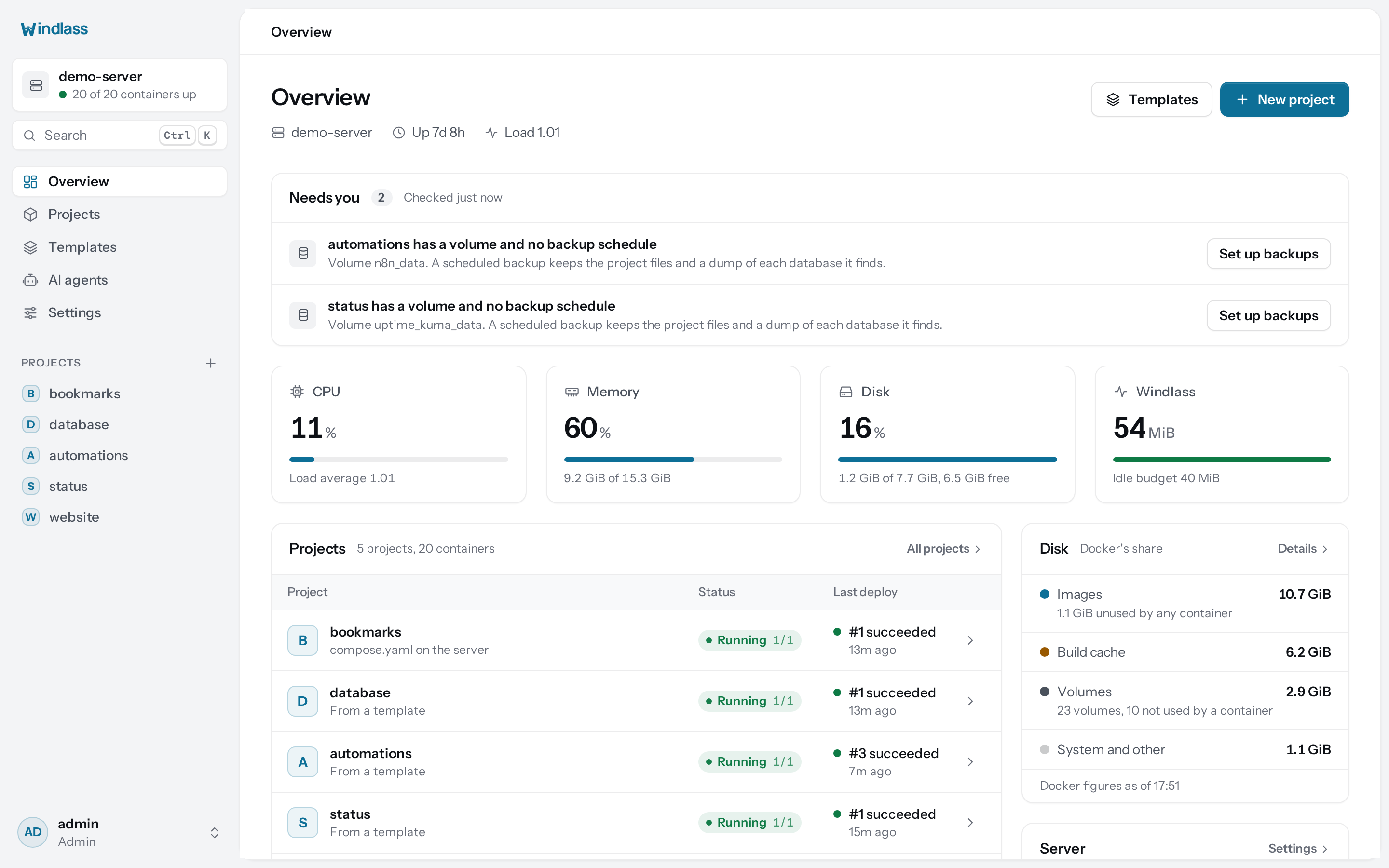
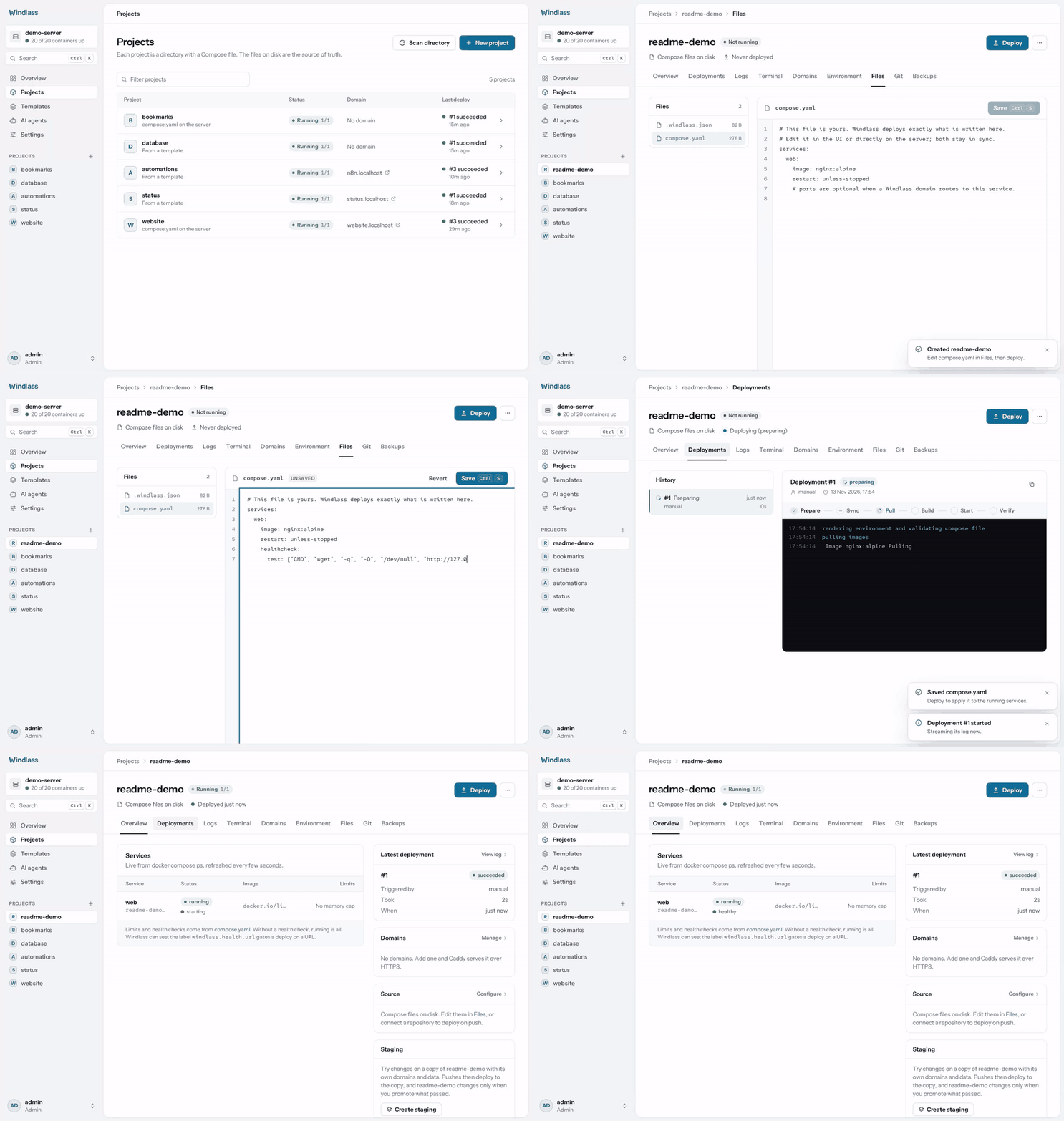
More screens in docs/screenshots, and the full guides at windlass.run.
Source-of-truth model
Application configuration lives under the projects directory:
<projects>/<name>/
├── compose.yaml       # services, images, ports, volumes, networks, env references, limits
├── .env               # optional standard dotenv file; mode 0600
└── .windlass.json     # source repository, branch, auto-deploy, and domains
Windlass executes the real docker compose CLI in that directory. Hand-editing the files
and running docker compose up -d is supported. The Files and Environment screens read the
same files, and Scan directory rebuilds the SQLite project/domain index.
SQLite is not application configuration. It contains platform state such as users, sessions, audit entries, deployment history, jobs, backup records, settings, encrypted credentials, and rebuildable project/domain/environment indexes. Removing SQLite does not stop running containers; filesystem scanning restores the application index, but platform history and accounts require a platform backup.
Main features
- Manual, Git, webhook, template, and rollback deployments
- Crash-resumable deployment jobs and replayable deployment events
- Staging per project: pushes deploy to a copy with its own domains and data, and Promote deploys the commit and image digests it verified to live
- Caddy application domains and a Settings-managed HTTPS domain for the panel itself
- Raw file editing plus individual or bulk-paste environment variable editing
- Compose-native CPU/memory limit visibility and application readiness checks
- Container logs, browser terminal, host/container metrics, and image cleanup
- Local and S3-compatible backups with optional schedules
- Local users, roles, TOTP, and optional GitHub or Google sign-in
- Personal API tokens for scripts and CI: read only, deploy only, deploy and edit, or admin
- An MCP server for AI agents: Claude Code, Cursor, VS Code or Codex can read projects, logs and deployments, and deploy with a deploy only token
- Private registry credentials, applied to the host with a real
docker login - Optional external-process plugins
Application readiness is configured with ordinary Compose labels:
services:
  web:
    labels:
      windlass.health.url: https://app.example.com/health
      windlass.health.status: "200"
      windlass.health.contains: ready
      windlass.health.stability_seconds: "10"
Install
curl -fsSL https://get.windlass.run | sudo sh
Claim the instance using the one-time token from sudo journalctl -u windlass | grep setup_token, then open Settings, General, Panel domain after pointing a DNS record at
the server. Caddy obtains and
renews the panel certificate automatically.
See Installation for systemd, container, configuration, update, and uninstall details.
Contributing
Building, testing and the architecture rules a change has to keep are in CONTRIBUTING.md. Vulnerabilities go to SECURITY.md, never a public issue.
Licence
Apache-2.0
Reviews
No reviews yet
Be the first to review this server!
More Developer Tools MCP Servers
Rea
Freeby Morluto · Developer Tools
Reverse engineer anything from your terminal or agent with one CLI and MCP server.
Paperclip
Freeby Paperclipai · Developer Tools
Trending hip-hop artist momentum scores across four cultural dimensions.
Scrapling
Freeby D4Vinci · Developer Tools
Web scraping with stealth HTTP, real browsers, and Cloudflare bypass. CSS selectors supported.
Git
Freeby Modelcontextprotocol · Developer Tools
Read, search, and manipulate Git repositories programmatically
Toleno
Freeby Toleno · Developer Tools
Toleno Network MCP Server — Manage your Toleno mining account with Claude AI using natural language.
MCP Marketplace
Freeby mcp-marketplace · Developer Tools
Search and install MCP servers from inside your AI client.