
Server data from the Official MCP Registry
Commit / defer / abstain over a conformal coverage region - not a probability of being right.
About
Commit / defer / abstain over a conformal coverage region - not a probability of being right.
Remote endpoints: streamable-http: https://mcp.monarkgate.tech/mcp
Security Report
Valid MCP server (1 strong, 1 medium validity signals). No known CVEs in dependencies. Imported from the Official MCP Registry.
4 tools verified · Open access · No issues found
Security scores are indicators to help you make informed decisions, not guarantees. Always review permissions before connecting any MCP server.
Permissions Found in Source Code
Found by scanning the linked source code. This listing connects to a hosted endpoint, so none of this runs on your machine: it describes what the server software does where it is hosted.
How to Connect
Remote Plugin
No local installation needed. Your AI client connects to the remote endpoint directly.
Add this to your MCP configuration to connect:
{
  "mcpServers": {
    "tech-monarkgate-monark": {
      "url": "https://mcp.monarkgate.tech/mcp"
    }
  }
}Documentation
View on GitHubFrom the project's GitHub README.
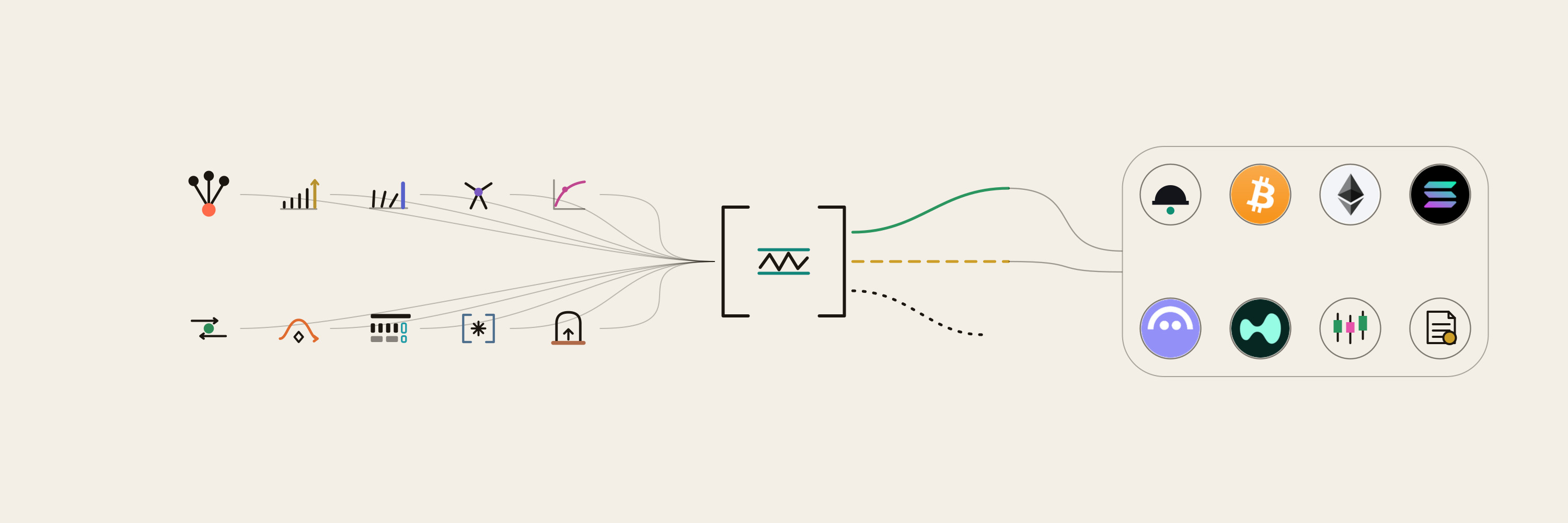
MONARK



MONARK is a two-sided toolkit — an AI side and a DeFi side — built like a Swiss-army knife: one handle,
several blades. The handle is the MONARK engine, the AI side: a coverage-controlled decision gate that
emits commit | defer | abstain against a depletable authorization budget (B_t) — never a probability of
being right — with the sensors that attest to what happened on chain, the frozen contracts they speak, the
harness through which other AI agents reach it, and the agents that keep it adapted to DeFi as DeFi changes.
The blades are the DeFi side: the on-chain applications it powers, each one grown from an empirical
study of on-chain data before it is served. The first is MONARK Bell; the others are research leads.
Single token, single ticker (MONARK). The agents are applications, not tokens. This repository is the
MONARK tokenisation layer, the eight frozen interface contracts (one of them, AttestedBook, upcoming
until served) and the served pieces that let AI agents and DeFi meet on measured ground.
Two sides, one engine — the eleven components
The engine is eleven components: three sensors, one gate, one act, six distribution pieces. Each of them can
serve both sides. Left: what it gives an AI agent connected to the MONARK MCP endpoint (today's four
tools are attest · gate · cascade · calibrate; a component marked planned has no served tool yet).
Right: what it gives the DeFi side — the on-chain applications it powers (in parentheses: the applications
on the site's diagram; wired = declared in the registry today, can serve = a lead, not a delivered link).
| AI side — for an agent on our MCP | Component | DeFi side — DeFAI, for the applications |
|---|---|---|
attest: an attested price testimony (bytes, hash, named residual hypotheses) the agent can cite instead of a scraped number — origin and bytes, never truth. | Shōgen — sensor, attested perception · built | A price an application can defend when it spends, hedges or de-risks (can serve: Warden, Softlanding, Firebreak, Ballast). |
gate + calibrate: the agent submits a claim and gets commit | defer | abstain, an auditable region and the budget left — never a probability of being right. | Hikae — the gate, coverage-controlled inference · built | The decision primitive of every application (wired: Firebreak, Warden, Softlanding, Verdict, Ballast). Bell's gate is its own closed publication check; a gate class for its off-hours gap is planned. |
cascade: the agent asks what a lending book would liquidate along a price path (a transitional tool; it abstains, under_calib). Through gate, the class liquidation-eligible-coverage returns a conformal upper bound on a caller-carried liquidable amount in its committed stratum, calibrated on one recorded episode; the other strata abstain (under_calib) — stated on the wire. | Ukemi — act, liquidation-cascade survival · built | Reads the deleveraging queue or the position before it clears (wired: Firebreak, Softlanding). |
A daily, replayable redemption-flow timeline (state.json, timeline.jsonl) any agent can read, and the served gate class stable-run-velocity-24h through gate. | Narabi — sensor, redemption-run sensing · built, served daily | Redemption-run sensing for a treasury that holds the stable: a daily, replayable reading of the redemption flow, stated after the fact, never ahead of it (can serve: Warden, Ballast). |
| planned: attest a document or an event the agent must act on — bytes and hash, never a verdict on its truth. | Mokugeki — sensor, document / event attestation · named | The attested event a settled decision starts from (can serve: Verdict). |
| planned: ask, before routing a swap, whether the fill is exposed to LVR / toxic flow. | Kaihi — LVR / toxicity avoidance · named | The execution leg of a de-risk or a hedge that must not be picked off (can serve: Firebreak, Softlanding, Ballast). |
| planned: execute a swap under transaction-cost analysis, with the gate's decision attached. | Kessai — swap execution, TCA · named | The act leg — de-risk, ease down, rebalance (can serve: Firebreak, Softlanding, Ballast). |
| planned: quote and manage inventory for the agent's market-making. | Kamae — inventory market-making · named | Inventory-aware hedging for a treasury (can serve: Ballast). |
| planned: read a PT / YT curve as an attested rate surface. | Kyokusen — PT / YT curve · named | The rate surface a rate treasury steadies against (can serve: Ballast). |
| planned: the weekend / off-hours gap as a sensed quantity the agent can gate on. | Koyomi — weekend gap · named | The off-hours gap of tokenized equities, the very quantity Bell publishes (can serve: Bell). |
The door: discovery of the tools and the skill (MCP Registry tech.monarkgate/monark). | Genkan — the storefront / MCP entry point · named (the harness serves the door today) | Distribution of every application to the agents that consume it (can serve: all six). |
Measurement first. No piece of MONARK is designed on a whiteboard and shipped. Each one starts as an
empirical study — a recorded liquidation book at an archive block, a redemption-flow series measured on calm
windows, a census of trading halts, a session-by-session record of tokenized-equity fills — and the study's
artefacts stay attached to the served piece: committed calibrations with their digests, replayable
timelines with per-line hash chains, published signing keys. That is what we mean by an instrumented
environment: an AI agent operating in DeFi through MONARK acts on attested readings and audited regions,
and gets an explicit abstain where nothing is measured — instead of a guess dressed as a number.
Kept adapted. DeFi does not hold still: protocols upgrade, liquidation engines change shape, oracles and data feeds move, calibrations drift. The engine is built so that each of these is a measured event with a pre-registered response (a drift criterion, a new recorder, a new residual hypothesis, a versioned change to a contract). The adaptation agents are the part of the AI side that detects those events and prepares the response. They are on the roadmap, not yet shipped (see the maturity table below).
What is served today
Everything below is live, machine-readable, and replayable by a third party without an account:
| Surface | What it serves | Who consumes it |
|---|---|---|
https://mcp.monarkgate.tech/mcp · https://api.monarkgate.tech/openapi.json | The engine's four tools (attest · gate · cascade · calibrate) over MCP and a plain HTTP/JSON mirror; the served OpenAPI document states the served version | Any MCP-capable agent |
https://monarkgate.tech/narabi/state.json · timeline.jsonl | Narabi's tracker state and its append-only, per-line hash-chained daily timeline (one line per window, with the blocks it was read from) | Anyone replaying the tracker; the site's /narabi page |
https://monarkgate.tech/narabi/instrument.json | A diagnostic file beside the tracker, written once from a closed block of days (never by the daily job): tracker replays at alternative parameters and a permutation-assessed CUSUM; it claims no bound | Anyone auditing the tracker; no page reads it |
https://bell.monarkgate.tech/state.json · timeline.jsonl · provenance.json · bell/pubkey.json | MONARK Bell's signed publications: per-session fills, VWAP and volume for the listed tokenized equities, halt census, supply and proof-of-reserve residuals, the provenance of each run, the active Ed25519 key | Anyone verifying a publication; the site's /bell page |
https://dojo.monarkgate.tech/ · timeline.jsonl · dojo/pubkey.json · lines/<sha256>.jsonl · history/<sha256>.jsonl | MONARK Dōjō's hold snapshot: a dated, public record of the MONARK token balances held by each address, read from the chain through two distinct operators, with a hold score per address; the signed timeline, the published key, a day's lines file and the history file that a signed line of the timeline names by its SHA-256 | Anyone recomputing it; the site's /dojo page |
https://monarkgate.tech | The vitrine: every number on it is read from a committed, hashed copy of the served files above — never typed | Readers |
A surface that is not in this table is not served. A component that has no served surface is labelled named, not built, wherever it appears.
The backbone — the gate
Everything in MONARK plugs into one decision primitive. A sensor reads the world and attests to it; a predictor turns that reading into a claim; the gate conformalises the claim into a region at a target coverage and returns one of three actions against a depletable budget:
- commit — the region is tight enough to act on, and the budget can pay for it;
- defer — the reading is ambiguous; the gate waits for a better one;
- abstain — the gate cannot state a region it stands behind, so it says nothing and invents no success.
The gate never reports how likely it is to be correct. It reports a region you can audit and a budget you can watch — never a probability of being right.
Maturity (labelled by what is built)
The labels are the point: they say what exists today and what is only named.
| Side | Layer | What it is | Status |
|---|---|---|---|
| AI | Backbone — the gate | Hikae (coverage control) + the MONARK token's budget B_t; turns a sensor reading into commit | defer | abstain | Built — eight frozen contracts (AttestedBook upcoming until served) |
| AI | Sensors and acts | the engine's agents: sensors that attest, acts that execute, one token across all of them | 4 built (Shōgen · Hikae · Ukemi · Narabi) · 7 named |
| AI | Harness — the door | the same engine made reachable by other AI agents over HTTP / MCP | Built — public 4-tool MCP endpoint (attest · gate · cascade · calibrate) |
| AI | Adaptation agents | agents that recalibrate, onboard protocols, track liquidation mechanics and watch data sources | Roadmap — named, not shipped |
| DeFi | Applications — powered by the engine | one application per DeFi need, served with its own published artefacts | 1 built (MONARK Bell) · 5 research leads |
The engine — AI side
Built:
- Shōgen — attested perception: an attested price testimony — origin and bytes, never truth.
- Hikae — coverage-controlled inference: the gate.
- Ukemi — liquidation-cascade survival: a recorder reads a lending protocol's liquidation book at an
archive block under a keyless RPC quorum and digests it (the AttestedBook contract). The served gate class
liquidation-eligible-coverageholds a committed calibration for one stratum of one recorded episode: for a caller-carried liquidable amount in that stratum it returns a conformal upper bound (the lower edge is 0 by construction), and every other stratum abstains (under_calib). The bound holds only if the amount was produced by the frozen close-factor rule, which the gate does not check, and no coverage is claimed on any other event — stated plainly on the wire. Thecascadetool is transitional and abstains by construction. - Narabi — redemption-run sensing. Its
AttestedFlowattestation (the fifth frozen contract) and the velocity adapter ship in this repo; the public endpoint serves the gate classstable-run-velocity-24hwith a committed calibration for one population — USDe — measured on calm onchain redemption-flow windows. That calibration is measured non-stationary across half-years, so no per-window coverage is claimed; the honesty sentence on the wire is the Barber, Candes, Ramdas and Tibshirani 2023 (Thm 2, unit weights) wording — no coverage is measured. Every other population abstains (under_calib). An off-tool daily sentinel steps the tracker at block finality and publishes a replayable timeline athttps://monarkgate.tech/narabi/(state.json,timeline.jsonl, per-line hash-chained).instrument.json— Instrument, not the official tracker: tracker replays at alternative parameters, and a one-sided CUSUM in the form Page (1954) introduced and Lorden (1971) presents, on the static misses, assessed by a permutation test of exchangeability as Vovk (2012) defines it. A third way, outside Lorden's i.i.d. theory and the e-detectors of Shin, Ramdas and Rinaldo (2022); no bound is claimed. One snapshot, taken once, never refreshed by the daily job.
The single public sentence for Narabi, verbatim:
Narabi runs an adaptive quantile tracker (Angelopoulos–Barber–Bates 2024, decaying step) on the attested daily USDe redemption flow: its state moves each 24h window from the realized outcome, and the full timeline is published so anyone can replay it. What it carries is a deterministic long-run bound that tightens as windows accumulate, printed daily with T, not a per-window coverage, not a probability; the gate's committed calibration does not depend on the tracker state. Until the pre-registered drift criterion fires and an ADR says otherwise, the gate's region is still the committed static calibration: the tracker adapts, the gate does not yet.
What Narabi is NOT. The bound printed daily is the Angelopoulos, Barber and Bates 2024 (Thm 1) quantity
(B + η₁)/(T·η_T) with c = B = 1/24 and ε = 0.1. The published region is the tracker's, not the gate's:
the gate keeps the committed static calibration and does not change until the pre-registered drift
criterion (rolling90_calm_miss ≥ 0.40, evaluable after 90 calm pairs) fires and a published decision record says so. Not a
per-window coverage, not a probability of being right, not a price call.
Replay them yourself. Narabi: recompute every window from its [from_block, to_block] via
eth_getLogs + totalSupply, then re-derive q with the committed trackerReplay over the s column of
timeline.jsonl. Bell: verify each timeline line's Ed25519 signature against the published key, recompute
state_sha256 from the served state, and rebuild the digest from the declared pools at the declared window
(apps/bell, scripts/verify-bell.mjs). The per-line hash chains make any rewrite detectable.
Named on the engine's roadmap (teasers — not delivered pieces, no metrics claimed): Mokugeki (document / event attestation) · Kaihi (LVR / toxicity avoidance) · Kessai (swap execution, transaction-cost analysis) · Kamae (inventory market-making) · Kyokusen (PT / YT curve) · Koyomi (weekend gap) · Genkan (the storefront / MCP entry point).
The applications — DeFi side
Applications are what the engine is put to work on. Each one is derived from the same gate and the same contracts, starts as an empirical study, and is served with its own published, replayable artefacts.
Built and served:
- MONARK Bell — the first application: a public, attested witness of tokenized equities outside cash-market hours: per
session (pre, regular, after, overnight, weekend), the on-chain fills at the declared pools, their VWAP and
volume, the trading-halt census and the supply / proof-of-reserve residuals — published as a signed,
hash-chained timeline at
https://bell.monarkgate.tech/(state.json,timeline.jsonl,provenance.json, the Ed25519 public key atbell/pubkey.json) with a reader-side verifier and the signing keyring in this repo. Never a price call; abstentions are counted and published as such.
Development leads — research phase (named, not delivered; no metrics, no dates):
- MONARK Firebreak — ride out an auto-deleveraging cascade on a perp venue rather than be caught in it.
- MONARK Warden — a least-privilege gate on a treasury a DAO or another agent controls.
- MONARK Softlanding — read the liquidation risk on a leveraged position and ease the exposure down before it clears.
- MONARK Verdict — turn a raw event call into a coverage-controlled, settled decision.
- MONARK Ballast — named; scope under study.
Each lead becomes an application the way Bell did: a study on chain data, a recorder, a frozen contract if one
is needed, a served host with a signed timeline — then, and only then, built.
Maturity criteria
A component or an application is labelled built when all of the following hold; otherwise it is named:
- A study first. A measurement on chain data, pre-registered where it can be (hypotheses and thresholds written before the run), with its artefacts committed and hashed next to the code.
- A frozen contract if the piece speaks a new shape (six today; a seventh is a versioned change to the interface, not a patch).
- A served surface. Its output is consumed by a live surface — an MCP/HTTP tool, a published file, a downstream component — not only by a test or a demo.
- An end-to-end integration test that replays the composition, and a deployment check that runs the reader-side verifier against the served host.
The same criteria apply to a change in the engine: a recalibration, a new recorder, a new residual hypothesis.
The studies behind the pieces
- Narabi — attested redemption flow of a stablecoin, read at block finality; calibration measured on calm windows and found non-stationary across half-years, which is why the served region says so instead of claiming a coverage. A pre-registered drift criterion decides when the gate may move.
- Ukemi — a lending protocol's liquidation book recorded at an archive block under a keyless RPC quorum, health factors cross-checked in exact fixed-point arithmetic, liquidations replayed along recorded oracle paths; hypotheses and outcomes of the calibration course are published on the site, digit for digit from the hashed report.
- MONARK Bell — a census of U.S. trading halts, session calendars with daylight-saving handling, the on-chain fills of tokenized equities at their declared pools read on two operators, and a signed publication protocol with an explicit earliest publication time.
- Shōgen and Hikae — a testimony format that carries bytes and residual hypotheses instead of truth, and a coverage-controlled gate whose region is auditable and whose budget is depletable.
Where a study finds nothing, the piece says so: an abstain, a named residual, a counted absence.
The interlocking (why the pieces work together)
AI side — the MONARK engine
  sensors (attest)  →  the gate: Hikae + MONARK B_t  →  acts (execute · upcoming)
                            commit | defer | abstain
  harness (MCP / HTTP)  ·  adaptation agents: recalibrate · onboard · track · watch
                                        │
                                        ▼
DeFi side — the applications
  MONARK Bell (built, served)  ·  Firebreak · Warden · Softlanding · Verdict · Ballast (research)
Every application plugs into the same gate; every future sensor attests into the same contract shape; every change to the engine meets the same maturity criteria.
Verify it yourself
- Bell. Fetch
bell/pubkey.json, then each line oftimeline.jsonl: check its Ed25519 signature against the active key, recomputestate_sha256from the served state andprovenance_sha256from the served provenance, and followprev_line_hashback to the genesis line.scripts/verify-bell.mjsdoes exactly this with Node alone; the deploy check it produces is committed in this repo. - Dōjō.
node apps/dojo/scripts/dojo-verify-cli.mjs --url https://dojo.monarkgate.tech --keyring apps/dojo/keys/dojo-keyring.jsonreads the served files alone, with the public keyring in this repo as its trust root (the serveddojo/pubkey.jsonis cross-checked against it): it walks the signed timeline (Ed25519 signatures, chaining, the validity window of each key), then recomputes everyprice_version, the history file and the lines of every snapshot with their Merkle roots;--address <address>adds the inclusion proof of one address,--day <YYYY-MM-DD>checks a past day. It prints one JSON line, whoseokis true only when every check holds, with Node alone. It does not replay the collection (a signature attests origin, never truth: the readings are what two operators reported), does not read the chain, and does not check the BLS signature of the public randomness beacon. - Narabi. Recompute every window from its
[from_block, to_block]viaeth_getLogs+totalSupply, then re-deriveqwith the committedtrackerReplayover thescolumn oftimeline.jsonl. - The site. Every figure on
monarkgate.techis read from a file underapps/site/data/whose hash is pinned inmanifest.sha256.jsonand compared byte for byte to the served file by a test.
For agent builders
- Add the endpoint (
hermes/openclawone-liners below) or install the skill. - Call
attestfor a price you must cite,gatefor a claim you must act on,cascadefor a lending position you must protect,calibrateto bring your own scores. - Read the answer as a region and a budget. On
abstain, do nothing and say why — the reason is on the wire. No confidence score exists to be misread. - Read Bell and Narabi as files: they are published to be consumed by programs, not only by people.
Eight frozen contracts
The interface is frozen and language-neutral (source of truth: schemas/*.json):
| Contract | Producer | Meaning |
|---|---|---|
AttestedPrice | Shōgen | An attested testimony (bytes + hash + named residual hypotheses) — origin and bytes, never truth. The price number is interpreted by a Hikae-side adapter — Shōgen never asserts a price. |
AttestedFlow | Narabi | An attested testimony of redemption flow (bytes + hash + a closed residual[] enum) — origin and bytes, never truth. burns/mints/supply are carried raw. |
Prediction | any predictor | The ŷ Hikae conformalises, with predictor_id (venue/model). |
CoverageVerdict | Hikae | Conformal region — polymorphic set (classification) | interval (regression, so Ukemi plugs in). No p_correct field. |
GateDecision | Hikae L3 | commit | defer | abstain + remaining_budget = B_t, the depletable conformal authorization capacity that attaches to MONARK (never a return). |
AttestedBook | Ukemi (recorder) | A self-declared reading of a liquidation book at an archive block under a keyless RPC quorum: the digests (book, holders) with block/provider/quorum context — upcoming until served. |
PolicyTable | MONARK (policy tables) | A class's policy table: one class entry and its rows (cell key, alpha, n, the served rank and q̂, scores_sha256). The verdict carries the digest of the table (policy_table_sha256) and of the row it used (policy_row_sha256). |
ToolError | the harness | The body of an HTTP 400 or 500 answer: {error, operation, message, code}, the code from the closed catalogue of the specification. Read the code, not the message. |
The token
MONARK carries B_t, a depletable authorization budget: each commit spends it; defer and
abstain do not. It is the fleet's right-to-act, metered — not a return, not a deposit, not an oracle.
Tokenomics: to be announced.
Contract address (CA): FYZcYCHSp8FzNba1UtDZydKKGosmxVNpFBiVuia38AhT (address only — no price, no buy call).
Fleet invariant — no confidence field, anywhere
Both Shōgen and Hikae refuse it. An output is a region, a set, or bytes + hash + named residual hypotheses — never a score. There is no confidence field anywhere in the interface, and the contract layer enforces this in code:
- Closed schemas (
additionalProperties: false) — the primary guard, mirroring Shōgen's decoder, which refuses an unknown key rather than ignoring it. Enforced at runtime byclosed-check.ts(hand-rolled allow-key sets), kept in sync with the JSON Schemas by a test. - Recursive forbidden-key check — defense in depth (
forbidden-keys.ts), catching a banned key at any depth. A contract carrying one throws instead of serialising. - Vocabulary gate (
scripts/grep-forbidden.mjs) — CI fails on marketing or overclaim wording.
Reach the engine (the door for other AI agents)
The engine is reachable by any MCP-capable agent over one public endpoint:
- MCP endpoint:
https://mcp.monarkgate.tech/mcp(HTTP/JSON mirror:POST https://api.monarkgate.tech/{attest|gate|cascade|calibrate}; the servedopenapi.jsonstates the served version). Four tools:attest · gate · cascade · calibrate. Listed on the official MCP Registry astech.monarkgate/monark. - Add it in one line:
hermes mcp add monark --url https://mcp.monarkgate.tech/mcp
openclaw mcp add monark --url https://mcp.monarkgate.tech/mcp --transport streamable-http
No personal data is required to use the service (no account, e-mail, or wallet).
Status
Phase two — integration, served piece by piece. The interface is frozen and the Hikae + Ukemi engines
are complete; Narabi and MONARK Bell are served with published, replayable timelines. The public projection
of this repository is produced by scripts/export-public.mjs.
Run the gates
npm ci
npm run ci   # vocabulary gate → typecheck (tsc strict) → tests (node:test)
Engineering choices
- Polyglot fleet, schema-first contracts. Shōgen is Rust, the runtime is Python, Hikae's engine and
the storefront are TS. So the contracts are expressed as language-neutral JSON Schema; the TS
package in
packages/contractsis the first binding. Rust and Python bind to the same schemas. - Zero runtime dependencies. The published contracts pull in nothing at runtime. Dev deps:
typescript,@types/node,ajv/ajv-formats(test-only), andeslint/typescript-eslint(lint only); tests run on the built-innode:test(Node ≥ 24 native TS type-stripping). Key-closedness is enforced hand-rolled at runtime (mirroring Shōgen's zero-dep unknown-key refusal); the value constraints (min/unique items, hash length, ASCII-printable) are expressed in the JSON Schemas and exercised againstajvin tests. ajvis a dev-dependency (test-only): it compiles the frozen JSON Schemas, resolves the$refs, and proves they reject the value-constraint violations (empty/duplicate arrays, wrong-length hash, control chars) that the TS types alone do not.- Measured before served. A piece reaches a public surface only with its study artefacts committed and hashed next to it (calibration digests, recorded fixtures with same-directory provenance, replayable timelines) and an end-to-end execution test as the proof of composition.
Layout
schemas/            JSON Schema — the language-neutral source of truth (closed)
packages/contracts  TS binding: types, closed-check, forbidden-keys, scores_sha256, serializers, tests
packages/hikae      HAC-CP engine: L1 split / L2 monitor / L3 gate, interval conformer  (built)
packages/ukemi      liquidation-cascade survival: clearing, liquidable                  (built)
packages/monark     integration adapters: Shōgen→AttestedPrice, Narabi AttestedFlow→Prediction; canonical CBOR
packages/atelier    local demo surface (not a shipped application)
apps/harness        the MCP / HTTP harness — four tools over the frozen contracts (engine, AI side)
apps/sentinel       off-tool sentinels: Narabi daily tracker; Ukemi liquidation-book recorder (engine, AI side)
apps/bell           MONARK Bell — the first application (DeFi side): publisher, hash chain, verifier, public keyring
apps/site           public vitrine
skills/monark       the integration skill (MIT-0)
.github/workflows   CI (5 blocking jobs)
Links
- Site: https://monarkgate.tech
- Bell (attested witness): https://bell.monarkgate.tech
- Narabi (daily timeline): https://monarkgate.tech/narabi/
- MCP endpoint: https://mcp.monarkgate.tech/mcp (HTTP/JSON mirror: POST https://api.monarkgate.tech/{attest|gate|cascade|calibrate})
- Linktree: https://linktr.ee/monarkgate
License
Apache-2.0 — see LICENSE. The published integration skill is MIT-0.
Reviews
No reviews yet
Be the first to review this server!
More Developer Tools MCP Servers
Rea
Freeby Morluto · Developer Tools
Reverse engineer anything from your terminal or agent with one CLI and MCP server.
Paperclip
Freeby Paperclipai · Developer Tools
Trending hip-hop artist momentum scores across four cultural dimensions.
Git
Freeby Modelcontextprotocol · Developer Tools
Read, search, and manipulate Git repositories programmatically
Toleno
Freeby Toleno · Developer Tools
Toleno Network MCP Server — Manage your Toleno mining account with Claude AI using natural language.
MCP Marketplace
Freeby mcp-marketplace · Developer Tools
Search and install MCP servers from inside your AI client.
mcp-creator-python
Freeby mcp-marketplace · Developer Tools
Create, build, and publish Python MCP servers to PyPI — conversationally.